Oil prices retreated in early Asian trade on Tuesday as renewed fears of global oversupply outweighed optimism surrounding progress in ending the U.S. government shutdown and fresh sanctions targeting major Russian producers.
Brent crude futures fell 0.2% to $63.94 per barrel, while U.S. West Texas Intermediate (WTI) declined 0.2% to $59.99 by 04:26 GMT. Both benchmarks had gained roughly 40 cents in the prior session, driven by signs of a possible resolution to the longest U.S. government shutdown in history.
The U.S. Senate approved a compromise bill late Monday to restore federal funding, with the House of Representatives expected to pass it later this week. Markets welcomed the development, but oil’s gains were capped by growing evidence that global crude supply continues to outpace demand.
OPEC Output Adds to Bearish Outlook
Energy consultancy Ritterbusch and Associates warned that rising OPEC production is tipping the global oil market further into surplus. In a note, analysts said:
- OPEC’s output expansion is increasing bearish sentiment.
- Demand remains subdued amid slower economic growth.
- Major oil-consuming nations are trimming import volumes.
Earlier this month, OPEC+ confirmed a production increase of 137,000 barrels per day for December, matching its output growth for October and November. The group also agreed to pause additional hikes during the first quarter of next year in an attempt to stabilize prices.
Despite this, traders remain wary that rising OPEC output—combined with weakening demand in Asia and Europe—could pressure prices below $60 per barrel if inventories continue to build.
Sanctions, Storage Trends Deepen Market Uncertainty
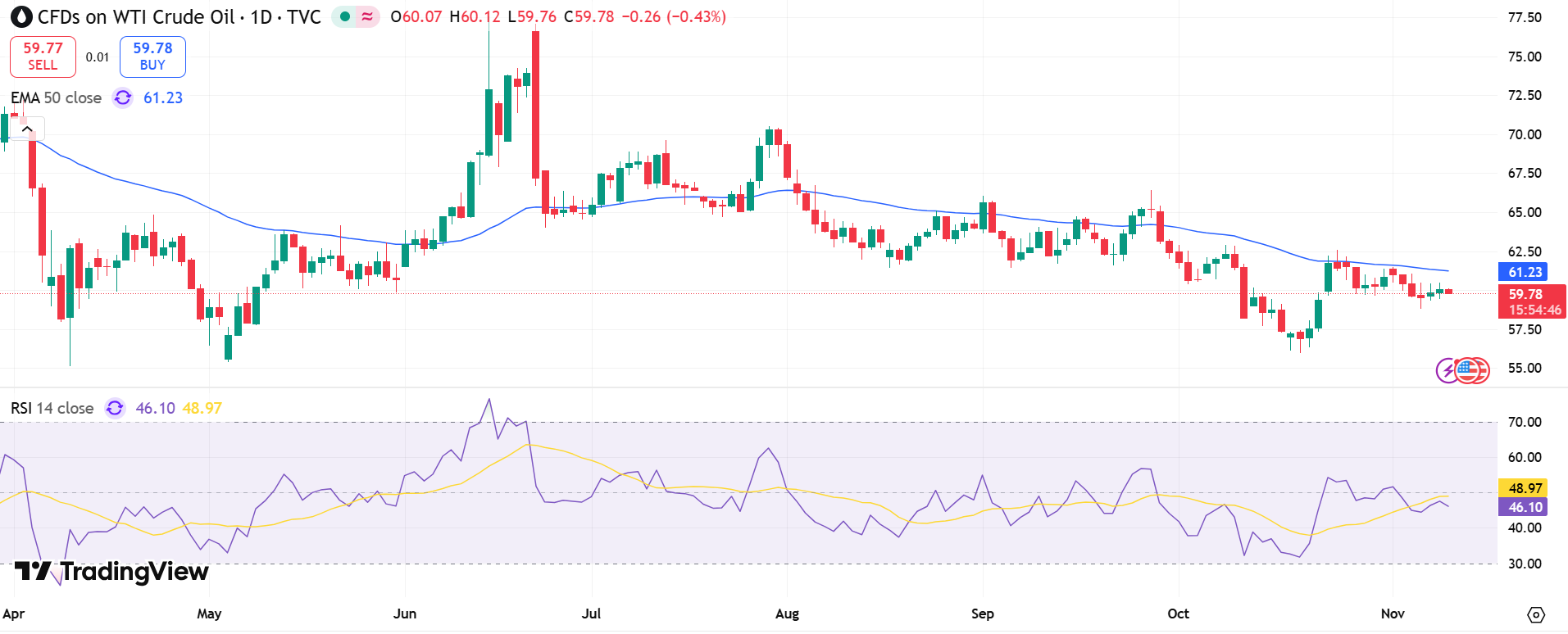
U.S. sanctions on Russian oil majors Rosneft and Lukoil added further uncertainty. According to Reuters, Lukoil declared force majeure at its Iraqi West Qurna-2 oil field, while Bulgaria moved to seize its Burgas refinery, marking the most significant disruption linked to sanctions so far.
Meanwhile, the volume of oil stored on tankers in Asian waters has doubled in recent weeks, as tightening Western sanctions and reduced import quotas curb Chinese and Indian demand. Some refiners have turned to Middle Eastern suppliers, further straining Russian exports.
Analysts warn that future price trends could hinge on:
- China’s willingness to stockpile Russian oil.
- India’s response to U.S. pressure to scale back purchases.
For now, markets remain locked between the weight of oversupply and the uncertainty surrounding sanctions — leaving oil’s next move delicately balanced.
Sources & Methodology
Primary-source standard: Market-moving facts should link to original data releases, regulator notices, company filings or official project announcements whenever available. Secondary reporting is used for additional context, not as a substitute for original evidence.
Page last reviewed: