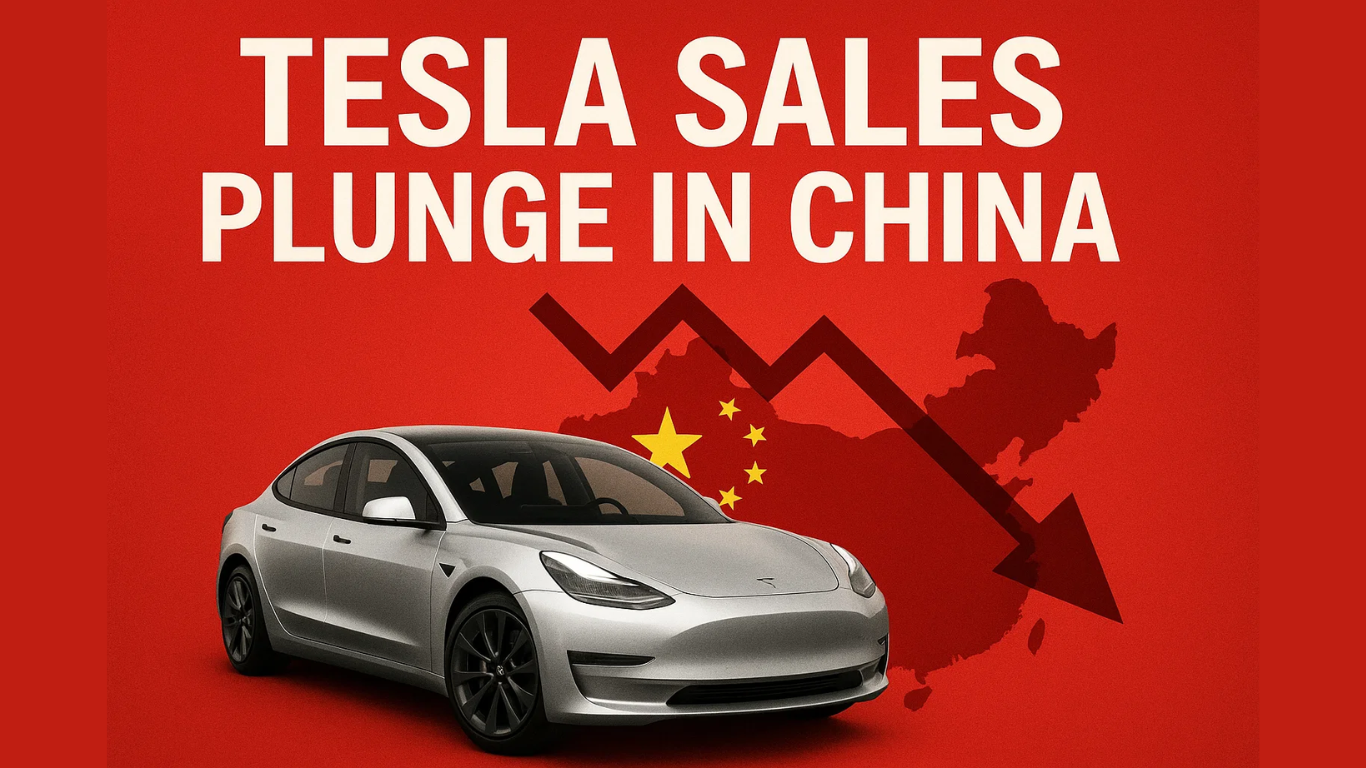
Tesla Inc. recorded its weakest sales in China in three years, signaling fresh challenges for the U.S. electric vehicle (EV) pioneer in the world’s largest auto market.
According to data from the China Passenger Car Association (CPCA), Tesla sold 26,006 vehicles in October, down 35.8% year-over-year and a steep fall from 71,525 units in September. The decline came even after the company began deliveries of the Model Y L, a six-seat, long-wheelbase version of its top-selling Model Y SUV, designed specifically for Chinese consumers.
While domestic sales weakened, exports of China-made Teslas rose to a two-year high of 35,491 units, reflecting the company’s growing reliance on overseas shipments to offset soft local demand.
Tesla’s market share in China’s EV sector slid to 3.2% in October, a sharp drop from 8.7% the previous month — its lowest level since 2020. Analysts say the data highlight Tesla’s ongoing struggle to maintain momentum in a fast-evolving market dominated by agile local competitors.
Competition Intensifies as Rivals Surge
The slowdown comes as domestic rivals aggressively expand their foothold in China’s EV industry. Local tech giant Xiaomi Corp. reported record monthly sales of 48,654 vehicles, led by its SU7 sedan and YU7 SUV, both marketed as direct challengers to Tesla’s lineup.
Although several high-profile safety incidents involving Xiaomi sedans sparked concerns, the company’s rapid sales growth underscores strong consumer confidence in homegrown brands.
Meanwhile, the Chinese EV market itself has shown signs of fatigue as government incentives and tax breaks — once major drivers of sales — have started to fade. As a result, overall car sales fell in October, reflecting a cautious consumer mood amid economic uncertainty.
Key highlights from the CPCA data include:
- Tesla’s domestic sales: 26,006 units, down 35.8% YoY
- China-made Tesla exports: 35,491 units, highest in two years
- Tesla’s market share: 3.2%, lowest in over three years
Global Headwinds Add to Tesla’s Strain
Tesla’s China setback follows a similar pattern in Europe, where October sales slumped across key markets, including Germany, Spain, the Netherlands, and Nordic countries. Analysts attribute the decline to intensifying competition, slower EV adoption, and price fatigue among consumers.
China remains Tesla’s second-largest market after the United States, accounting for nearly 23% of its global revenue in the third quarter. However, with rivals scaling production and introducing cheaper alternatives, Tesla’s pricing power and market share face increasing pressure.
Analysts expect that the company’s ability to stabilize demand in China — while managing global economic headwinds — will determine its growth trajectory heading into 2026.
Sources & Methodology
Primary-source standard: Market-moving facts should link to original data releases, regulator notices, company filings or official project announcements whenever available. Secondary reporting is used for additional context, not as a substitute for original evidence.
Page last reviewed: