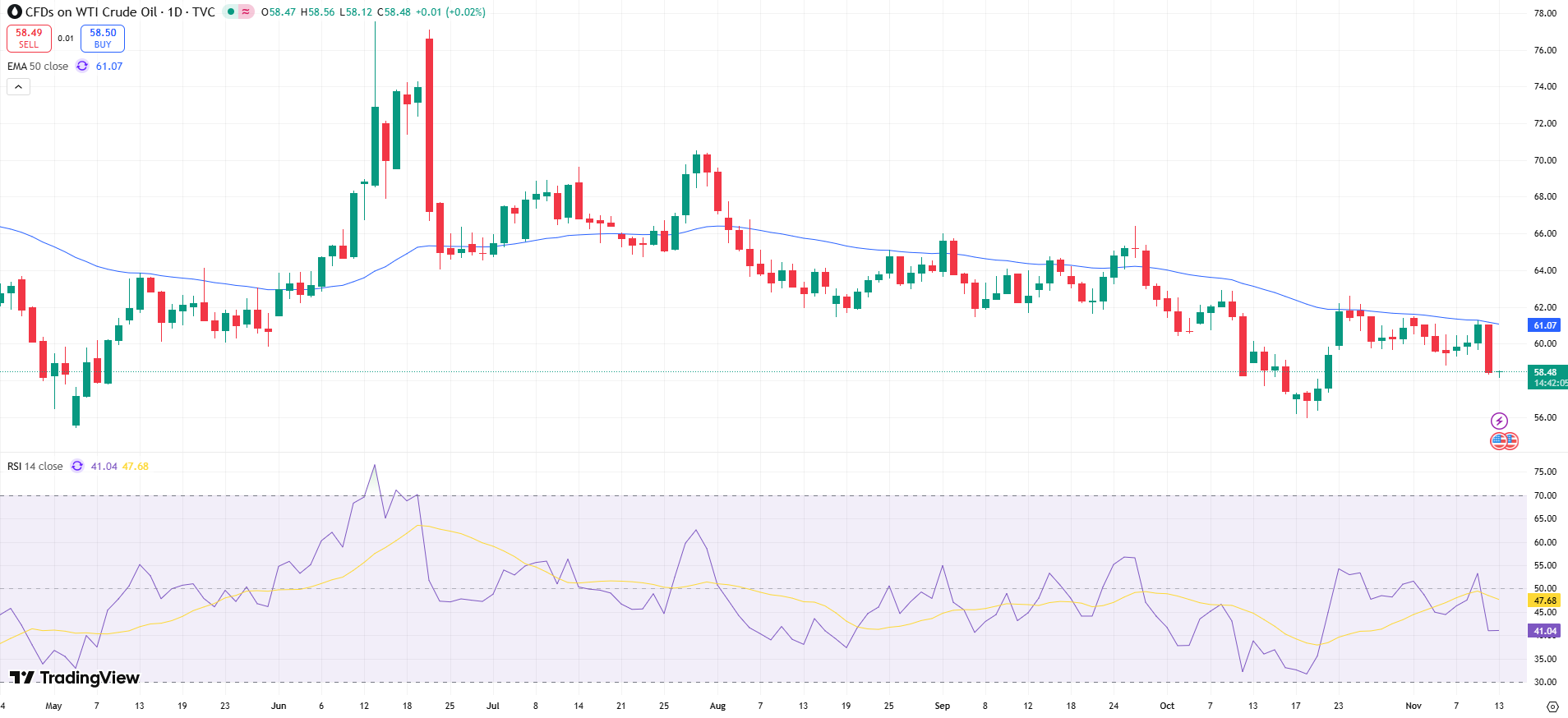
Oil prices extended losses on Thursday, pressured by rising U.S. crude inventories and a cautious market outlook from OPEC. Brent crude slipped 0.1% to $62.62 a barrel, while West Texas Intermediate (WTI) fell 0.2% to $58.38 in early Asian trade, following steep declines of over 4% in the previous session.
According to data from the American Petroleum Institute (API), U.S. crude inventories grew by 1.3 million barrels for the week ending November 7, signaling softer demand in the world’s largest oil-consuming nation. While gasoline and distillate stockpiles declined, the uptick in crude reserves reinforced fears of a well-supplied market amid slower global fuel consumption.
Investor sentiment remained fragile after the Organization of the Petroleum Exporting Countries (OPEC) projected a supply surplus in 2026, reversing earlier forecasts that pointed to a potential deficit. The outlook underscored growing unease about production trends outpacing demand growth in coming years.
OPEC Forecast Sparks Market Concerns
The oil market’s bearish turn was fueled by OPEC’s latest Monthly Oil Market Report, which revised the group’s expectations for future supply-demand balance. OPEC now expects global supply to exceed demand by 2026, as output from OPEC+ members, including Russia, continues to climb.
Suvro Sarkar, Energy Sector Lead at DBS Bank, noted that the “recent weakness stems from OPEC’s acknowledgment of a possible glut,” marking a shift from the organization’s previously bullish tone. He added that this adjustment aligns with OPEC’s recent decision to pause the unwinding of voluntary production cuts in Q1 2025—a signal of caution rather than panic.
Analysts point to three key pressures on oil markets:
- Higher U.S. crude inventories signaling excess supply
- OPEC’s revised 2026 surplus projection
- EIA forecasts showing record U.S. oil output this year
Short-Term Outlook Remains Cautiously Stable
The U.S. Energy Information Administration (EIA) expects global oil inventories to continue expanding through 2026, as production growth outpaces petroleum demand. In its Short-Term Energy Outlook, the agency also projected record-breaking U.S. oil production for 2025, further weighing on prices.
However, analysts maintain that oil prices may stabilize near current levels. “There should be considerable support around $60 per barrel, especially if stricter sanctions disrupt Russian exports in the short term,” Sarkar said.
While global markets adjust to OPEC’s cautious stance and rising U.S. output, traders are closely watching upcoming EIA inventory data for clearer signals on whether the current weakness represents a temporary correction or a sustained downturn in the oil cycle.\
Sources & Methodology
Primary-source standard: Market-moving facts should link to original data releases, regulator notices, company filings or official project announcements whenever available. Secondary reporting is used for additional context, not as a substitute for original evidence.
Page last reviewed: