

Oil prices advanced more than 1% in early Asian trading on Monday after OPEC+ reaffirmed its commitment to keep output unchanged through the first quarter of 2025. The move came as the alliance continues to navigate uneven global demand and the potential for oversupply as early as 2026.
By 20:52 ET (01:52 GMT), Brent futures climbed 1.2% to $63.13 per barrel, while WTI crude rose 1.2% to $59.27. The gains reversed some of last week’s weakness, largely driven by concerns that supply could tighten amid escalating geopolitical tensions.
OPEC+ leaders emphasized that their voluntary cut of 3.24 million barrels per day will remain in place. The group also approved a plan to reassess production capacity between January and September 2026—a move that may shape baseline quotas for 2027 and potentially trigger member disagreements as countries push for higher allocations.
Key points highlighted by ING analysts:
- Capacity reviews could spark internal disputes over future quotas
- The group remains concerned about demand softness
- Oversupply risks for 2026 are influencing today’s cautious posture
Venezuela and U.S. Tensions Raise Supply Risks
Traders also reacted to renewed friction between the U.S. and Venezuela after President Donald Trump signaled he may consider closing U.S. airspace over the country, adding to existing military pressure in the region.
According to ING analysts, the situation has escalated with U.S. forces striking vessels accused of transporting narcotics and increasing their presence nearby. Venezuela currently exports about 800,000 barrels per day, most of which flows to China.
Any further deterioration in U.S.–Venezuela relations would heighten supply vulnerability, particularly as global inventories remain tight.
Additional points traders monitored:
- Risk of transport disruptions affecting Venezuelan exports
- Heightened geopolitical uncertainty reinforcing bullish crude sentiment
Russian Export Disruptions Add Upward Pressure
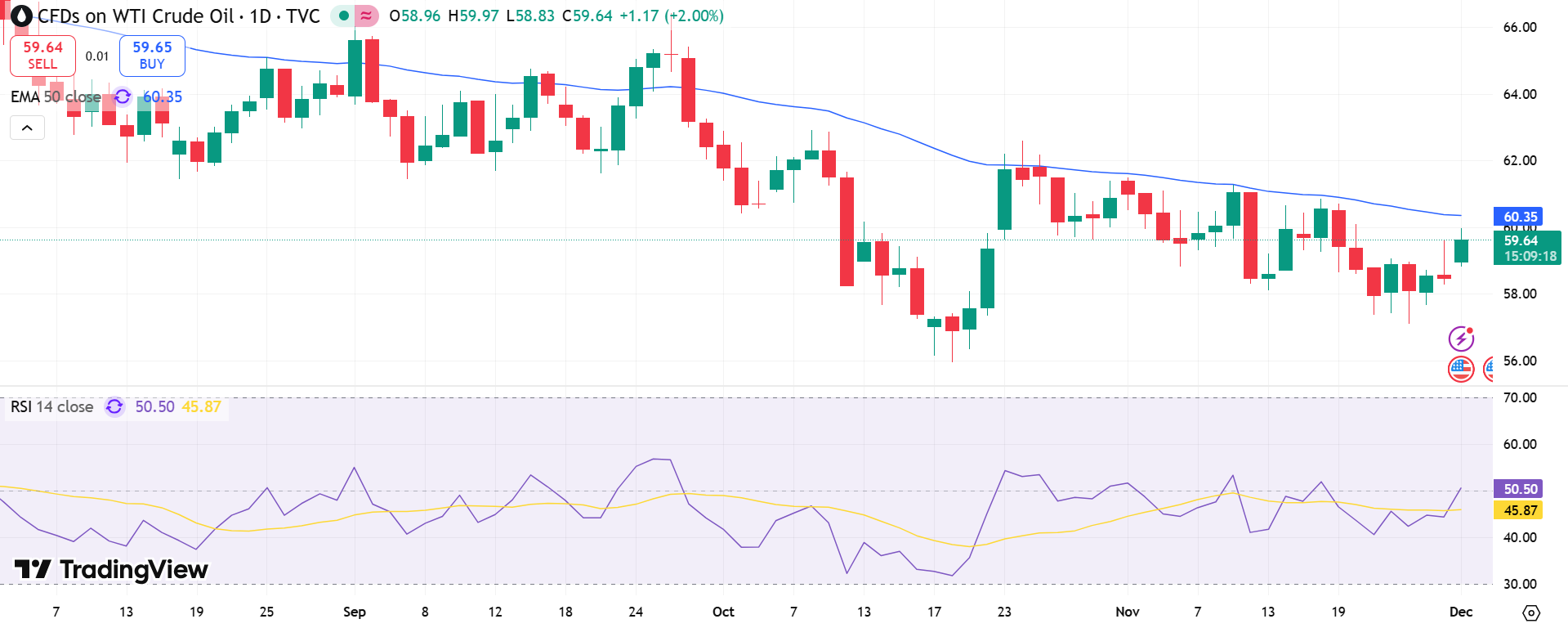
Fresh disruptions to Russian energy infrastructure provided another tailwind for crude. Attacks over the weekend damaged operations at the Caspian Pipeline Consortium (CPC)—a crucial artery for Kazakh and Russian shipments through the Black Sea.
The CPC reported a suspension of loadings at its Novorossiysk terminal after a naval drone strike severely damaged a mooring point. The pipeline has averaged 1.48 million barrels per day in exports this year, about 200,000 barrels per day higher than in 2023 due to increased production from Kazakhstan’s Tengiz field.
These interruptions compounded existing supply concerns and helped support prices at the start of the trading week.

