
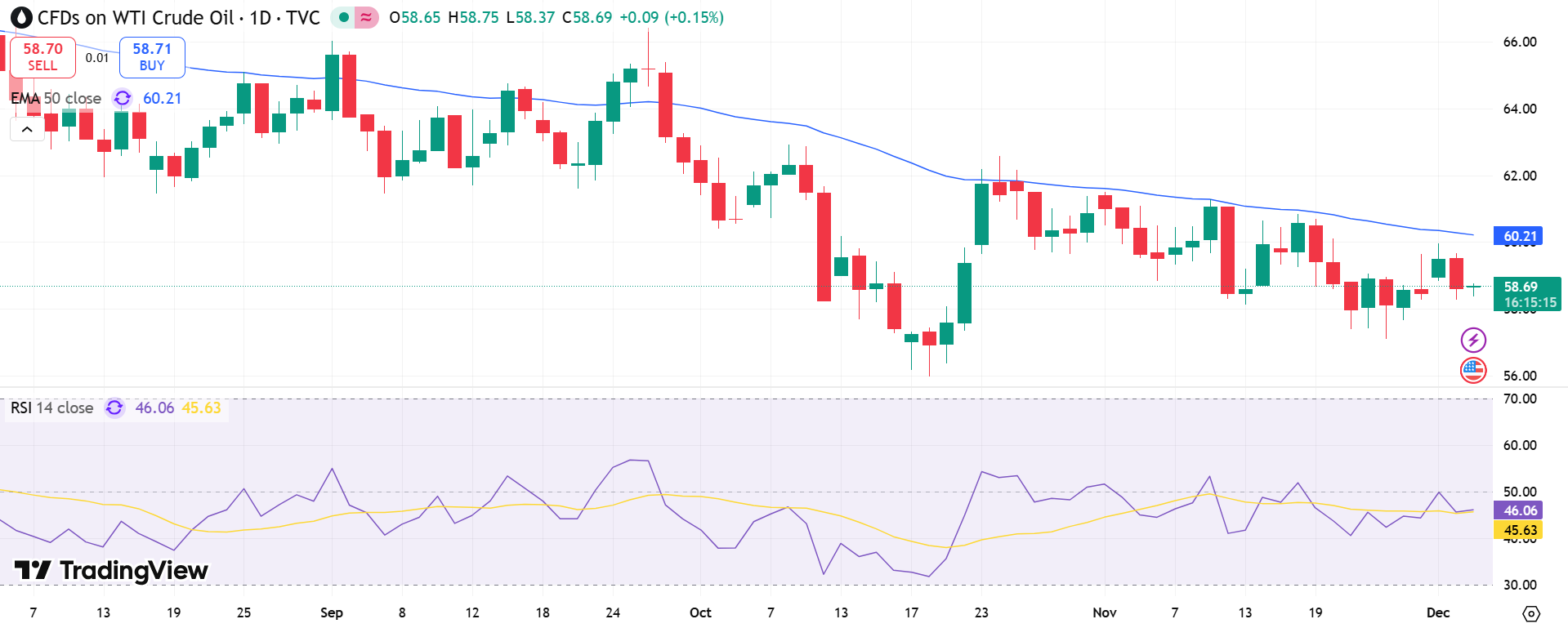
Oil prices retreated for the second straight session on Wednesday as investors tracked delicate Russia-Ukraine peace efforts that could reshape global crude flows. Despite pockets of geopolitical tension, markets showed limited movement by midday, with Brent crude edging up 2 cents to $62.47 and West Texas Intermediate rising 3 cents to $58.67.
The pullback comes even as Ukraine intensifies drone strikes on Russian energy assets and Moscow threatens potential retaliation against ships assisting Kyiv. Analysts at ING noted that Brent has slipped to its lowest level since October, underscoring persistent pressure from weak demand fundamentals.
Russia confirmed there was no breakthrough in a five-hour meeting between President Vladimir Putin and top envoys from U.S. President Donald Trump’s administration. Markets now await further signals on whether negotiations might ease sanctions on energy giants such as Rosneft and Lukoil, potentially releasing restricted barrels back into the market.
Geopolitical Tension Fuels Uncertainty
President Putin escalated verbal attacks on Tuesday, accusing European governments of obstructing U.S.-led peace efforts by presenting proposals Moscow deemed “absolutely unacceptable.” The rhetoric has raised doubts that a diplomatic agreement will unlock broader access to Russian crude, which currently finds limited buyers outside China and India.
Market strategist Tony Sycamore of IG said the sector faces conflicting forces: diplomatic uncertainty on one side and swelling inventories on the other. He warned that crude must hold support levels in the mid-$50 range to avoid a deeper, sentiment-driven downturn.
Meanwhile, the war continues to expand beyond front-line territories. Ukraine’s stepped-up drone attacks on Russia’s Black Sea infrastructure have underscored systemic vulnerabilities in the region’s export network.
Inventory Build Stirs Oversupply Concerns
Fresh data from the American Petroleum Institute added to bearish pressures. According to market sources citing API figures, U.S. crude stockpiles climbed 2.48 million barrels last week. Gasoline inventories rose 3.14 million barrels, while distillates increased 2.88 million barrels.
Additional details highlight supply bottlenecks:
- Caspian Pipeline Consortium aims to finish repairs on a damaged Black Sea mooring ahead of schedule.
- Restoration of full export capacity is expected after a prior drone strike disrupted flows.
The U.S. Energy Information Administration will release official government data later Wednesday, offering traders a clearer picture of whether oversupply risks could extend into December.
Sources & Methodology
Primary-source standard: Market-moving facts should link to original data releases, regulator notices, company filings or official project announcements whenever available. Secondary reporting is used for additional context, not as a substitute for original evidence.
Page last reviewed: