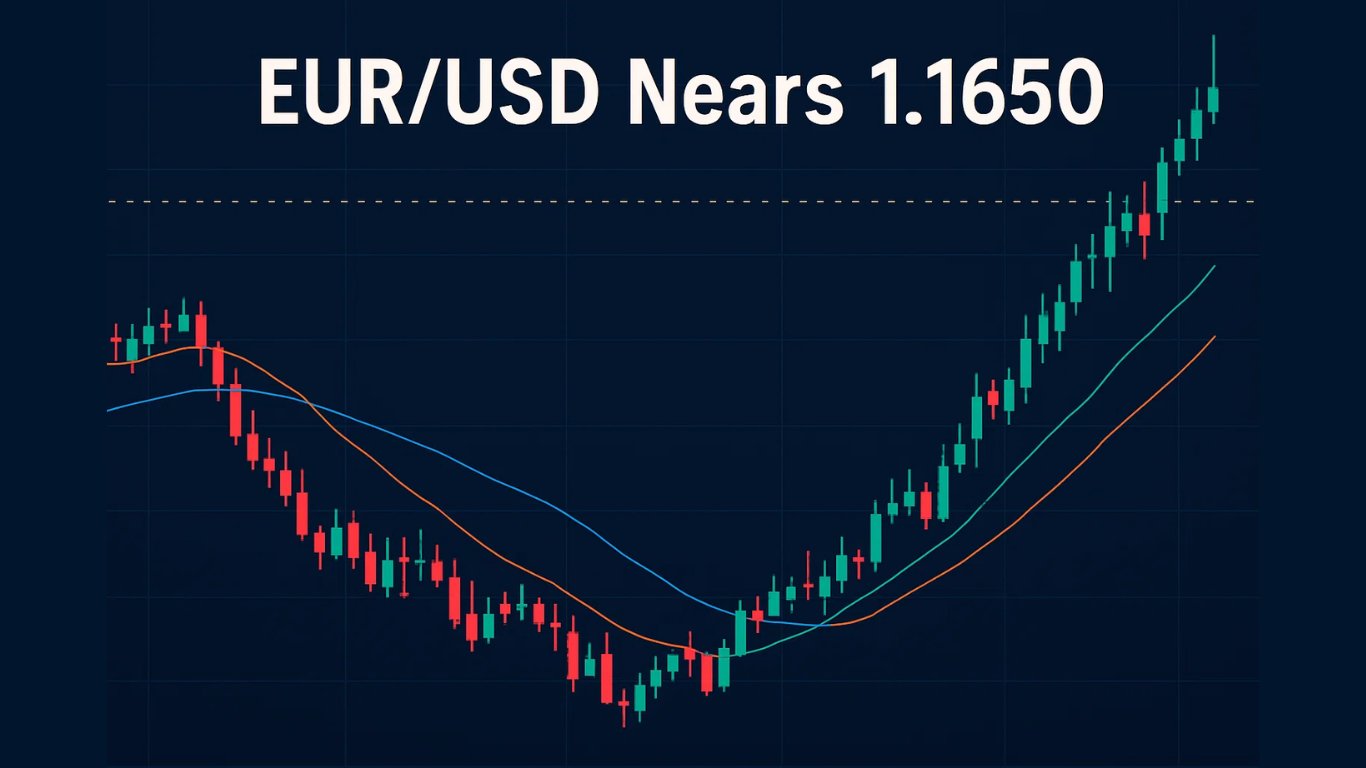
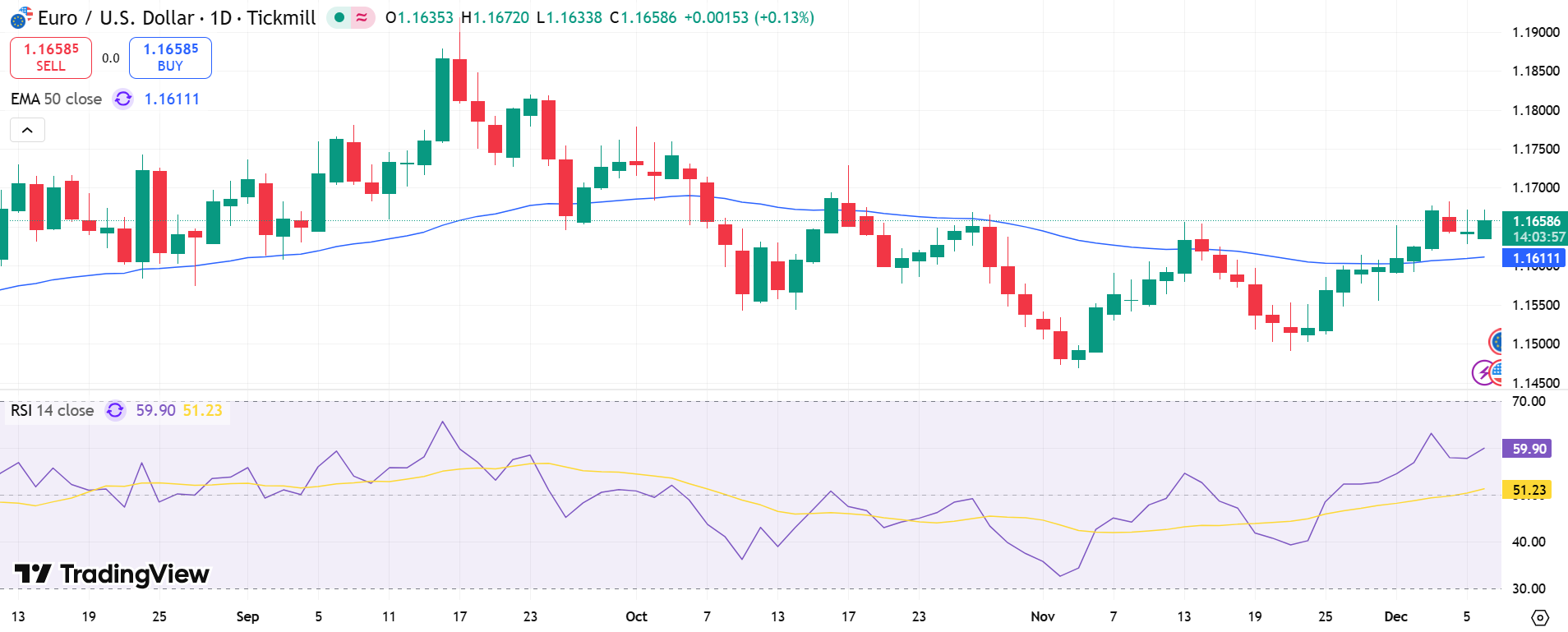
The euro advanced modestly against the U.S. dollar on Monday, with EUR/USD trading near 1.1645 in early Asian hours. Investors enter the week focused on the Federal Reserve’s December meeting, where markets continue to price in a 90% probability of a 25-basis-point rate cut, according to the CME FedWatch Tool. Expectations for a policy shift have restrained the dollar’s ability to sustain last week’s rebound despite firmer U.S. data.
Upcoming releases from Europe—including Germany’s Industrial Production report and the Eurozone Sentix Investor Confidence survey—will offer the next cues for euro sentiment. For now, momentum indicators skew modestly in the euro’s favor.
The 20-period SMA has crossed decisively above the 50-, 100- and 200-period SMAs, with all slopes pointing higher. The 20-period average, currently at 1.1646, provides immediate dynamic support. The RSI (14) at 59 reflects a steady, neutral-to-bullish bias.
Technical Levels Define Narrow Trading Corridor
The pair remains confined within a Fibonacci-based range stemming from the 1.1885 swing high to the 1.1474 low. The 50% retracement at 1.1680 continues to act as the primary resistance ceiling. A break above that threshold would expose the 61.8% retracement at 1.1728, a level likely to determine whether bullish sentiment extends beyond the week.
Strong support is clustered near 1.1630, where the ascending trend line overlaps with the 38.2% retracement. A deeper pullback could find additional footing between 1.1580 and 1.1570, an area reinforced by the 200-period SMA and the 23.6% retracement.
Key technical highlights:
- Resistance: 1.1680 (50% Fib), 1.1728 (61.8% Fib)
- Support: 1.1630 (trend line + 38.2% Fib), 1.1580–1.1570 (200 SMA)
- Bias: Mildly bullish while holding above 1.1630
These levels reflect a market still sensitive to policy expectations rather than macro data surprises.
Strong U.S. Data Fails to Shift Rate Expectations
Last week’s U.S. releases temporarily lifted the dollar. Planned layoffs fell 53% in November to 71,321, according to Challenger, Gray & Christmas. Initial jobless claims fell sharply to 191,000, the lowest since September 2022, beating expectations by nearly 30,000.
Yet the data failed to meaningfully shift rate-cut expectations, leaving the dollar unable to build a sustained rally. Traders now await Friday’s release of the PCE Price Index, the Fed’s preferred inflation gauge, though this month’s reading—reflecting September data—is unlikely to alter the policy outlook ahead of the meeting.
Later the same day, the University of Michigan will publish December consumer sentiment. While an upside surprise may lend temporary support to the dollar, most investors are expected to remain cautious until the Fed signals its formal policy direction.
Sources & Methodology
Primary-source standard: Market-moving facts should link to original data releases, regulator notices, company filings or official project announcements whenever available. Secondary reporting is used for additional context, not as a substitute for original evidence.
Page last reviewed: