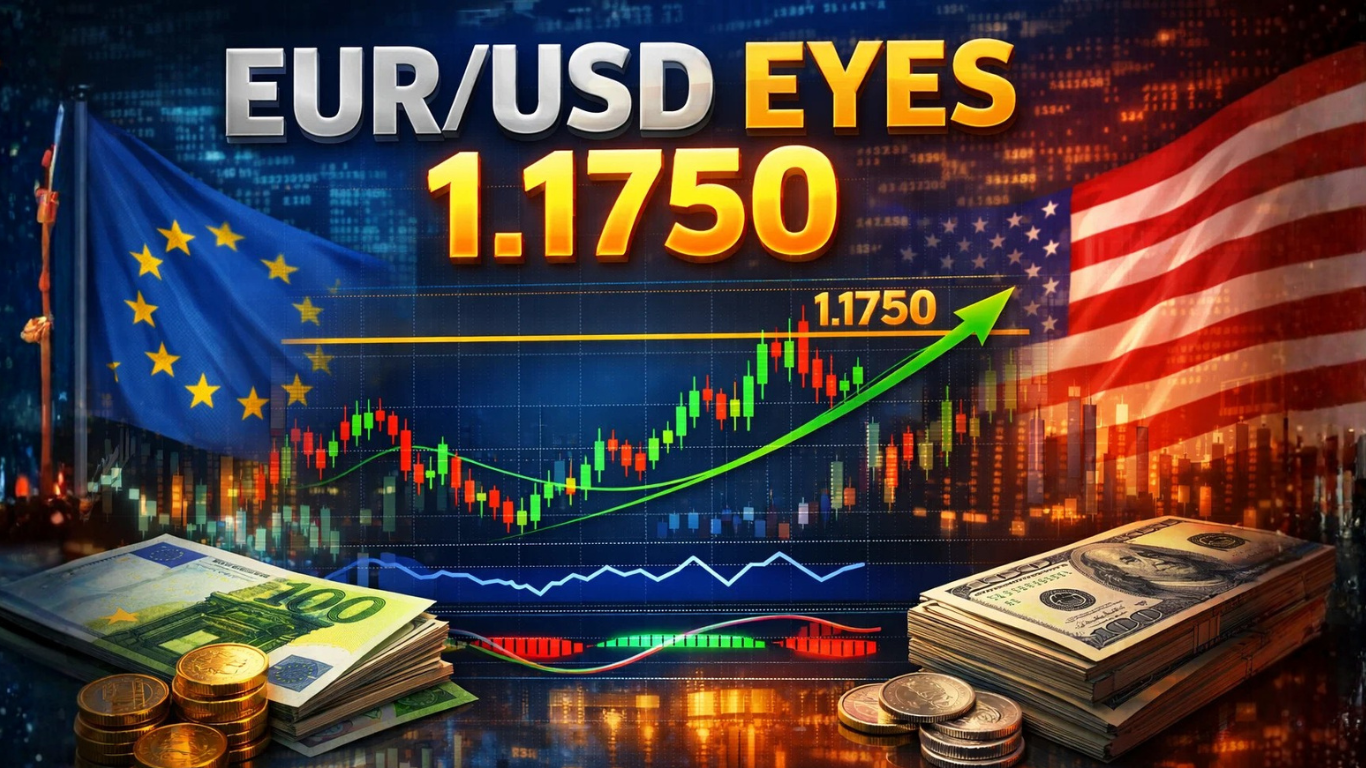
The euro traded in a narrow range against the dollar on Thursday, hovering near 1.1740 after two modest daily declines. While near-term momentum has softened, the broader technical structure continues to favor the upside. On the daily chart, EUR/USD remains contained within an ascending channel, a formation typically associated with higher prices over time.
Trend indicators reinforce that constructive backdrop. The 20-day simple moving average remains above the 50-day and 200-day averages, signaling that medium- and long-term momentum still leans bullish. The pair is holding above the 50-day SMA near 1.1700 and comfortably above the 200-day SMA around 1.1600, though gains are capped just below the 20-day SMA near 1.1745. A Relative Strength Index reading of 48.8 reflects neutral conditions, suggesting buyers are hesitant but not retreating.
Key Support and Resistance Levels
Price action has drifted into the lower half of the ascending channel, highlighting a lack of aggressive buying. Even so, structural support remains intact. The rising trend line drawn from the 1.1500 area continues to underpin the pair, converging with technical levels that could attract buyers on dips.
Traders are closely watching the following levels:
- Support: 1.1680 at the rising trend line
- Secondary support: 1.1620, followed by 1.1600 at the 200-day SMA
- Resistance: 1.1750, the channel midpoint
- Upper target: 1.1800 near the channel ceiling
A sustained break above 1.1750 would strengthen the bullish case, while a decisive move below the trend line could expose deeper losses.
Fed Outlook and ECB Decision in Focus
Macro drivers remain central to near-term direction. U.S. labor data released earlier this week showed payrolls fell by 105,000 in October before rebounding by 64,000 in November. While the initial reaction weakened the dollar, markets quickly concluded that the October decline was distorted by temporary government job losses, limiting the data’s lasting impact.
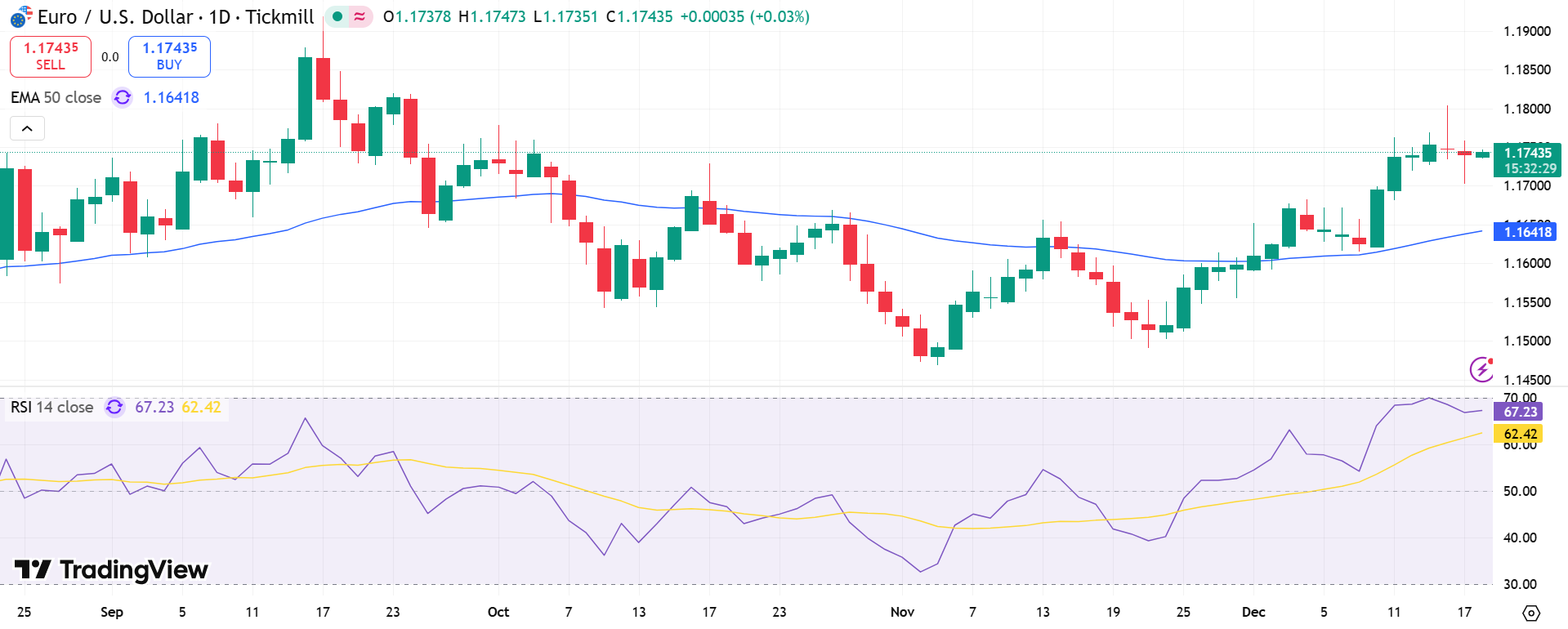
According to the CME FedWatch Tool, investors are assigning roughly a 25% probability to a 25-basis-point Federal Reserve rate cut in January, little changed after the employment report. Atlanta Fed President Raphael Bostic reinforced that view, saying the labor data offered mixed signals and arguing for holding rates steady, citing persistent input-cost pressures.
With no major U.S. economic releases midweek, attention has shifted to commentary from Fed officials. Any broad support for policy stability into early 2026 could underpin the dollar and restrain euro gains.
The spotlight now turns to the European Central Bank, which is set to announce its rate decision and updated economic projections on Thursday. Guidance from Frankfurt on growth and inflation expectations could prove decisive in determining whether EUR/USD can build enough momentum to challenge 1.1750 and beyond.
Sources & Methodology
Primary-source standard: Market-moving facts should link to original data releases, regulator notices, company filings or official project announcements whenever available. Secondary reporting is used for additional context, not as a substitute for original evidence.
Page last reviewed: