Oil prices steadied in Asian trading on Friday, preserving weekly gains as geopolitical tensions continued to underpin the market, even while thin holiday liquidity limited fresh momentum. Investors remained cautious but attentive to supply-side risks emerging from politically sensitive oil-producing regions.
Brent crude futures for February delivery edged up 0.1% to $62.30 per barrel, while U.S. West Texas Intermediate (WTI) rose 0.1% to $58.42. Both benchmarks were on track to post weekly gains of nearly 3%, marking one of the stronger short-term performances in recent months.
Despite this rebound, oil remains under pressure on a yearly basis. Persistent oversupply, uneven global demand growth, and expanding production outside the OPEC+ alliance have weighed heavily on prices throughout the year.
Geopolitical Risks Support Near-Term Prices
Recent geopolitical developments have injected a risk premium into crude markets. The United States has intensified pressure on Venezuelan oil exports by enforcing a two-month “quarantine” on shipments, a move aimed at tightening restrictions on one of OPEC’s sanctioned producers.
Venezuela had gradually increased crude exports in recent months, particularly toward Asian buyers, helping offset supply tightness elsewhere. Any disruption to these flows raises concerns over near-term availability and shipping logistics.
Additional uncertainty emerged after U.S. officials confirmed airstrikes targeting Islamic State militants in northwestern Nigeria. While the action was limited in scope, it reinforced broader concerns around stability in oil-producing regions and potential downstream effects on energy infrastructure.
Key geopolitical factors currently influencing oil markets include:
- U.S. enforcement actions affecting Venezuelan crude exports
- Rising security risks linked to Nigeria, a major African producer
- Heightened sensitivity to supply disruptions during low-liquidity periods
- Increased risk premiums priced into short-term futures contracts
Together, these elements have helped stabilize prices after weeks of downward pressure.
Annual Losses Reflect Demand and Supply Imbalances
Despite recent gains, oil remains on course for substantial annual declines. Brent crude is down nearly 16% year to date, while WTI has fallen close to 19%, reflecting structural challenges facing the energy market.
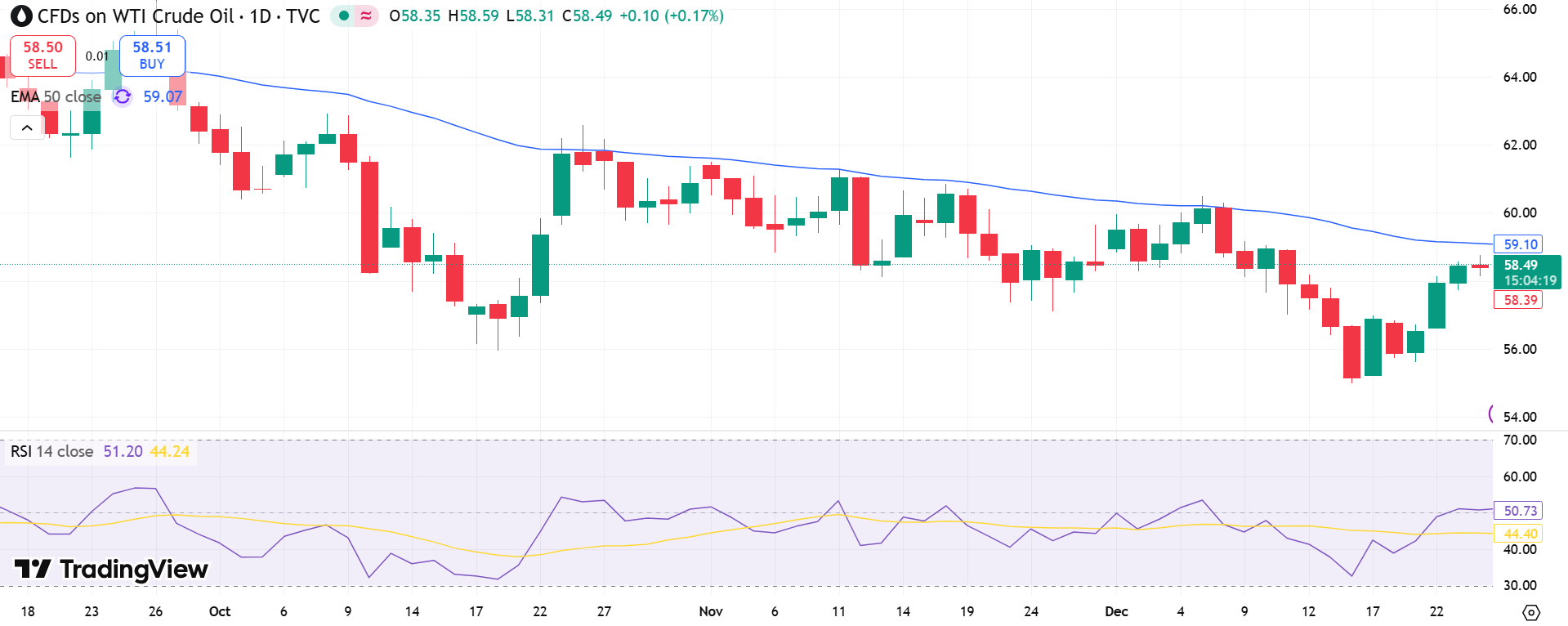
Global demand growth has been uneven, weighed down by slower economic expansion in key consuming regions and efficiency gains that curb fuel usage. At the same time, non-OPEC producers—particularly the United States, Brazil, and Guyana—have continued to add supply, diluting the impact of OPEC+ production discipline.
Market activity remained subdued on Friday as U.S. inventory data releases were delayed by the Christmas holiday, and many financial centers operated on reduced hours. This lack of fresh data kept prices moving within narrow ranges.
Looking ahead, traders are expected to focus on early January indicators, including updated inventory figures, demand forecasts, and policy guidance from major producers. These signals will be critical in determining whether oil can extend its recovery or resumes its broader downward trend into the new year.
Sources & Methodology
Primary-source standard: Market-moving facts should link to original data releases, regulator notices, company filings or official project announcements whenever available. Secondary reporting is used for additional context, not as a substitute for original evidence.
Page last reviewed: