
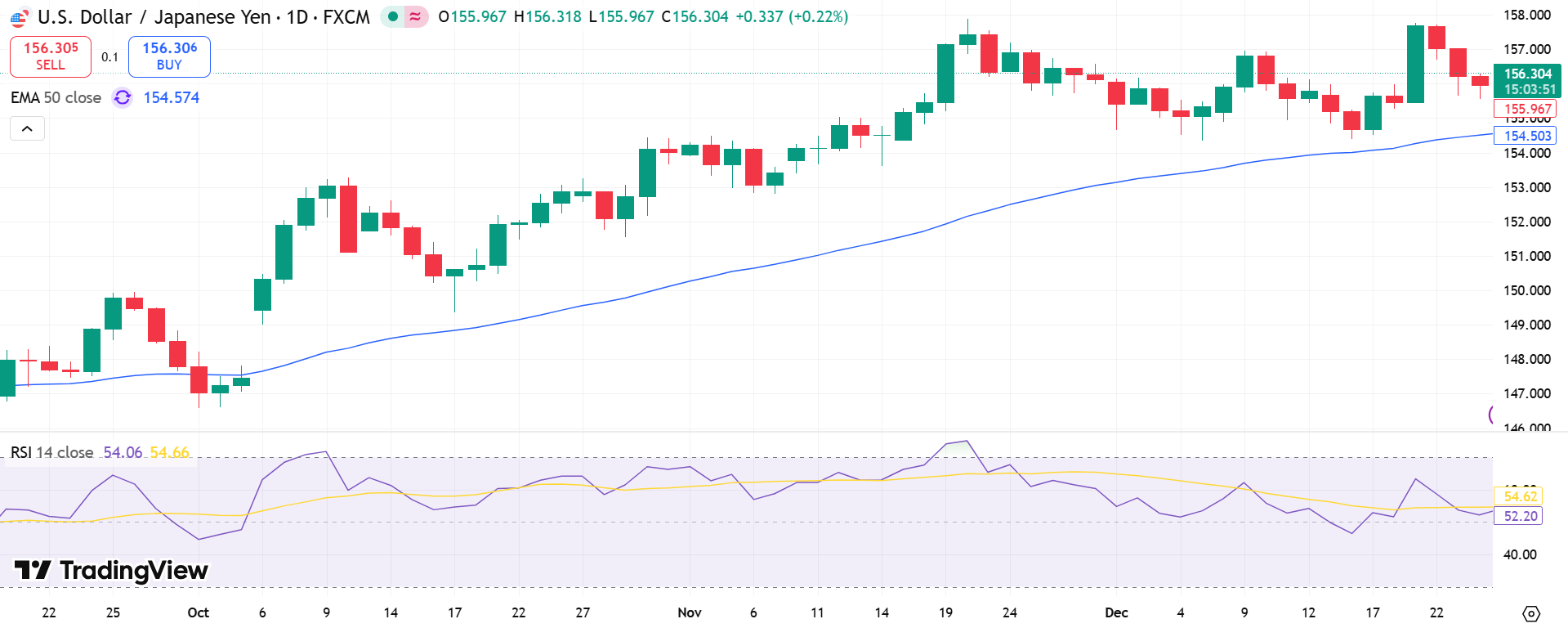
The U.S. dollar weakened against the Japanese yen on Wednesday, pushing the USD/JPY pair down to near 155.80, as markets fully unwound gains sparked by last week’s Bank of Japan (BoJ) policy decision. The pullback reflects renewed skepticism over the pace of Japanese monetary tightening alongside growing expectations that the U.S. Federal Reserve will begin cutting interest rates in 2026.
During the European session, USD/JPY traded about 0.23% lower, extending a three-day decline after failing to hold above the 158.00 level, its highest point in nearly 11 months. Currency traders have increasingly shifted focus from policy headlines to forward guidance, inflation trends, and official signals on market intervention.
BoJ Rate Move Fails to Support the Yen
The yen initially weakened after the BoJ raised its policy rate by 25 basis points to 0.75%, marking another step away from ultra-loose monetary policy. However, the central bank offered limited clarity on how quickly or how far rates could rise, dampening confidence that tightening will continue at a meaningful pace.
Without firm guidance, investors quickly reversed yen-selling positions. The reversal was amplified by warnings from Japan’s Finance Minister, Satsuki Katayama, who reiterated that authorities stand ready to respond to “excessive and one-sided” currency moves. Such comments often act as informal intervention signals, encouraging traders to reduce short-yen exposure.
Market attention is now shifting to inflation data for further direction. Tokyo’s Consumer Price Index, a leading indicator for nationwide inflation, is due Friday. Core Tokyo CPI (excluding fresh food) is expected to rise 2.5% year over year, slowing from 2.8% in November, a trend that could limit the BoJ’s urgency to tighten further.
Key near-term influences on the yen include:
- Official rhetoric warning against sharp currency depreciation
- Slowing Tokyo inflation momentum
- Uncertainty over the pace of future BoJ rate hikes
- Reduced speculative positioning after recent volatility
Fed Rate-Cut Expectations Weigh on Dollar
The dollar’s broader weakness has also contributed to USD/JPY’s decline. Investors increasingly expect the Federal Reserve to pivot toward easing as inflation moderates and economic growth cools.
According to the CME FedWatch Tool, markets assign a 70.6% probability that the Fed will cut interest rates by at least 50 basis points in 2026. These expectations have pressured U.S. Treasury yields, reducing the dollar’s yield advantage over the yen.
A softer dollar environment tends to amplify currency corrections when paired with rising sensitivity to intervention risks in Japan. As a result, USD/JPY has retraced all gains recorded after the BoJ decision, highlighting how fragile directional conviction remains.
Looking ahead, traders are likely to remain cautious. With inflation data pending in Japan and policy expectations shifting in the United States, the pair may stay volatile near the mid-155 range. Until clearer guidance emerges from either central bank, currency markets appear inclined to fade extremes rather than chase momentum.
Sources & Methodology
Primary-source standard: Market-moving facts should link to original data releases, regulator notices, company filings or official project announcements whenever available. Secondary reporting is used for additional context, not as a substitute for original evidence.
Page last reviewed: