
Oil prices opened the week higher as investors assessed diplomatic signals from talks between U.S. President Donald Trump and Ukrainian President Volodymyr Zelenskiy, while ongoing geopolitical tensions in the Middle East reinforced concerns over potential supply disruptions.
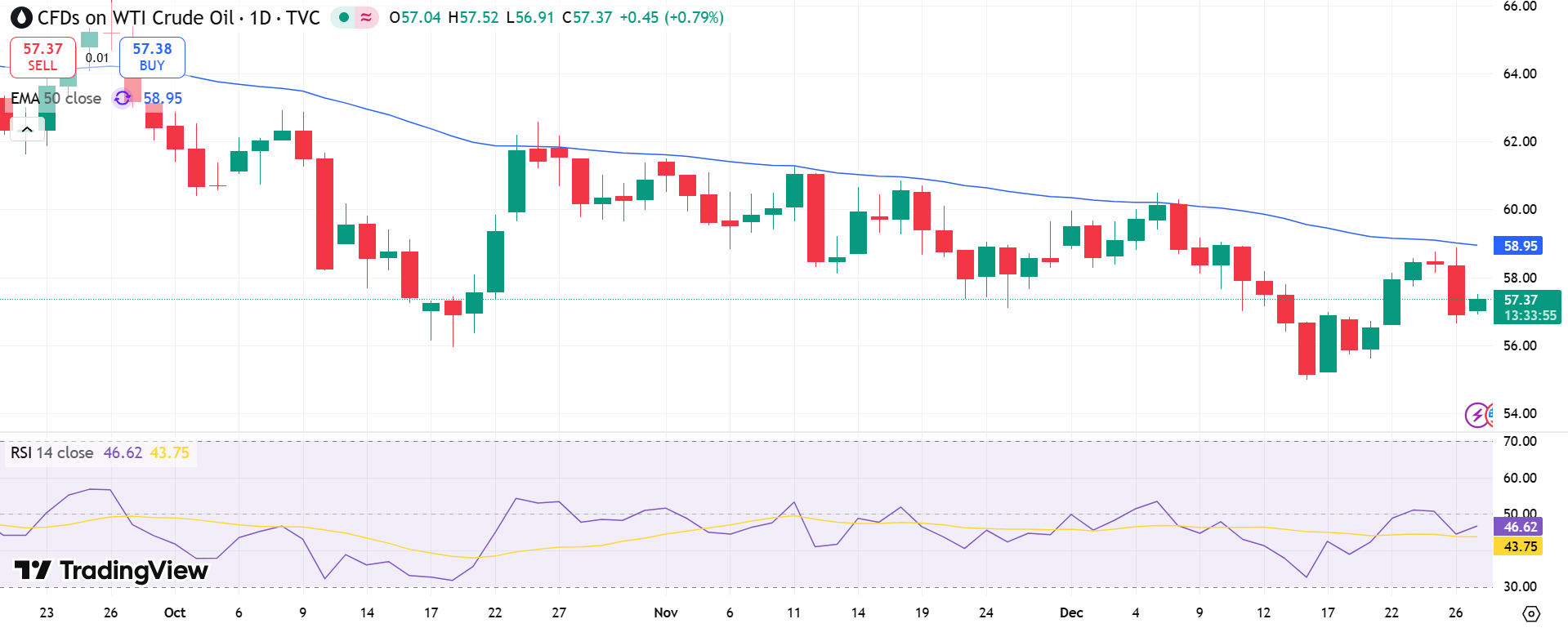
Brent crude futures climbed 63 cents, or 1.04%, to $61.27 per barrel, while U.S. West Texas Intermediate advanced 58 cents, or 1.02%, to $57.32 in early Asian trading. The rebound followed a sharp selloff late last week, when both benchmarks fell more than 2% amid fears of oversupply and hopes that a Ukraine peace deal could ease geopolitical risk premiums.
Markets remain sensitive to political developments because energy supply chains remain exposed to conflict-related disruptions. While prices recovered modestly, traders remain cautious about how negotiations between Washington and Kyiv may reshape expectations for Russian exports.
Ukraine Talks Add Uncertainty to Energy Outlook
President Trump said on Sunday that discussions with President Zelenskiy were “getting very close” to an agreement aimed at ending the war in Ukraine, though he acknowledged that disagreements over the Donbas region remain unresolved. The two leaders spoke publicly after meeting at Trump’s Mar-a-Lago residence, with Trump noting that clarity on the talks could emerge “within a few weeks.”
Analysts caution that the lack of agreement on territorial issues limits the likelihood of a rapid diplomatic breakthrough. According to Mingyu Gao, chief energy and chemical researcher at China Futures Co., negotiations remain deadlocked, reducing the probability of near-term sanctions relief or a sudden rise in Russian supply.
Over the weekend, Russia and Ukraine continued targeting each other’s energy infrastructure, reinforcing market anxiety. Attacks on refineries, pipelines, or export terminals can quickly tighten physical supply, especially in an already fragile global balance.
Middle East Tensions Reinforce Supply Risk Premium
Beyond Eastern Europe, renewed instability in the Middle East is adding another layer of risk to oil markets. Saudi air strikes in Yemen and warnings from Iran that it is engaged in what it described as a “full-scale war” with the U.S., Europe, and Israel have heightened fears of regional escalation.
According to analysts at Haitong Futures, these developments are contributing to higher risk premiums as traders factor in the possibility of shipping or production disruptions across key energy corridors.
Several additional factors are shaping near-term price expectations:
- Ongoing U.S. enforcement against Venezuelan oil shipments
- Fallout from reported U.S. strikes on ISIS-linked targets in Nigeria
- Nigeria’s production capacity of roughly 1.5 million barrels per day
- Uncertainty around compliance and output levels among major producers
Tony Sycamore, an analyst at IG, said WTI is likely to trade within a $55–$60 per barrel range, barring a major geopolitical escalation or a clear diplomatic breakthrough.
Markets Balance Diplomacy Against Supply Risks
While hopes for progress in Ukraine have capped oil’s upside, persistent global tensions continue to limit downside pressure. Traders are weighing the possibility of future peace against the reality of ongoing conflict, enforcement actions, and regional instability.
For now, oil markets appear locked in a narrow range, supported by geopolitical risk premiums but restrained by expectations of ample global supply. The next decisive move is likely to depend on whether diplomacy delivers concrete results—or whether conflict once again dominates the energy landscape.
Sources & Methodology
Primary-source standard: Market-moving facts should link to original data releases, regulator notices, company filings or official project announcements whenever available. Secondary reporting is used for additional context, not as a substitute for original evidence.
Page last reviewed: