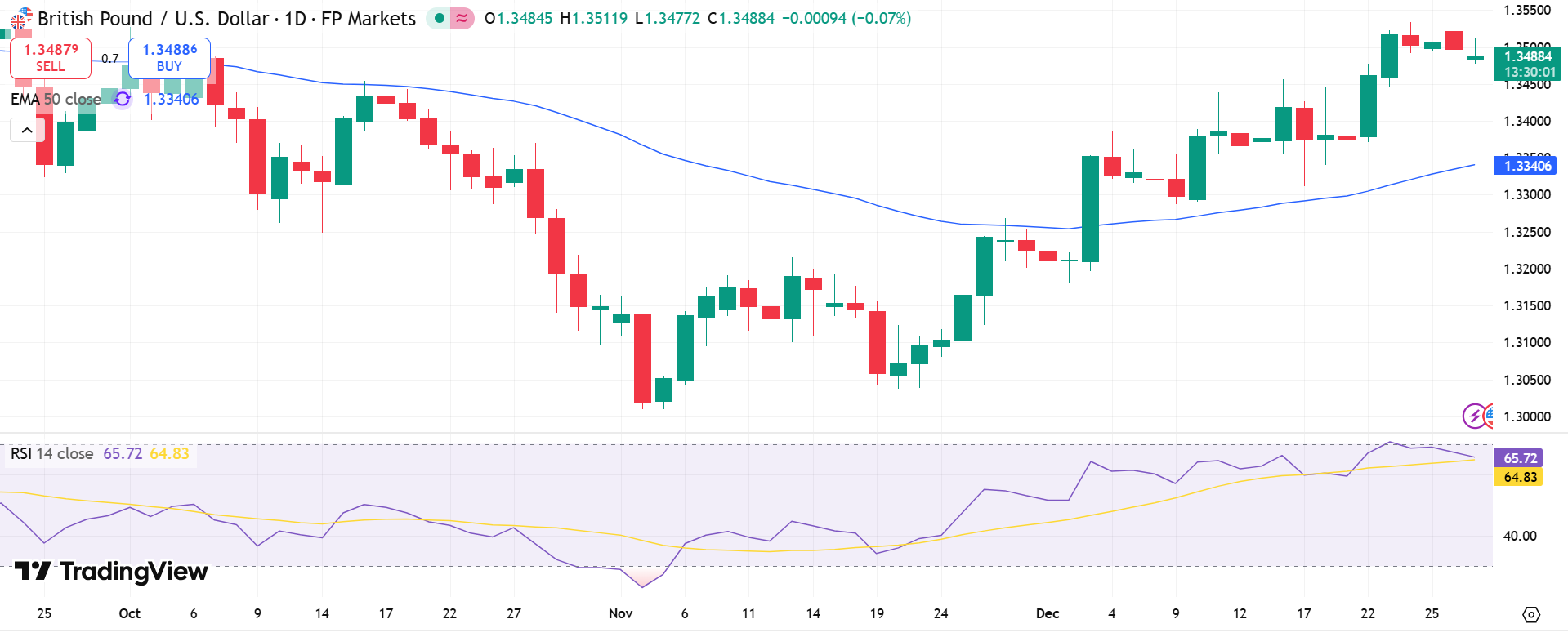
The British pound weakened modestly against the U.S. dollar in early European trading, with GBP/USD drifting toward 1.3485, pressured by renewed demand for the greenback. Despite the pullback, technical signals and policy expectations suggest the broader outlook for the pair remains constructive, provided key support levels continue to hold.
Market focus is split between diverging central bank paths. In the United States, investors are increasingly confident the Federal Reserve will cut interest rates this week, while in the UK, slowing inflation and softer labor data are reinforcing expectations that the Bank of England will also ease policy in coming months. This combination has kept the pair range-bound, with short-term volatility driven by shifting rate expectations rather than fundamentals alone.
Technical Levels Keep Bullish Bias Intact
From a chart perspective, the recent upside break above the 1.3275–1.3280 zone marked an important technical shift. That area combines the 200-day simple moving average with the 38.2% Fibonacci retracement of the September–November decline, making it a key confirmation level for bullish momentum.
Daily momentum indicators remain in positive territory, suggesting the broader trend still favors buyers despite the latest pullback. A sustained move above 1.3365, which corresponds to the 50% retracement level, could reopen the path toward the 1.3455–1.3460 resistance band, followed by a test of the psychologically important 1.3500 handle.
Key technical reference points include:
- Resistance near 1.3365, then 1.3455–1.3460
- Psychological ceiling at 1.3500
- Initial support around 1.3300
- Deeper support at 1.3225 and 1.3200
A decisive break below 1.3200 would weaken the bullish structure and expose downside risk toward the 1.3145–1.3140 region, with sub-1.3100 levels possible if selling accelerates.
Fed Rate Cut Odds Shape Dollar Direction
Markets are pricing in nearly a 90% probability that the U.S. Federal Reserve will cut its benchmark rate by 25 basis points, bringing the target range to 3.50%–3.75%. This would mark the third rate reduction of the year, according to futures-based expectations.
However, investors anticipate what many describe as a “hawkish cut.” Policymakers are expected to signal caution about further easing in early 2026, citing still-resilient labor conditions and uneven progress on inflation. Such guidance could limit downside pressure on the dollar, helping explain why GBP/USD struggles to extend gains above recent highs.
BoE Outlook Adds Pressure to the Pound
On the UK side, fiscal and macro signals are tilting toward looser policy. Concerns over higher taxation following the autumn budget, cooling wage growth, and easing inflation have strengthened the case for further monetary accommodation.
Markets currently assign roughly an 88% probability to a 25-basis-point Bank of England rate cut at the December meeting, according to pricing reflected in CME-linked data. This expectation caps sterling’s upside even as technical indicators remain constructive.
Together, these dynamics leave GBP/USD caught between supportive chart signals and a complex policy backdrop. For now, the pair retains a cautiously positive bias, but sustained gains will likely depend on whether central banks validate—or challenge—market expectations in the days ahead.
Sources & Methodology
Primary-source standard: Market-moving facts should link to original data releases, regulator notices, company filings or official project announcements whenever available. Secondary reporting is used for additional context, not as a substitute for original evidence.
Page last reviewed: