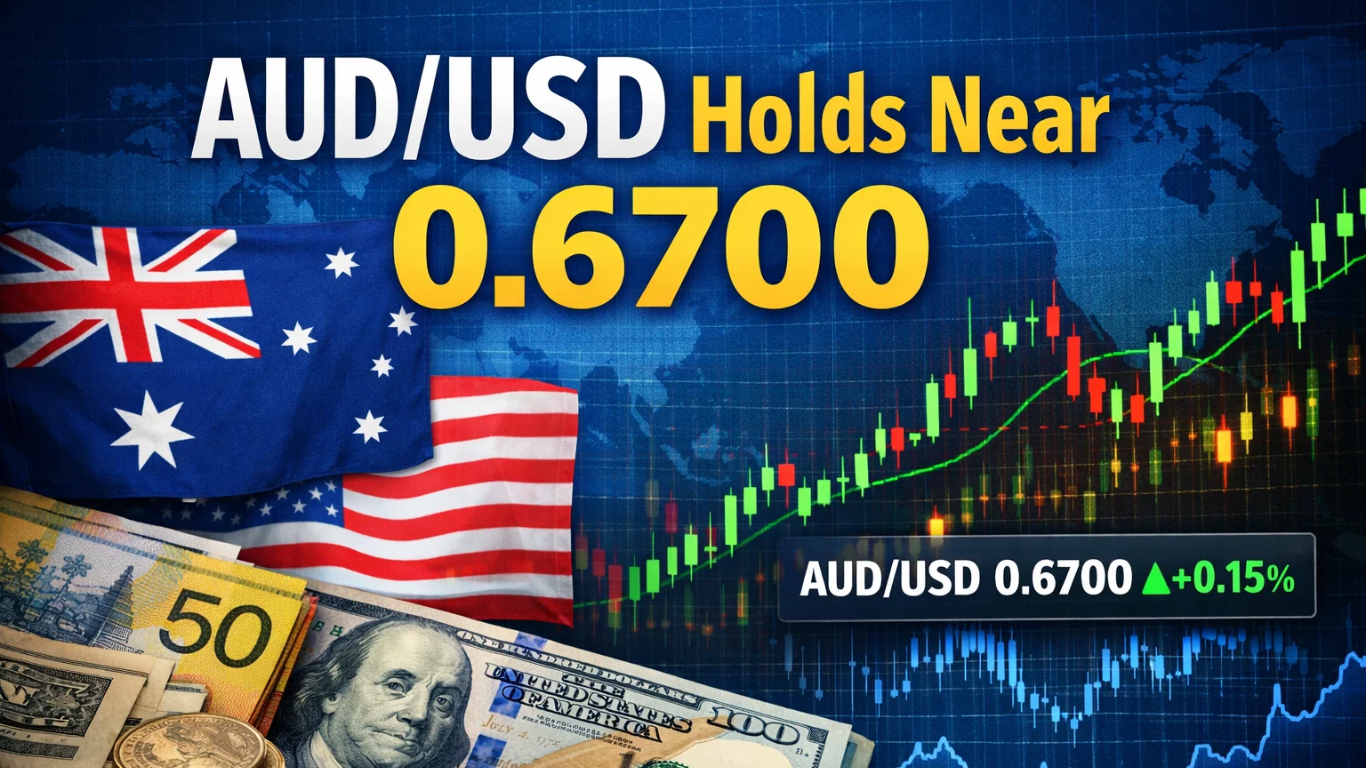
The Australian dollar is holding steady near the 0.6700 level for a third consecutive session, showing little reaction to stronger-than-expected Chinese business activity data. December purchasing managers’ indexes from China surprised to the upside, signaling expansion, yet thin year-end liquidity has limited follow-through in currency markets.
With many global investors sidelined ahead of the New Year, trading conditions remain subdued, keeping AUD/USD confined to a narrow range. The pair continues to oscillate just above 0.6700, reflecting balance between supportive fundamentals and a lack of near-term catalysts.
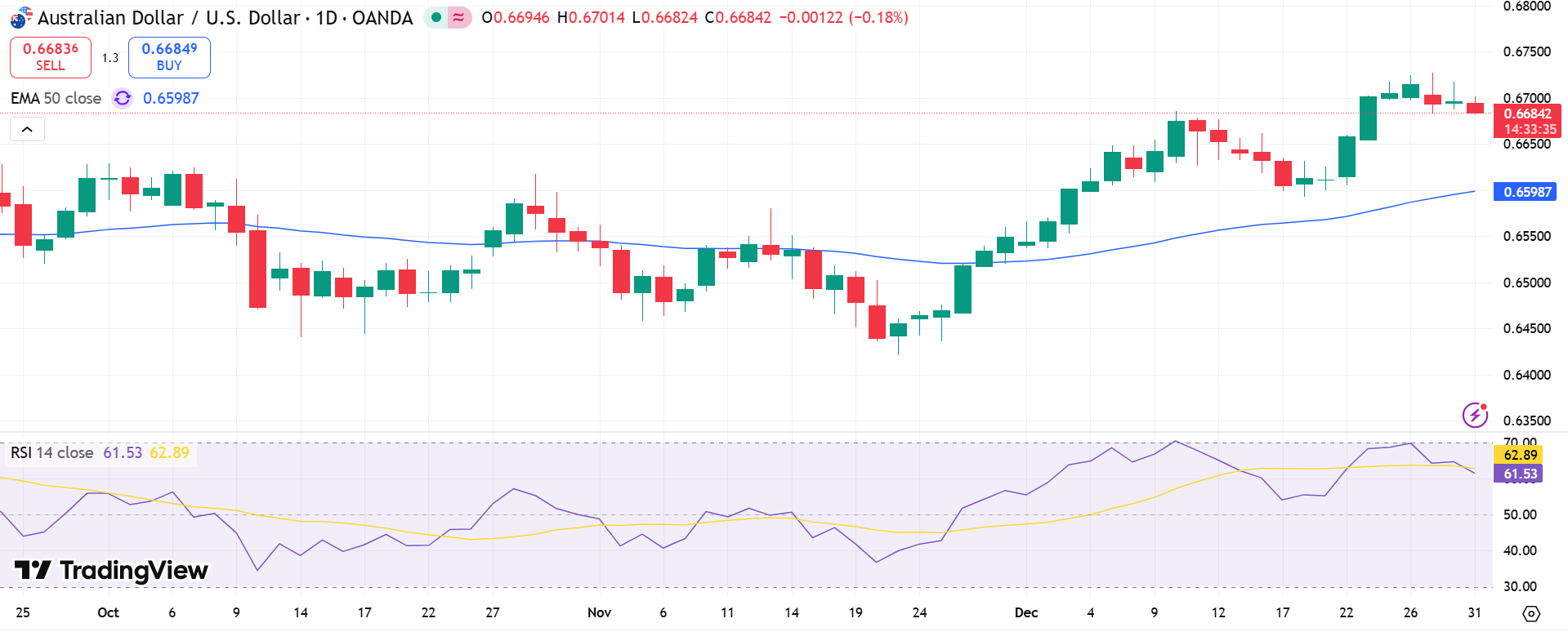
Despite the muted price action, the broader technical structure remains constructive. AUD/USD is trading well above its 20-week exponential moving average (EMA) at 0.6561, preserving a short-term uptrend that has been in place for several weeks. This positioning suggests that dips are still being treated as buying opportunities rather than trend reversals.
Momentum indicators reinforce this view. The 14-day Relative Strength Index (RSI) sits near 61, comfortably above its midpoint and signaling positive momentum without reaching overbought territory. As long as prices remain above the rising EMA zone between 0.6561 and 0.6546, downside pressure is likely to stay limited.
Technical Levels Point to Further Upside Potential
From a chart perspective, AUD/USD continues to build a base that could support further gains if resistance gives way. A sustained weekly close above 0.6700 would mark a psychological and technical breakout, opening the path toward the October 7 high near 0.6810.
Key technical signals supporting the bullish bias include:
- Price holding above the 20-week EMA at 0.6561
- RSI at 60.93, indicating healthy momentum
- Upward slope of medium-term moving averages
- Room for RSI to rise before overbought conditions near 70
As long as these conditions remain intact, pullbacks are likely to be shallow, with buyers defending higher lows.
RBA and Fed Expectations Shape the Macro Picture
Fundamental support for the Australian dollar has also been reinforced by shifting expectations around Reserve Bank of Australia policy. Minutes from the RBA’s December 9 meeting revealed that policymakers discussed the possibility of raising interest rates in 2026, citing upside risks to inflation.
Market pricing reflects a cautious but increasingly hawkish outlook. According to Reuters-based swap data:
- Only 27% probability of an RBA rate hike is priced for February
- A hike is fully priced by June 2026
- Markets assign a 56% chance of another move by end-2026
At the same time, the U.S. dollar has weakened notably. Expectations that the Federal Reserve will cut rates by at least 50 basis points in 2026 have pushed the U.S. Dollar Index to an 11-week low near 97.75, offering further support to AUD/USD.
Together, a resilient technical setup, cautiously hawkish RBA signals, and a softer greenback are helping the Australian dollar hold firm—even as thin holiday trading keeps volatility contained.
Sources & Methodology
Primary-source standard: Market-moving facts should link to original data releases, regulator notices, company filings or official project announcements whenever available. Secondary reporting is used for additional context, not as a substitute for original evidence.
Page last reviewed: