The EUR/USD pair edged above 1.1750 during early Asian trading on Friday, reversing losses from the previous session as traders digested central bank signals. The European Central Bank’s hawkish bias continues to contrast with the Federal Reserve’s easing stance, giving the euro a temporary lift against the U.S. dollar.
Markets now await Germany’s Manufacturing PMI data, which could influence short-term euro sentiment. Despite a modest rebound, volatility remains muted as liquidity thins during the year-end period, limiting large intraday moves. Analysts note that policy divergence between the ECB and Fed remains the primary driver of directional bias in early 2026 trading.
Technical Levels Signal Caution
On the 4-hour chart, EUR/USD trades at 1.1761, slightly below the session’s opening. Key technical observations include:
- 20-period SMA: Flattened near 1.1780, acting as immediate resistance
- 100- and 200-period SMAs: Rising at 1.1727 and 1.1658, offering medium-term support
- Momentum Indicator: Below midline, suggesting weakening buying pressure
- RSI: At 45, indicating modest downward tilt
A decisive break above the 20 SMA could trigger short-term upside toward 1.1785–1.1800, while a drop below the 100 SMA may open the door for deeper retracements near 1.1650.
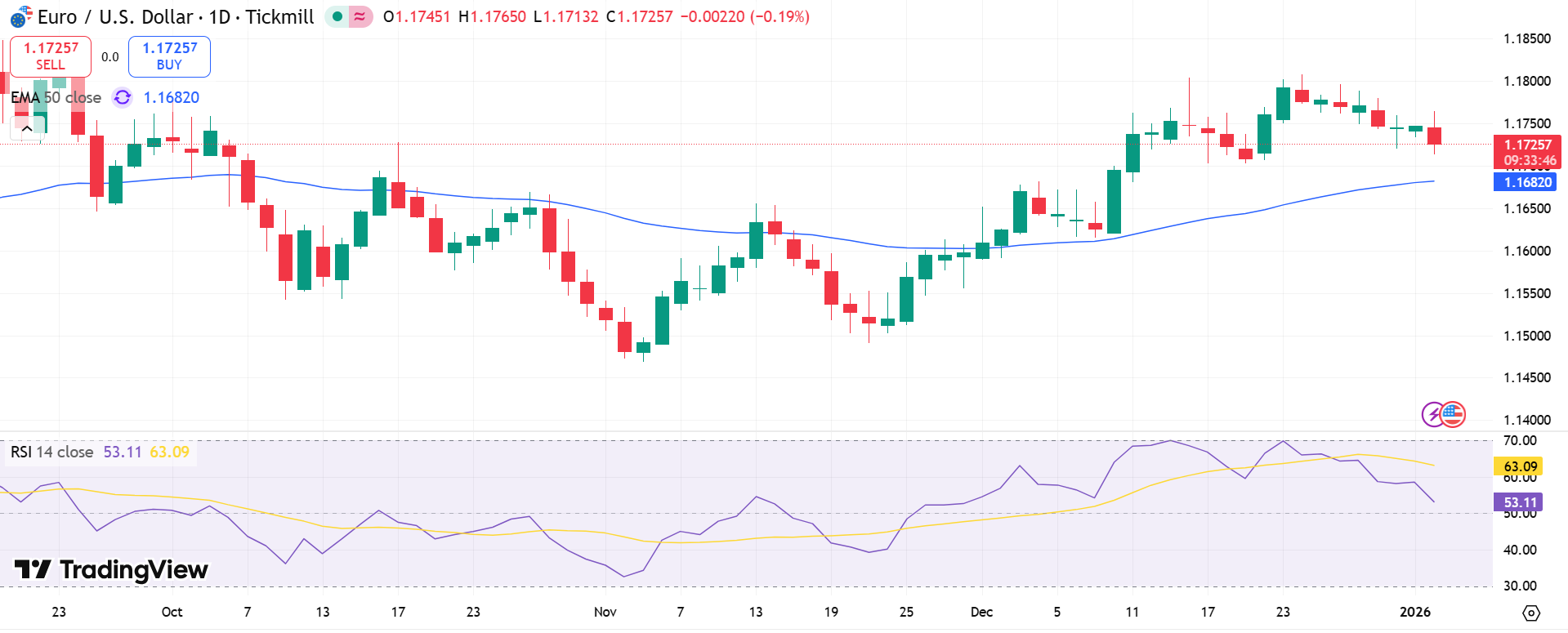
In the daily chart, the pair maintains a bullish bias, trading above its 20-, 100-, and 200-day SMAs. The 20-day SMA at 1.1716 serves as immediate support, while momentum and RSI indicators remain positive, though slightly easing, reflecting subdued buying interest.
Bullet points – Key Technical Insights:
- Support: 20-day SMA at 1.1716; 100-day SMA near 1.1727
- Resistance: 20-period SMA on 4-hour chart at 1.1780–1.1774
- RSI: Daily at 62 (slightly easing); 4-hour at 45
- Momentum: Daily above midline; 4-hour slightly declining
Outlook Hinges on Economic Data
Traders are watching German Manufacturing PMI and Eurozone industrial activity, as these reports may confirm whether the euro can sustain its current gains. Analysts caution that thin liquidity and consolidative patterns make sharp directional moves less likely in the short term.
Longer-term, ECB-Fed policy divergence, combined with market expectations of U.S. rate cuts and eurozone stability, could underpin further EUR/USD strength. However, technical resistance around 1.1780–1.1800 and the potential for downside corrections remain critical risk factors for traders entering positions in early 2026.
Sources & Methodology
Primary-source standard: Market-moving facts should link to original data releases, regulator notices, company filings or official project announcements whenever available. Secondary reporting is used for additional context, not as a substitute for original evidence.
Page last reviewed: