
The Australian Dollar weakened modestly against the U.S. Dollar on Thursday after fresh trade data highlighted a loss of momentum in Australia’s external sector. Official figures showed the country’s trade surplus narrowed sharply to A$2.94 billion in November, down from a revised A$4.35 billion in October, underscoring softer export performance.
The data revealed that exports fell 2.9% month-on-month, reversing a strong gain seen previously, while imports edged up 0.2%, pointing to steadier domestic demand. Currency markets interpreted the narrowing surplus as a sign that Australia’s growth outlook remains fragile, particularly as global demand cools and commodity prices fluctuate.
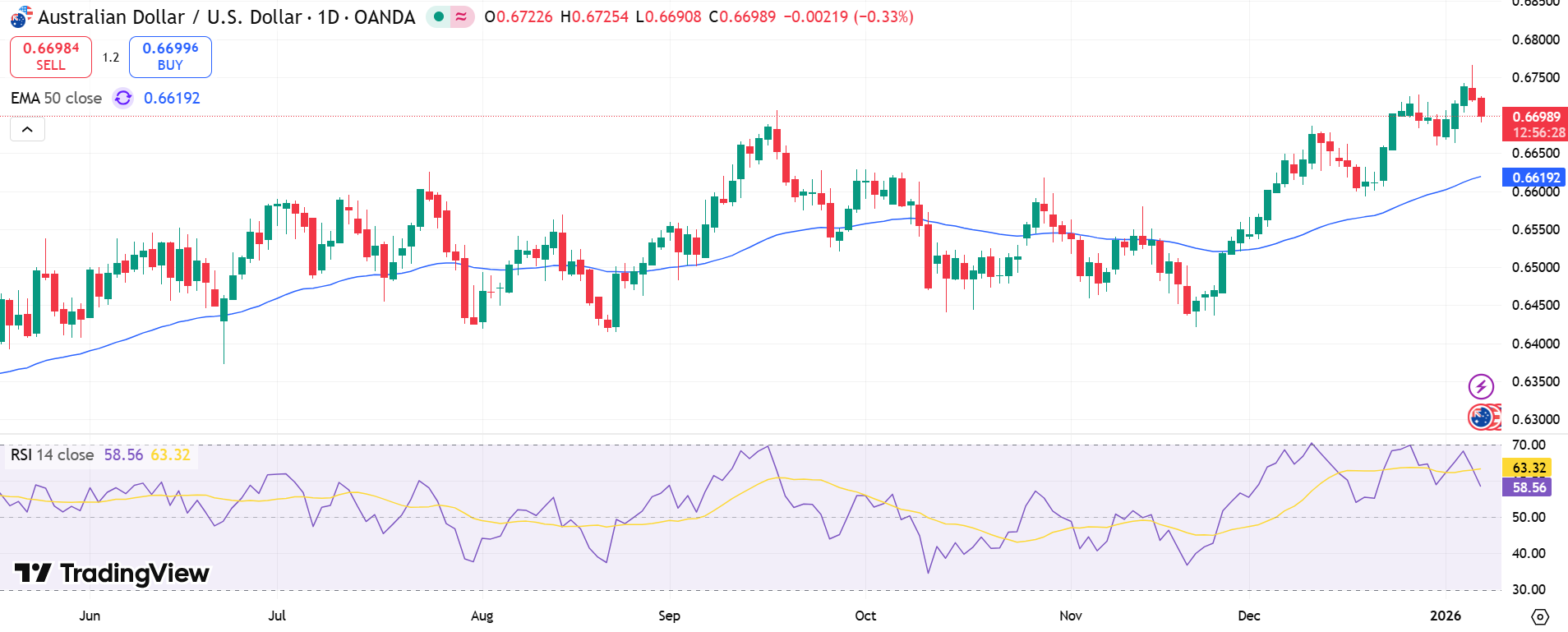
As a result, AUD/USD traded near 0.6720, with investors cautious about pushing the currency higher until there is clearer guidance from the Reserve Bank of Australia (RBA).
Technical Signals Still Lean Bullish
Despite the near-term dip, technical indicators suggest the Australian Dollar retains a constructive medium-term bias. On the daily chart, AUD/USD remains within an ascending channel, a pattern typically associated with sustained upward momentum.
The 14-day Relative Strength Index stands at 64.4, indicating bullish conditions without yet reaching overbought territory. From a chart perspective, the pair has room to extend gains if macro conditions cooperate.
Key technical levels traders are monitoring include:
- Resistance at 0.6766, the highest level since October 2024
- Upper channel resistance near 0.6840
- Initial support around 0.6720, aligned with the channel base
- Secondary support at the 9-day EMA near 0.6706
A decisive break below this support zone could expose the pair to deeper losses toward the 50-day EMA around 0.6626, potentially shifting sentiment more decisively bearish.
Inflation and RBA Policy in Focus
Fundamentals remain mixed. Australia’s Consumer Price Index rose 3.4% year-on-year in November, easing from 3.8% in October and marking the lowest inflation reading since August. While the slowdown was faster than expected, inflation remains above the RBA’s 2–3% target range, keeping policymakers cautious.
RBA Deputy Governor Andrew Hauser said the inflation data broadly matched expectations and signaled that rate cuts are unlikely in the near term. Investors are now awaiting the quarterly CPI report later this month, which is expected to offer clearer direction on policy.
Meanwhile, the U.S. Dollar held steady, supported by resilient U.S. services data and cautious positioning ahead of Friday’s Nonfarm Payrolls report, where job gains are forecast at 55,000. Fed officials remain divided, with some calling for aggressive easing and others urging patience.
With Australia tied closely to China—where recent PMI data showed only marginal growth—any shift in global demand or central bank policy could quickly ripple through the Aussie Dollar. For now, traders are balancing supportive technical signals against growing uncertainty on the policy front.
Sources & Methodology
Primary-source standard: Market-moving facts should link to original data releases, regulator notices, company filings or official project announcements whenever available. Secondary reporting is used for additional context, not as a substitute for original evidence.
Page last reviewed: