The euro remained under pressure on Friday, with EUR/USD hovering near 1.1650 during European trading hours. The pair extended its weekly decline as broad U.S. dollar strength and cautious investor sentiment limited appetite for risk-sensitive currencies. With several critical U.S. events due later in the session, traders were reluctant to challenge the dollar’s recent advance.
The greenback has been supported by a modest rise in U.S. Treasury yields and demand for safe assets amid global uncertainty. This dynamic has left the euro struggling to regain traction, even as some investors argue that the single currency has already priced in a softer growth outlook for the eurozone. For now, momentum favors the dollar, keeping EUR/USD close to levels last seen earlier this year.
Beyond macro data, markets are also monitoring a potential Supreme Court ruling on the scope of former President Donald Trump’s tariff powers. Any decision affecting U.S. trade policy could quickly alter risk sentiment and currency positioning.
Technical Signals Point to Bearish Bias
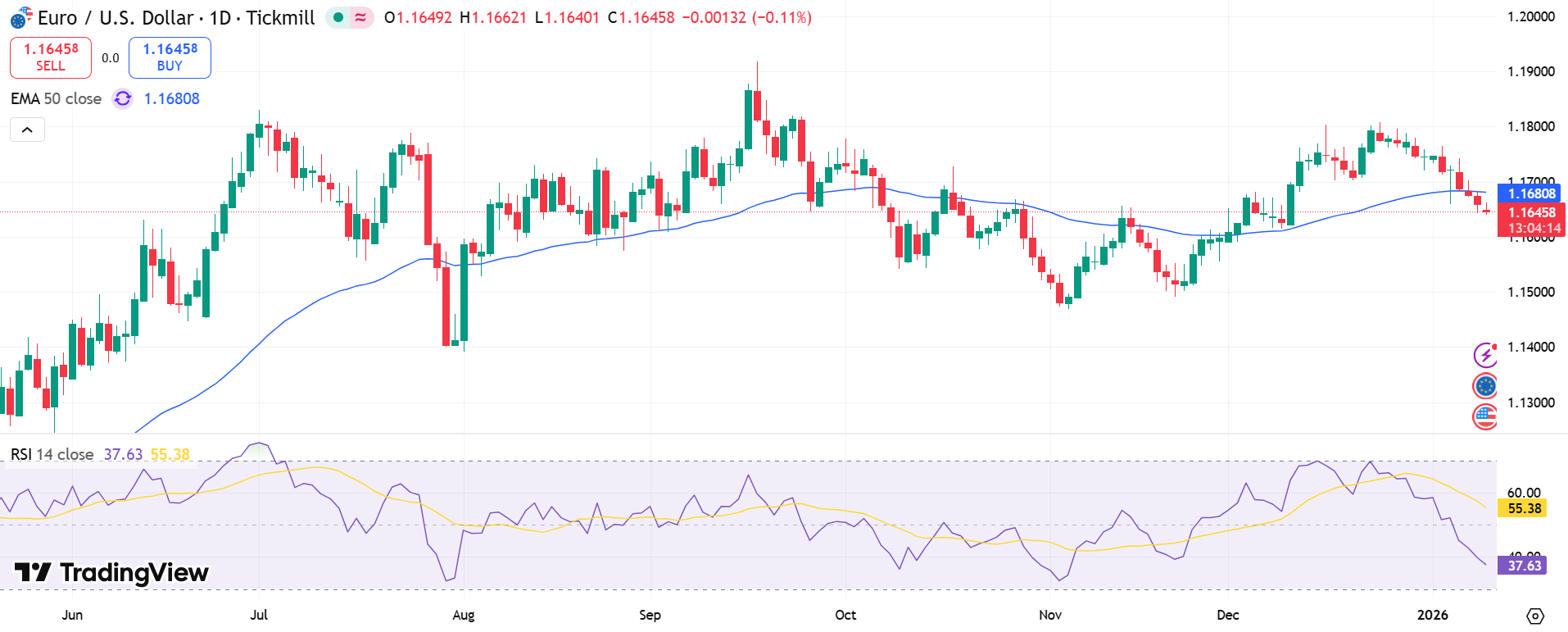
From a technical perspective, EUR/USD continues to trade below its key short- and medium-term averages. On the four-hour chart, the pair sits beneath the 20-, 50-, 100-, and 200-period Simple Moving Averages, reinforcing the prevailing bearish structure. The Relative Strength Index near 32 signals downside momentum, though it also suggests conditions are approaching oversold territory.
Price action is testing an important Fibonacci level. The 50% retracement at 1.1652, measured from the 1.1503 low to the 1.1800 high, has emerged as near-term support. A sustained break below this zone would likely shift focus toward deeper retracement levels.
Key technical levels in focus include:
- Support: 1.1650, then 1.1617 and 1.1600
- Resistance: 1.1712, capped by a descending trend line
- Momentum: RSI near oversold, favoring sellers
As long as short-term moving averages slope lower, rebounds are likely to face selling pressure.
US Payrolls to Shape Fed Expectations
The immediate catalyst for EUR/USD is the upcoming U.S. Nonfarm Payrolls (NFP) report. Economists expect job growth of around 60,000 in December, down from 64,000 in November, while the unemployment rate is forecast to ease to 4.5%. The data will be closely watched for clues on the Federal Reserve’s next policy steps.
Market pricing suggests a less than 15% chance of a rate cut in January and roughly a 40% probability of a 25-basis-point cut in March, according to futures data. A stronger-than-expected report—such as payrolls above 80,000—could reinforce expectations for extended policy pauses, keeping the dollar supported and pushing EUR/USD lower. Conversely, a weak print near 30,000 jobs, paired with rising unemployment, could revive bets on a March cut and allow the euro to stabilize.
Until clarity emerges, EUR/USD appears set to remain fragile, with traders bracing for volatility as U.S. data and legal developments converge.
Sources & Methodology
Primary-source standard: Market-moving facts should link to original data releases, regulator notices, company filings or official project announcements whenever available. Secondary reporting is used for additional context, not as a substitute for original evidence.
Page last reviewed: