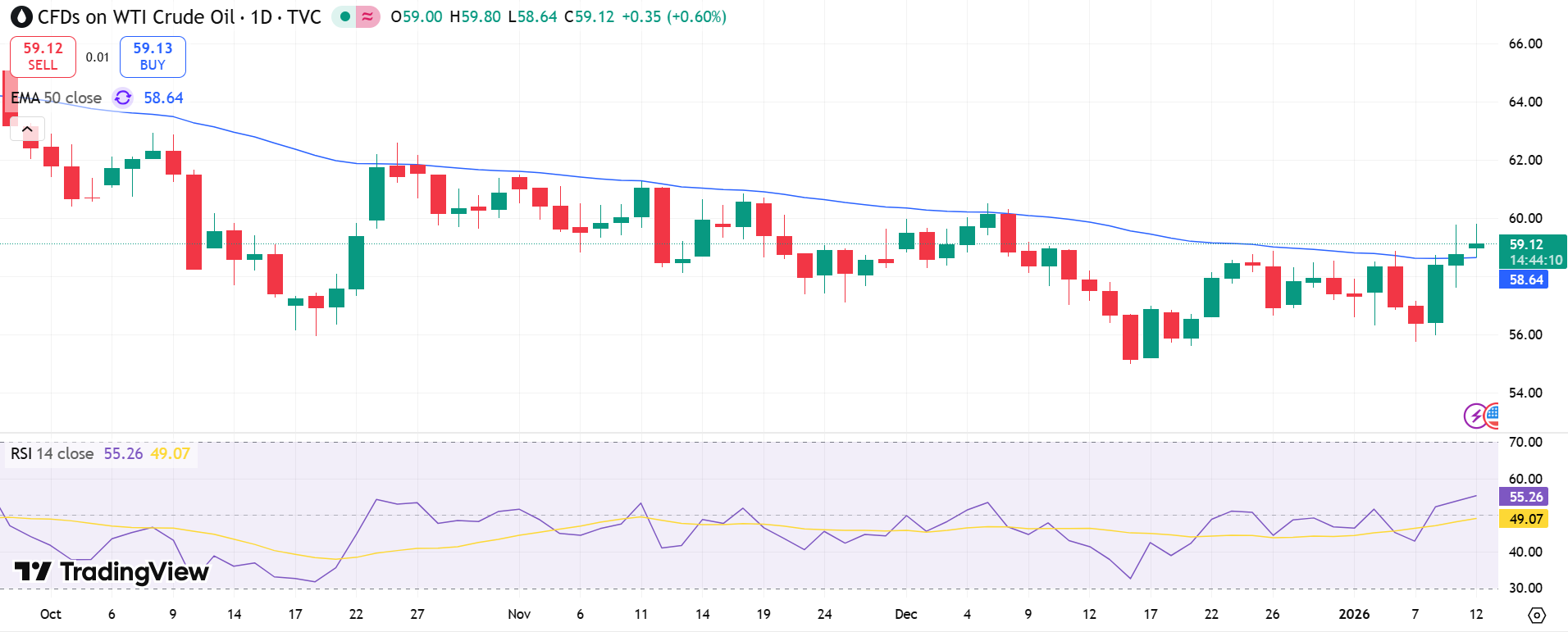
Oil benchmarks saw modest gains Monday as markets balanced escalating unrest in Iran with efforts to restart Venezuelan exports. Brent crude edged up about $0.05 to $63.39 a barrel, while West Texas Intermediate (WTI) ticked 4 cents higher to $59.16, reflecting investor caution amid heightened supply anxiety. Both contracts had logged their largest weekly gains since October, rising over 3% as geopolitical tensions intensified.
Protests in Iran — the largest since 2022 — have prompted concerns over potential disruptions to oil production and shipments. Rights groups reported more than 500 deaths, and analysts warn that the unrest could put roughly 1.9 million barrels per day of Iranian exports at risk if worker strikes spread within the oil sector.
Despite these geopolitical pressures, traders remain cautious and have largely held prices in check, seeking evidence of real supply disruptions before committing to larger price moves.
Venezuela’s Supply Return Counters Risk
Efforts to revive Venezuelan oil flows have counterbalanced upward price pressure from Iran. Following political changes in Caracas, the United States is preparing to receive up to 50 million barrels of previously sanctioned Venezuelan crude, spurring a rush among energy firms to finalize tanker arrangements and port logistics.
Even as Venezuelan exports restart, analysts emphasize that global oversupply expectations for 2026 limit sustained price run-ups. Market pricing reflects a belief that a structural surplus — supported by OPEC output and resilient non-OPEC production — will temper long-term gains unless demand strengthens markedly or a genuine supply cutoff emerges.
In addition to Iran and Venezuela, other supply risks are on investors’ radars. OPEC’s recent production survey showed total output slipped slightly in December, with Iran and Venezuela contributing most of the decline — a subtle reminder of how fragile supplies can be amid geopolitical shifts.
Key Market Dynamics in Focus
The current oil landscape is shaped by five principal forces, reflecting how geopolitics, economics and logistics intersect:
- Iran unrest risk: Protests threatening nearly 2 M bpd of exports.
- Venezuelan export resumption: Up to 50 M barrels set to enter U.S. markets.
- Oversupply outlook: Futures pricing in surplus conditions for 2026.
- OPEC production shifts: Output declines weighed by Iran/Venezuela trends.
- Broader geopolitical threats: Russia and Ukraine conflict impacts supply risk sentiment.
At a glance:
• Brent near $63–$64/bbl, WTI around $59–$60/bbl.
• Weekly gains above 3% amid risk premium.
Oil market participants continue to monitor developments in the Middle East and Latin America, knowing that only tangible supply interruptions or a shift in demand trends will break the current range-bound pattern. Amid persistent uncertainty, traders and analysts alike stress that clear supply shocks — not just headline risks — are needed to drive a new pricing regime.
Sources & Methodology
Primary-source standard: Market-moving facts should link to original data releases, regulator notices, company filings or official project announcements whenever available. Secondary reporting is used for additional context, not as a substitute for original evidence.
Page last reviewed: