
The USD/JPY pair rebounded to near 158.00 in early Asian trading after briefly dipping toward 157.50, underscoring a shift in near-term sentiment. Renewed political unease in Japan and concerns about the country’s fiscal outlook weighed on the yen, allowing the U.S. dollar to regain traction. The move comes despite lingering global risks and debate over the U.S. Federal Reserve’s policy independence.
Technically, the pair retains an upward bias. On the four-hour chart, the 100-period simple moving average is rising near 156.31, providing immediate dynamic support. Momentum indicators point to steady demand rather than speculative excess: the RSI near 62 signals firm buying pressure without entering overbought territory, while the MACD remains positive with a gradually expanding histogram. If the current tone persists, the pair may probe higher levels; any pullback would likely test support near the 100-SMA.
The dollar’s resilience has also been supported by stable global equity markets and repositioning ahead of key U.S. data, particularly the Nonfarm Payrolls report. Together, these factors have reduced demand for the yen’s traditional safe-haven role.
Japan Data Undermines Yen Support
Domestic fundamentals continue to challenge the yen. While household spending unexpectedly rose 2.9% year-on-year in November, the improvement failed to offset broader income pressures. More telling was the persistence of declining real wages. Government data show inflation-adjusted wages fell for an 11th consecutive month, dropping 2.8% in November, highlighting how price growth continues to outpace earnings.
This imbalance complicates policy decisions for the Bank of Japan (BoJ). Weak purchasing power restrains consumption and clouds the sustainability of inflation, limiting confidence in a rapid normalization of monetary policy. Political strains and fiscal concerns further add to the yen’s vulnerability.
External pressures have also intensified. China recently imposed restrictions on rare-earth and magnet exports to Japan, escalating a diplomatic dispute and raising supply-chain risks for Japanese manufacturers. The move adds another layer of uncertainty for an economy heavily reliant on advanced manufacturing inputs.
Key pressures weighing on the yen include:
- 11 straight months of falling real wages
- Fiscal and political uncertainty in Tokyo
- China-Japan trade and supply-chain tensions
Dollar Strength Meets Policy Uncertainty
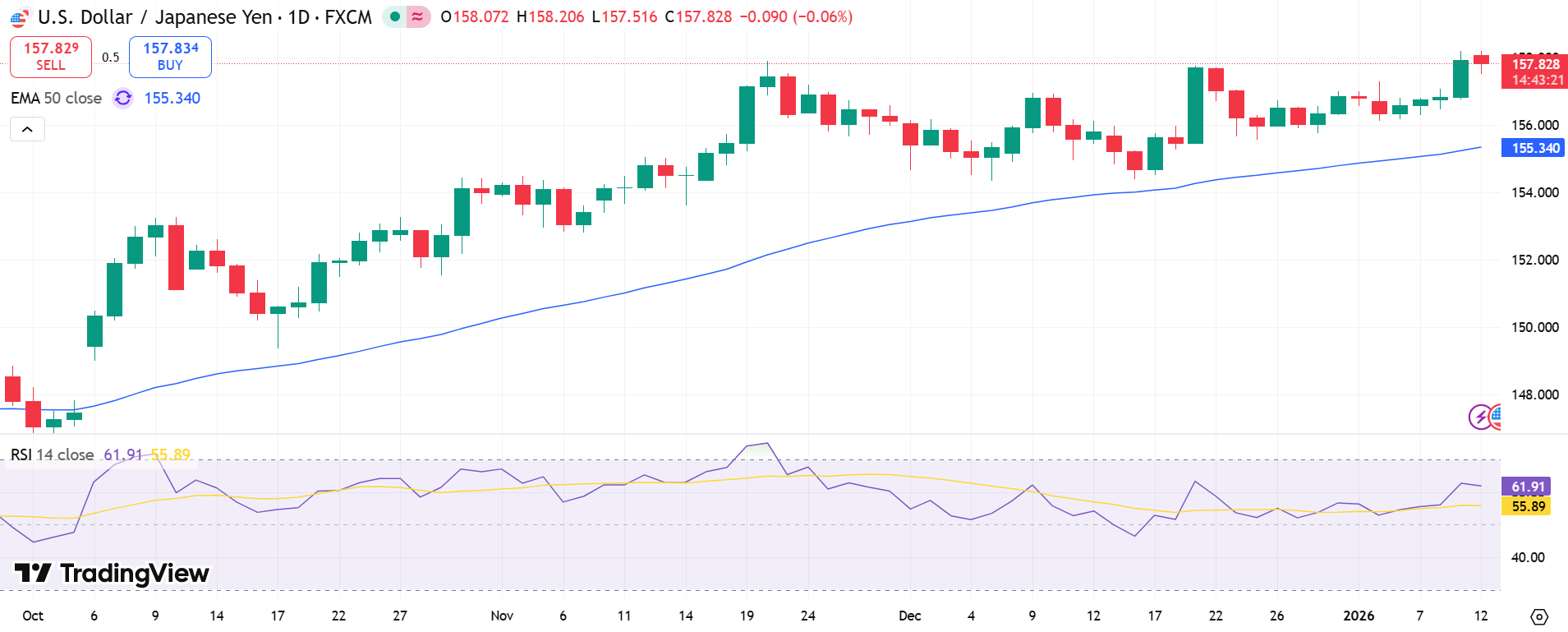
On the other side of the pair, the U.S. dollar has extended a two-week uptrend, hovering near a one-month high. This strength reflects short-term positioning rather than a decisive shift in policy expectations. Markets continue to price in the possibility that the Federal Reserve could begin cutting rates as early as March, with another reduction later in the year.
Such expectations cap the dollar’s upside over the medium term, especially as investors await clearer signals from labor-market data. For now, the divergence between a cautiously resilient dollar and a structurally pressured yen favors USD/JPY stability near recent highs.
Looking ahead, traders will focus on:
- U.S. Nonfarm Payrolls for clues on Fed timing
- BoJ communication on future tightening
- Geopolitical and trade developments affecting Japan
Until a clear catalyst emerges, USD/JPY is likely to remain supported near 158.00, with direction hinging on whether U.S. data validate rate-cut bets or reinforce the dollar’s near-term strength.
Sources & Methodology
Primary-source standard: Market-moving facts should link to original data releases, regulator notices, company filings or official project announcements whenever available. Secondary reporting is used for additional context, not as a substitute for original evidence.
Page last reviewed: