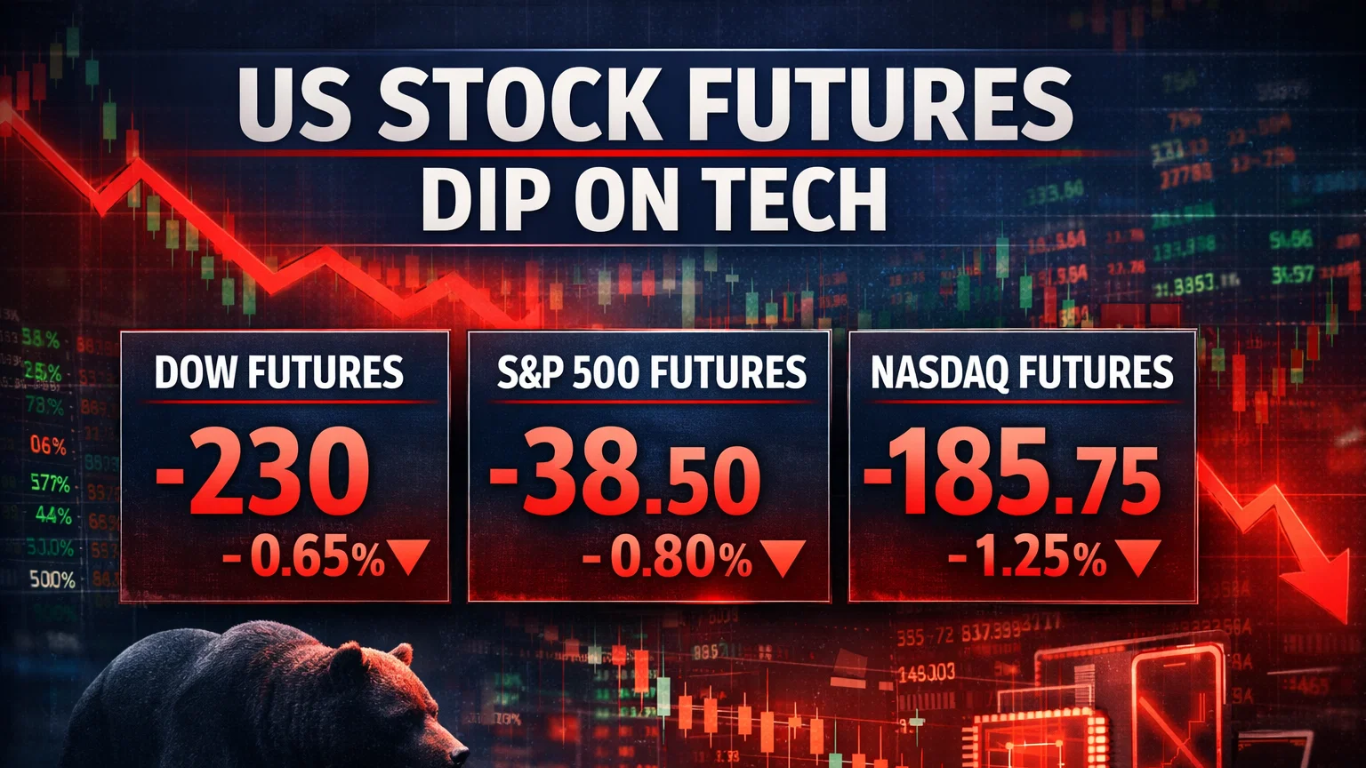
U.S. stock index futures edged lower Wednesday evening, signaling continued caution after Wall Street posted a two-day decline driven by weakness in bank shares and a pullback in technology stocks. Investors appeared reluctant to add risk ahead of key earnings from Taiwan Semiconductor Manufacturing Co. (TSMC), a bellwether for the global chip industry, due Thursday.
By late evening trading, S&P 500 futures slipped 0.1% to 6,957, while Nasdaq 100 futures fell nearly 0.2% to 25,590. Dow Jones futures declined 0.15% to 49,282, reflecting a market still digesting policy risks, earnings signals and geopolitical uncertainty.
Tech Stocks Pause Before TSMC Results
Technology shares, which powered much of Wall Street’s early-January rally, retreated as investors locked in profits and reassessed valuations. Attention centered on TSMC’s fourth-quarter earnings, widely viewed as a read-through for demand in advanced chips tied to artificial intelligence and high-performance computing.
TSMC, the world’s largest contract chipmaker and a key supplier to Nvidia, saw its U.S.-listed shares fall more than 1% during regular trading. The caution rippled through the sector as traders positioned defensively ahead of the results.
Additional pressure came from policy and regulatory headlines. President Donald Trump announced 25% tariffs on certain advanced computing chip imports, though the impact is expected to be limited given U.S.-based manufacturing by major producers. Separately, reports of potential Chinese restrictions on domestic Nvidia sales weighed on sentiment, sending Nvidia shares down over 1%.
Broader tech losses were amplified after reports that China advised local firms to halt use of some U.S. and Israeli cybersecurity software. Broadcom slid more than 4%, while Oracle dropped over 4% following a lawsuit from bondholders related to losses tied to its AI expansion.
Banks Drag as Policy and Earnings Clash
Financial stocks were another source of weakness, overshadowing otherwise mixed earnings results. Trump’s proposal to impose a 10% cap on credit-card interest rates unsettled investors, with bank executives warning the move could squeeze returns and restrict credit availability.
The sector’s decline came despite several earnings beats:
- Bank of America and Citigroup fell more than 3% each after reporting stronger-than-expected quarterly profits
- Wells Fargo slid over 4% after revenue missed forecasts
- JPMorgan Chase extended losses by nearly 1% following middling results earlier in the week
Geopolitics and Records Keep Volatility Alive
Markets also remained sensitive to geopolitical developments, including concerns over potential U.S. involvement in Venezuela and Iran. Tehran warned of retaliation if Washington intervenes in ongoing nationwide protests, reinforcing a cautious tone.
The pullback followed a period of record highs earlier in January. While volatility has increased, investors continue to balance strong earnings prospects in technology against policy risk, geopolitical uncertainty and stretched valuations.
Sources & Methodology
Primary-source standard: Market-moving facts should link to original data releases, regulator notices, company filings or official project announcements whenever available. Secondary reporting is used for additional context, not as a substitute for original evidence.
Page last reviewed: