On Monday, the U.S. dollar got a little weaker compared to the Japanese yen. The exchange rate, called USD/JPY, moved down to around 154.90 during European trading hours. This means one dollar bought slightly fewer yen than before.
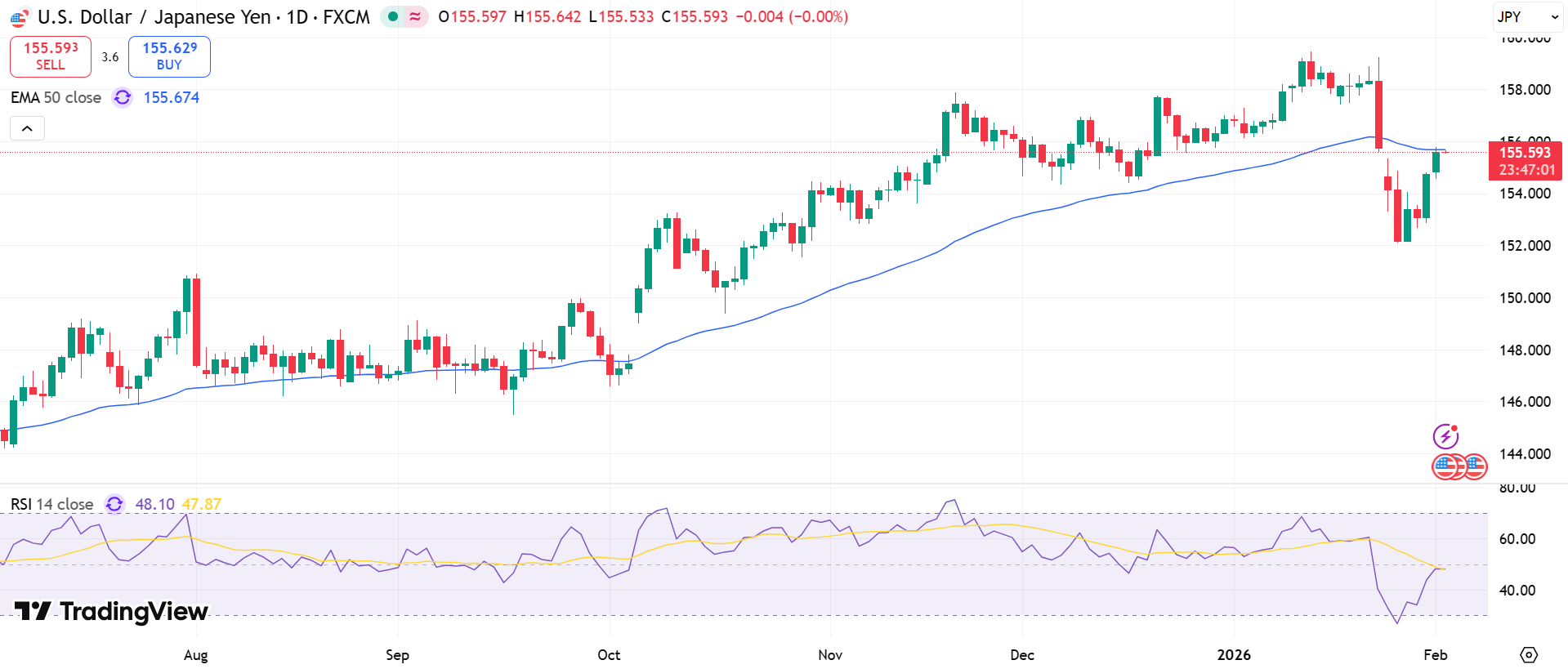
For weeks, the dollar–yen pair has been moving inside a slanted “price tunnel” that goes downward. Right now, the price is near the top of that tunnel, and traders are trying to decide if it will break out or slide back down again.
Why the chart looks tricky
Market experts who study charts say the pair is at an important turning point. The price is sitting near its short-term average (called the 9-day EMA) but still below its longer-term average (the 50-day EMA at about 155.63). Since that longer line is slowly turning down, it suggests the dollar may struggle to rise unless buyers push harder.
A tool called the Relative Strength Index (RSI), which measures how tired buyers or sellers are, is around 46 — right in the middle. That means the market is not clearly strong or weak.
If the rate falls below 154.85, traders think it could drop toward 150.00 or even around 149.20. But if it breaks above 156.00, the dollar could climb toward 161.00 and maybe even the old high near 162.00 from July 2024.
Why the yen is under pressure
The Japanese yen has been weak lately because prices in Tokyo are rising more slowly. Inflation in Japan’s capital fell to 1.5% in January, down from 2.0%. Slower inflation makes it less likely that Japan’s central bank will raise interest rates again soon, which can weaken a currency.
At the same time, Japan’s Prime Minister has promised more government spending and a temporary pause on food tax. Many economists worry this could hurt Japan’s finances and keep the yen weaker.
Big world events also matter
Traders are watching closely in case the U.S. and Japan decide to step in together to help the yen. Recent “rate checks” from both countries have made people think joint action is possible.
World conflicts in the Middle East and Ukraine, plus trade arguments between the U.S. and Canada, are also keeping some safe-haven demand for the yen — meaning people still buy yen when they feel nervous.
The U.S. dollar has gotten a small boost from talk that Kevin Warsh might become the next head of the Federal Reserve. Stronger dollar news like this can lift USD/JPY.
What comes next
Investors are now waiting for U.S. inflation data (called the PPI) and comments from Federal Reserve officials. These will help decide whether the dollar gets stronger or weaker.
Simple guide for kids:
- If USD/JPY goes above 156.00 → dollar might keep rising.
- If it goes below 154.85 → dollar could fall toward 150.
- Japan’s prices and its central bank are very important for the yen.
For now, the dollar and yen are stuck in a tug-of-war, and big moves could happen in either direction.
Sources & Methodology
Primary-source standard: Market-moving facts should link to original data releases, regulator notices, company filings or official project announcements whenever available. Secondary reporting is used for additional context, not as a substitute for original evidence.
Page last reviewed: