Crude oil prices ticked up slightly on Friday morning in Asia, but the market was still on track for its first weekly decline in seven weeks. That break in momentum matters because oil had been rising steadily since December, much like a ball rolling uphill with strong push behind it.
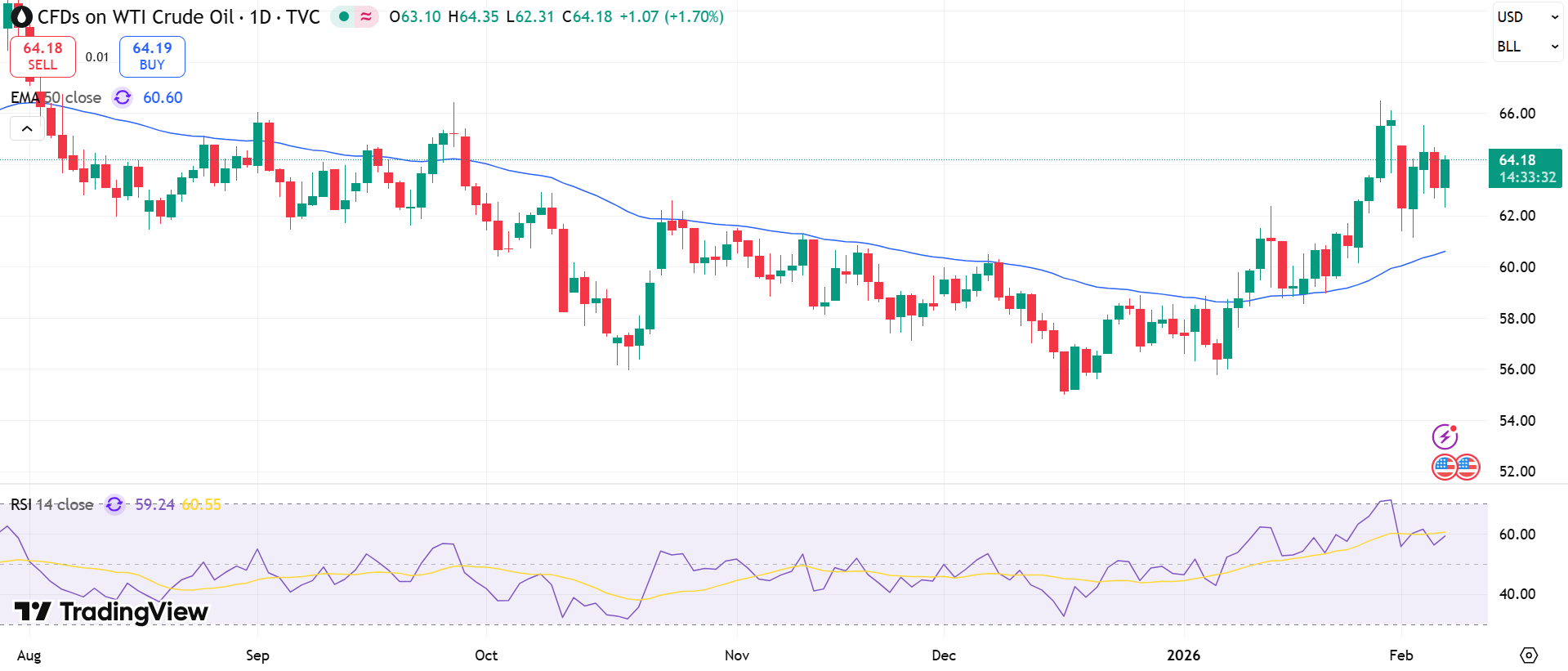
Brent crude — the world’s main oil benchmark — gained 25 cents to $67.80 a barrel, while U.S. West Texas Intermediate rose the same amount to $63.54. These small moves could not hide the bigger picture: both prices are now more than 3% below their six-month highs reached in late January.
Back then, markets were nervous after U.S. President Donald Trump threatened action against Iran. Fear of conflict made traders buy oil, expecting supply disruptions. That fear has cooled, and so have prices.
Why US–Iran talks matter
Washington and Tehran were scheduled to meet in Oman on Friday, but even before sitting down, they disagreed on what to discuss. Iran wants to talk only about its nuclear program, while the U.S. wants a broader conversation that also includes missiles, regional conflicts, and human rights.
Because of this gap, analysts say tensions remain high — and tension keeps oil prices from falling too fast. Daniel Hynes of ANZ warned that the risk of conflict is still hanging over the market like a storm cloud.
The reason the region matters so much is the Strait of Hormuz, a narrow waterway between Oman and Iran where about one-fifth of the world’s oil flows every day. If ships could not pass safely, global energy supplies would shake.
Why this chokepoint matters:
- Saudi Arabia, the UAE, Kuwait, and Iraq ship most of their oil through it.
- Iran also relies on it for exports.
- Even small disruptions can move global prices sharply.
If talks calm things down, traders expect prices to slide further because the “fear premium” in oil would disappear.
Supply picture turning softer
Beyond politics, the basic math of oil is shifting. Capital Economics argues that worry about war will slowly fade while supply keeps improving. They point especially to Kazakhstan, where oil production is recovering after earlier outages.
More supply with steady demand usually means lower prices — just like more apples at a market can push their price down. Their forecast suggests oil could drift toward $50 a barrel by the end of 2026 if trends continue.
At the same time, OPEC producers such as Saudi Arabia and the UAE are carefully watching prices, trying to balance income with market stability. Too high, and they risk killing demand; too low, and government budgets suffer.
For everyday readers, think of the oil market like traffic:
- Geopolitics is the weather — rain slows everything, sunshine speeds it up.
- Supply is the number of cars on the road.
- Demand is how many people need to travel.
Right now, the weather is getting clearer and more cars are coming onto the road, which is why prices are easing.
Bottom line
Oil’s first weekly decline in seven weeks reflects less fear, better supply, and uncertain diplomacy. The coming days — and what happens in Oman — will decide whether prices stabilize around $60 or begin a longer slide toward $50.
Sources & Methodology
Primary-source standard: Market-moving facts should link to original data releases, regulator notices, company filings or official project announcements whenever available. Secondary reporting is used for additional context, not as a substitute for original evidence.
Page last reviewed: