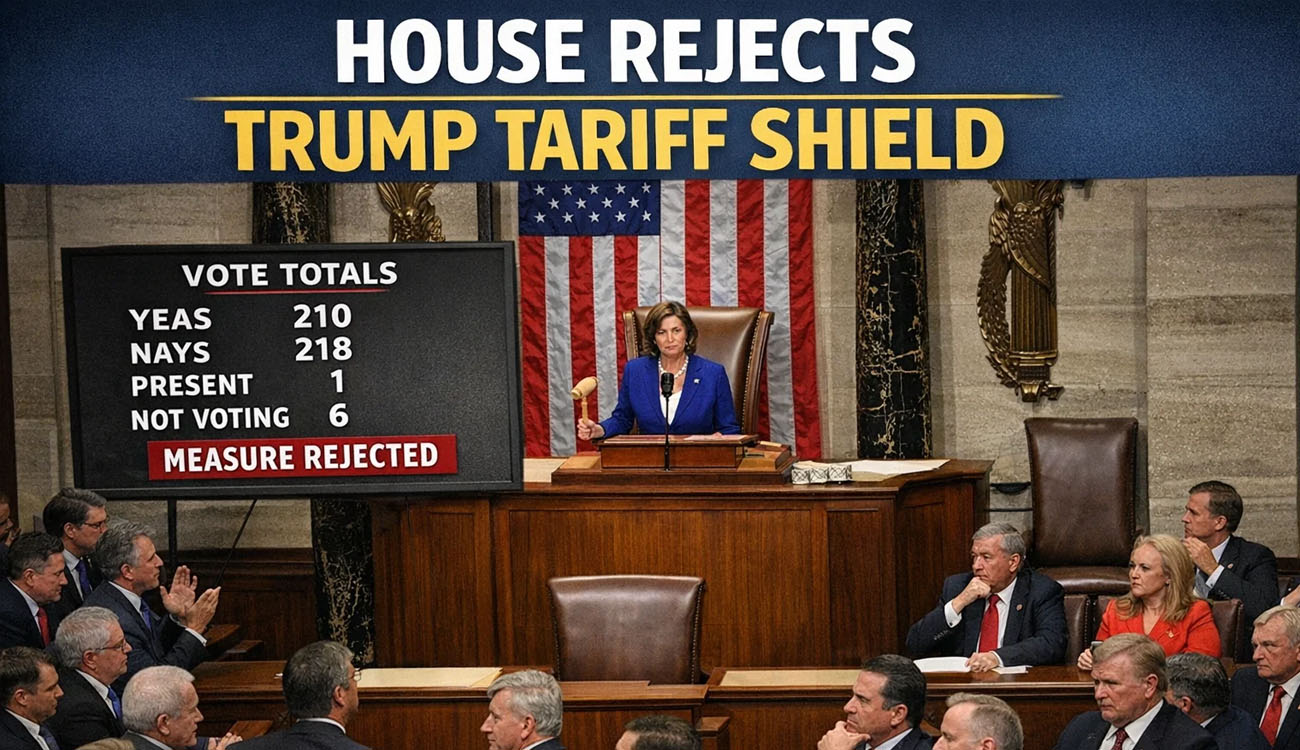
The U.S. House of Representatives delivered a sharp rebuke to Republican leaders on Tuesday when it refused to protect President Donald Trump’s tariffs from legal challenges. In a razor-thin 217–214 vote, lawmakers rejected a rule that would have blocked any effort to challenge the tariffs until July 31. The defeat exposes how fragile Republican control of the House has become and how divided the party is over Trump’s trade strategy.
Three Republican lawmakers broke ranks and voted with all 214 Democrats, sinking a procedural measure that was meant to open debate on three unrelated bills. Instead, it became a referendum on Trump’s tariffs — and Republican leadership lost. The result instantly raised the odds that Congress could move to roll back parts of the president’s trade policy.
For House Speaker Mike Johnson, the vote was a painful reminder of his slim majority. Republicans control the chamber by just 218–214, meaning Johnson can lose only one Republican vote when Democrats are united against him. On Tuesday, he lost three. That math leaves him with almost no room to maneuver on any future partisan fights involving tariffs, spending, or national security.
What Democrats plan next
With the ban defeated, Democrats are preparing to push forward quickly. Party leaders signaled they could force a vote as early as Wednesday to end Trump’s use of a “national security emergency” to justify punitive tariffs on Canada and other close trading partners. If successful, that move would strip the president of a key legal tool he has used to raise import taxes.
Democrats are also drafting separate resolutions aimed at Trump’s tariffs on Mexico and other countries, setting up a broader battle over who controls U.S. trade policy — Congress or the White House. Their argument is simple: higher tariffs raise prices for American families and hurt U.S. companies that rely on global supply chains.
Republicans counter that tariffs are needed to protect U.S. workers and push foreign governments to change their behavior. Tuesday’s vote suggests that even inside the GOP, that argument no longer commands full loyalty.
Courts and expired rules
Until now, House Republicans had used internal rules to block any challenge to Trump’s tariffs. Those protections have been in place since March of last year, with an extension that lasted through January. The rule expired after some Republicans said it was harming their districts by driving up costs for businesses and consumers. Tuesday’s vote confirmed that opposition inside the party has not gone away.
Adding to the uncertainty, Supreme Court Justice Ketanji Brown Jackson said the nation’s highest court will take more time to decide whether Trump’s tariffs are legal. That delay keeps the issue alive in both Congress and the courts, ensuring that trade policy will remain a political flashpoint well into 2025.
For now, the House is headed toward a messy, high-stakes showdown over tariffs — with the outcome far from certain.
Key numbers to know
- 217–214 — House vote rejecting the tariff ban
- 3 — Republicans who voted with Democrats
- July 31 — date the rejected ban would have lasted until
- 218–214 — Republicans’ narrow House majority
Sources & Methodology
Primary-source standard: Market-moving facts should link to original data releases, regulator notices, company filings or official project announcements whenever available. Secondary reporting is used for additional context, not as a substitute for original evidence.
Page last reviewed: