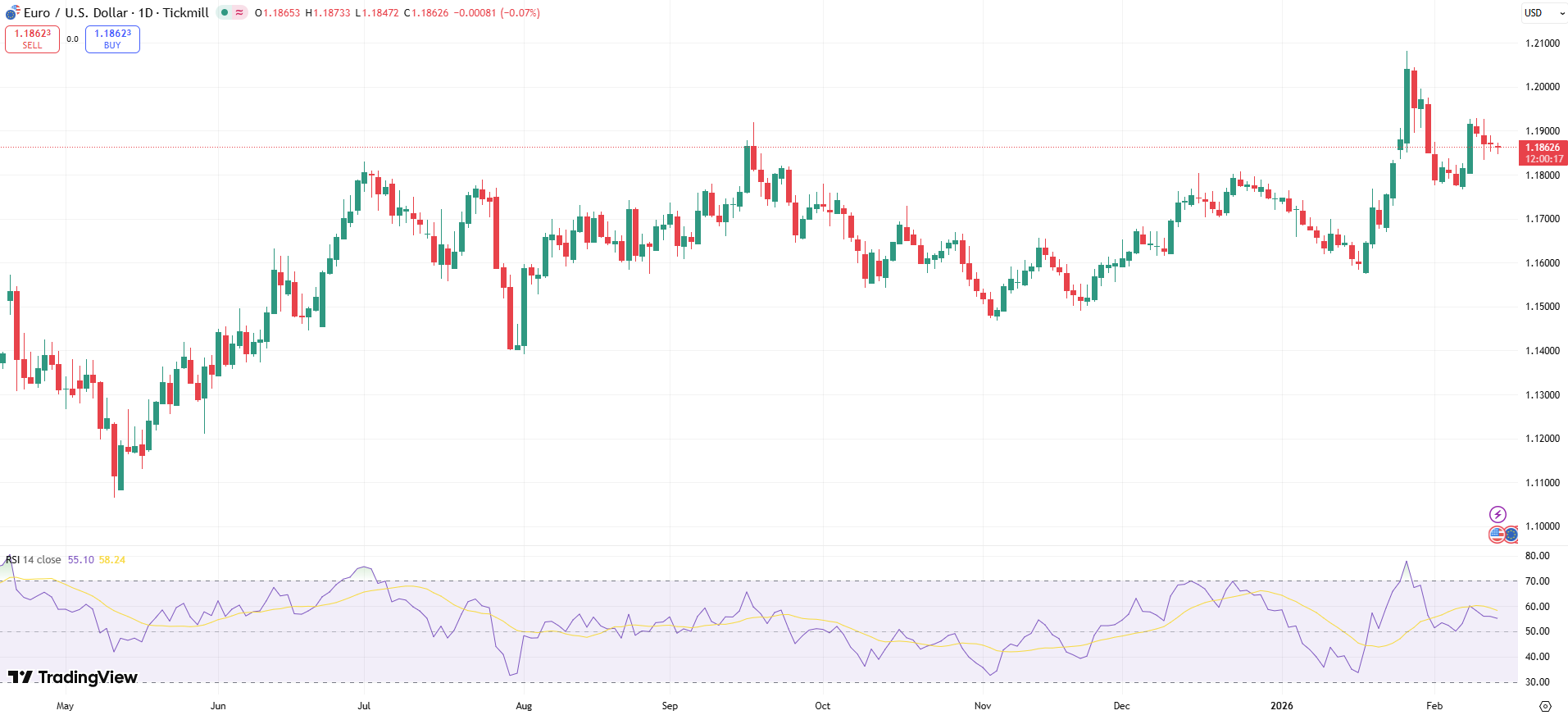
The EUR/USD currency pair is trading close to 1.1850 on Friday, marking its fourth straight day of losses. During European trading, the pair hovered around 1.1853 as investors stayed cautious ahead of key economic data from both the Eurozone and the United States.
The pressure comes from modest strength in the U.S. dollar and a careful market mood. When investors feel uncertain, they often buy the dollar because it is seen as a safer currency. That makes it harder for the euro to rise.
The U.S. Dollar Index, which measures the dollar against six major currencies, remains above 97.00, showing steady demand. At the same time, U.S. stock index futures are down about 0.2%, reflecting a slightly negative tone in global markets.
Technical Signals Show Weak Momentum
Short-term charts show that EUR/USD is losing strength. On the 4-hour chart, the pair trades at 1.1853. The 20-period Simple Moving Average (SMA) has turned lower and sits above the 50- and 100-period SMAs. Meanwhile, the 100- and 200-period SMAs are still rising gently, suggesting the longer trend has not fully turned negative.
The Relative Strength Index (RSI), a tool used to measure momentum, stands at 44. Since RSI readings below 50 often signal weakening buying pressure, this suggests the pair may struggle to climb quickly.
Important price levels:
- Recent low: 1.1590
- Recent high: 1.2025
- 50% retracement: 1.1808 (first support)
- 61.8% retracement: 1.1756 (deeper support)
- 100 SMA: 1.1854
- 20 SMA: 1.1888
If EUR/USD stays above 1.1854, it could try to rebound toward 1.1888. If it falls below 1.1808, further losses toward 1.1756 become more likely.
CPI Data Could Drive Next Move
Investors are waiting for two major data releases. First is the Eurozone’s second estimate of fourth-quarter GDP. Second, and more important, is the U.S. Consumer Price Index (CPI) report.
Economists expect U.S. annual inflation to slow to 2.5% in January from 2.7% in December. Core CPI, which excludes food and energy, is forecast to rise 0.3% month-over-month after increasing 0.2% previously.
In simple terms:
- If inflation is higher than expected, the dollar may strengthen.
- If inflation is lower, the dollar could weaken.
- A stronger dollar usually pushes EUR/USD lower.
There is also political news affecting sentiment. The Financial Times reported that U.S. President Donald Trump may roll back some tariffs on steel and aluminum. If confirmed, this could improve global market mood and reduce demand for the dollar as a safe haven.
For now, EUR/USD remains under pressure near 1.1850. The next clear move will likely depend on inflation numbers and whether the dollar keeps its strength going into the weekend.
Sources & Methodology
Primary-source standard: Market-moving facts should link to original data releases, regulator notices, company filings or official project announcements whenever available. Secondary reporting is used for additional context, not as a substitute for original evidence.
Page last reviewed: