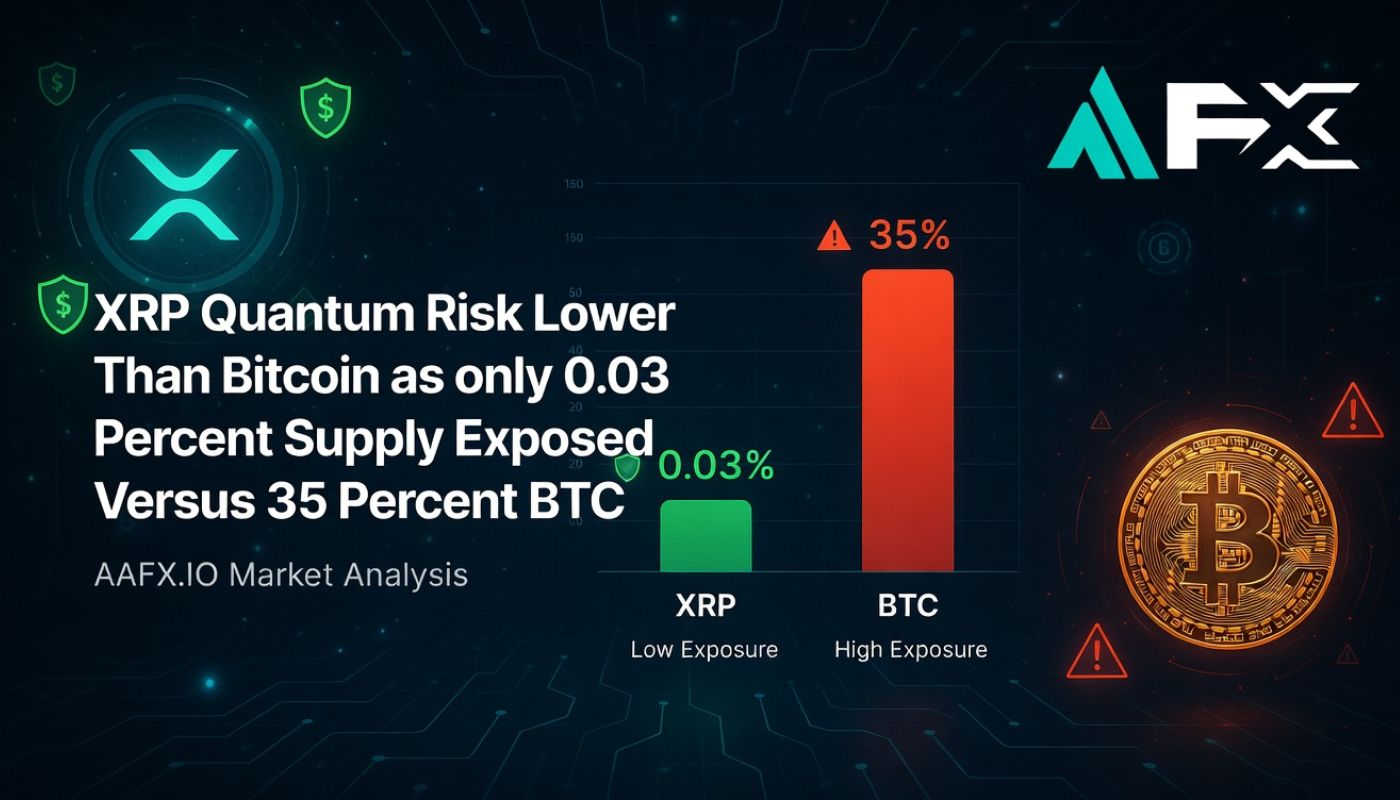
XRP may be structurally less exposed to future quantum computing threats than Bitcoin, according to recent expert analysis, with only a fraction of its supply currently vulnerable compared to a significantly larger share of BTC. The difference stems from how each network handles public keys, account design, and security features.
Why Quantum Computing Threatens Crypto Security
The quantum risk narrative centers on the possibility that advanced machines running Shor’s algorithm could reverse engineer private keys from exposed public keys. In most blockchain systems, a public key becomes visible when a user sends a transaction, potentially opening a theoretical attack vector.
This means vulnerability is not tied to wallet balances but to transaction history. Addresses that have never sent funds remain protected because their public keys are not revealed on chain.
XRP Ledger Design Limits Exposure
Recent analysis of the XRP Ledger shows that a large portion of XRP accounts remain inherently protected. Around 300000 accounts holding approximately 2.4 billion XRP have never initiated a transaction, meaning their public keys remain hidden.
At the same time, only a very small portion of the supply appears exposed due to past activity. Dormant accounts that previously transacted but have not updated their keys represent a minimal share of risk.
Key insights from the XRP ecosystem include:
• Around 2.4 billion XRP held in inactive receiving only accounts remain protected
• Only about 21 million XRP is considered exposed in dormant accounts
• This represents roughly 0.03 percent of circulating supply
• Built in key rotation allows users to update security without moving funds
The key rotation feature is particularly significant, as it enables users to change signing credentials without triggering a transaction, reducing exposure risk.
Additional Safeguards Strengthen XRP Position
Beyond key management, XRP includes structural features that further reduce risk. Time locked escrow functionality ensures that certain funds cannot be accessed until predefined conditions are met, adding a layer of logical protection independent of cryptography.
Experts note that while these features are not a complete solution to quantum threats, they provide practical safeguards that can be implemented today. However, inactive accounts remain a weak point if owners are unable to update their keys.
Bitcoin Faces Larger Structural Exposure
In contrast, Bitcoin’s design leaves a larger portion of its supply theoretically vulnerable. Early transaction formats exposed public keys directly, even without spending activity, creating a broader attack surface.
Estimates suggest that up to 6.9 million BTC, roughly 35 percent of circulating supply, could be exposed under a future quantum scenario. This includes long dormant holdings such as those attributed to early network participants.
Bitcoin holders also face a structural limitation. Unlike XRP, the network does not support native key rotation, requiring users to move funds to new addresses to maintain security. This process introduces a temporary exposure window during transaction processing.
Key differences in Bitcoin security dynamics include:
• Large share of early coins with exposed public keys
• No native key rotation mechanism
• Required fund transfers to upgrade security
• Temporary exposure during transaction confirmation windows
Market Implications and Future Outlook
While the quantum threat remains theoretical, the comparison highlights how blockchain design choices can influence long term security. XRP’s architecture appears better positioned to adapt in the near term, while Bitcoin may require protocol level upgrades to mitigate future risks.
Developers across the crypto ecosystem are already exploring quantum resistant cryptographic solutions. As the technology evolves, networks that combine flexibility with strong security primitives may gain a strategic advantage.
For investors, the key takeaway is not immediate risk but long term resilience. As quantum computing progresses, assets with adaptable security frameworks could see increased confidence, shaping future capital allocation in the digital asset market.