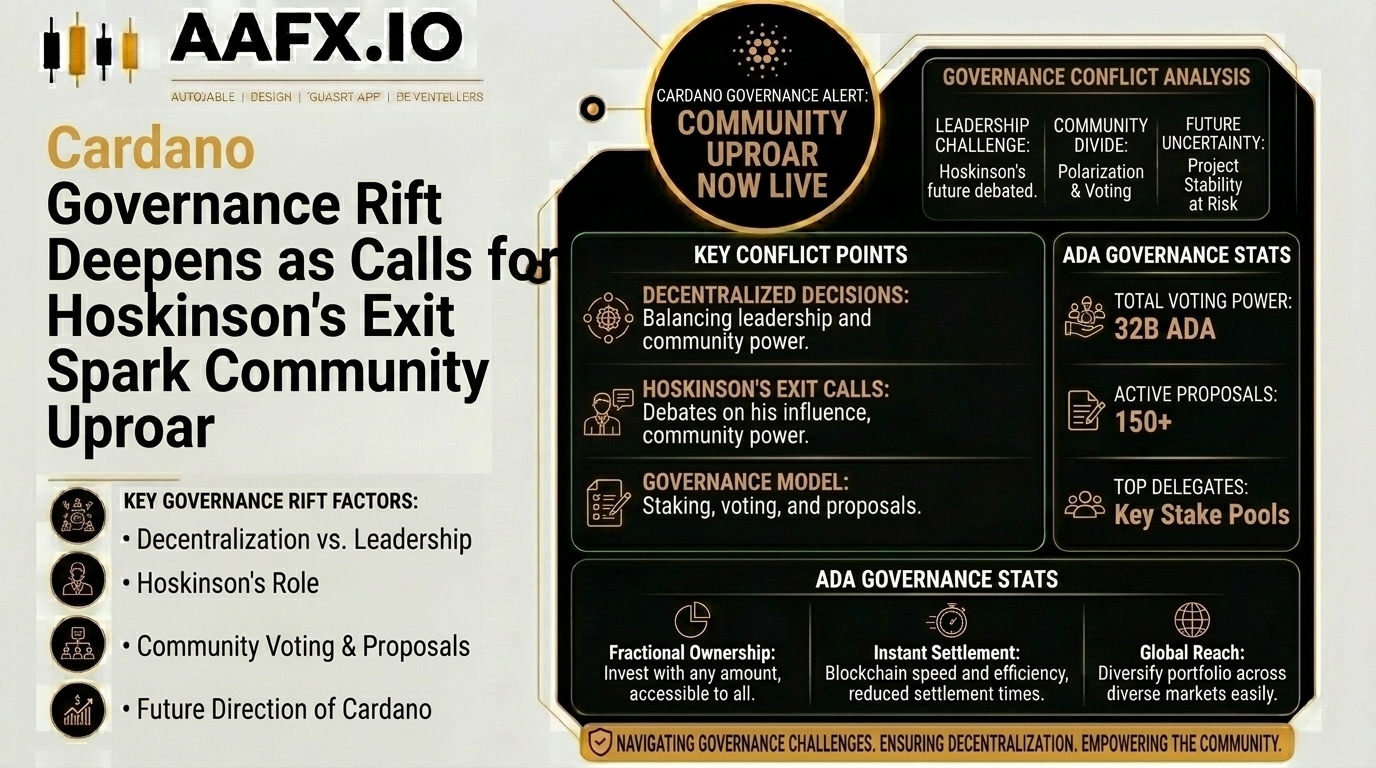
A heated governance dispute has erupted within the Cardano ecosystem after Justin Bons, founder and chief investment officer of Cyber Capital, publicly called for Charles Hoskinson to step aside from leadership influence over the network.
The comments, posted on X, quickly gained traction and exposed longstanding disagreements over decentralization, governance, and the future direction of Cardano.
At the center of the controversy is a proposal to move governance discussions to a moderated Discord server. Hoskinson has argued that a structured platform could improve the quality of debate and reduce the constant noise that often dominates discussions on social media.
The idea draws inspiration from Midnight, another project led by Hoskinson that relies heavily on moderated community engagement.
Bons, however, sees the proposal differently. He argues that concentrating governance conversations in a controlled environment risks suppressing dissenting opinions and granting disproportionate influence to factions aligned with Input Output Global (IOG), the company behind much of Cardano’s development.
Scalability Concerns Fuel Criticism
The governance debate has also reignited questions about Cardano’s technical progress. Bons claimed that the network’s maximum throughput remains around 23 transactions per second (TPS), a figure he says reflects missed scalability targets.
His criticism comes at a sensitive time for Cardano. The blockchain is preparing for significant upgrades, including the implementation of Ouroboros Leios, a protocol enhancement designed to dramatically improve transaction processing capacity and network efficiency.
Several factors are contributing to the current tension:
- Governance Transition: Cardano is entering its Voltaire era, giving the community greater control over decision-making.
- Scalability Questions: Critics continue to debate whether the network has delivered on its performance promises.
- Communication Challenges: Community members remain divided on whether governance should occur on open social platforms or within moderated channels.
For supporters of the Discord proposal, the change is a practical solution to growing governance complexity. They argue that meaningful discussions have become increasingly difficult on public platforms, where algorithm-driven engagement often rewards conflict rather than constructive debate.
Community Divisions Come Into Focus
The backlash against Bons was swift. Several prominent Cardano supporters accused him of spreading fear, uncertainty, and doubt while contributing little to the ecosystem itself. Others argued that outside figures should not dictate how ADA holders organize governance discussions.
Yet not all responses dismissed his concerns. Some community members acknowledged that decentralization principles require open debate and warned against creating structures that could inadvertently marginalize dissenting voices.
The dispute underscores a broader challenge facing Cardano and many blockchain networks: balancing efficient governance with the principles of decentralization.
As Cardano moves toward major funding decisions and technical upgrades, the debate surrounding Hoskinson and governance structures may prove to be more than a temporary social media controversy. It is becoming a defining test of how one of the cryptocurrency industry’s largest networks intends to govern itself in the years ahead.
Sources & Methodology
Primary-source standard: Market-moving facts should link to original data releases, regulator notices, company filings or official project announcements whenever available. Secondary reporting is used for additional context, not as a substitute for original evidence.
Page last reviewed: