

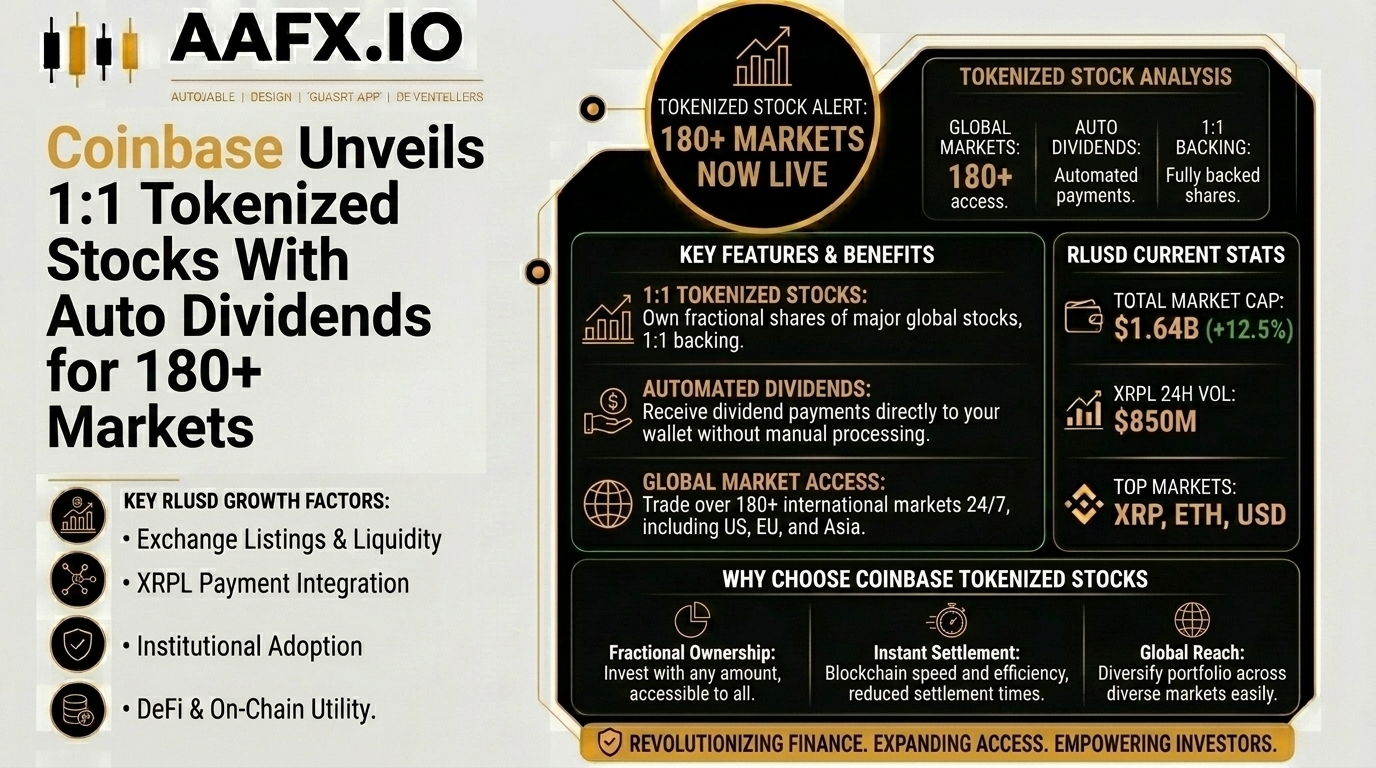
Coinbase plans to launch 1:1 backed tokenized U.S. stocks with automatic dividends and onchain settlement, expanding global access to American equities.
Coinbase Pushes Into Tokenized Equities
Coinbase is making one of its boldest moves beyond cryptocurrency by introducing tokenized U.S. stocks backed one-for-one by underlying shares. The new offering, announced by the exchange on Tuesday, promises genuine ownership of equities rather than synthetic exposure or derivative contracts.
The products will initially be available only to eligible users outside the United States, with no official launch date announced. Transactions and settlements will occur on Base, Coinbase’s Layer-2 blockchain network, enabling around-the-clock trading and nearly instant settlement.
Chief Executive Brian Armstrong described the initiative as a significant shift in how investors can access traditional financial markets.
“For the first time, these are real 1:1 backed tokenized stocks you can trust,” Armstrong said, emphasizing that investors would hold an actual ownership interest represented onchain.
Unlike earlier tokenized stock offerings, Coinbase says its platform will automatically process dividends, stock splits, and other corporate actions, reducing the operational complexity typically associated with cross-border investing.
Growing Race for Blockchain Stocks
Coinbase’s announcement intensifies competition in the rapidly expanding tokenized securities market. Several major players have already entered the sector:
- Kraken recently launched tokenized U.S. stocks in more than 180 countries through its xStocks platform.
- Robinhood is developing tokenized equity offerings for European investors.
- Gemini and Bybit have explored similar blockchain-based stock products.
- Traditional financial firms, including BlackRock, Franklin Templeton, JPMorgan, and Citi, have expanded their tokenization initiatives.
Industry forecasts suggest the opportunity is substantial. Citi has projected that tokenized securities could become a multi-trillion-dollar market before the end of the decade, as financial institutions increasingly embrace blockchain infrastructure.
The appeal is particularly strong among international investors. Accessing U.S. equities often requires navigating complex brokerage rules, local restrictions, and lengthy settlement periods. Tokenized stocks seek to eliminate many of these barriers by enabling continuous trading and digital ownership through blockchain networks.
Ownership Claims Face Scrutiny
Despite the excitement surrounding tokenized securities, questions remain regarding legal ownership rights and investor protections.
Historically, many tokenized stock products have functioned as IOUs or derivatives that merely track the value of an underlying asset. The gap between owning a digital token and possessing enforceable shareholder rights has been a persistent concern among regulators and institutional investors.
Coinbase argues its structure solves this issue by directly linking each token to a corresponding share and by automating corporate actions onchain. However, analysts say the true test will come when the company releases detailed legal documentation and custody arrangements.
The initiative also highlights Coinbase’s broader ambition to become a full-scale financial services platform rather than simply a cryptocurrency exchange. For now, U.S. investors remain excluded while regulators continue to examine the legal framework surrounding tokenized securities.
If successful, Coinbase’s model could accelerate the convergence of traditional finance and blockchain technology, opening a new chapter in global equity investing.
