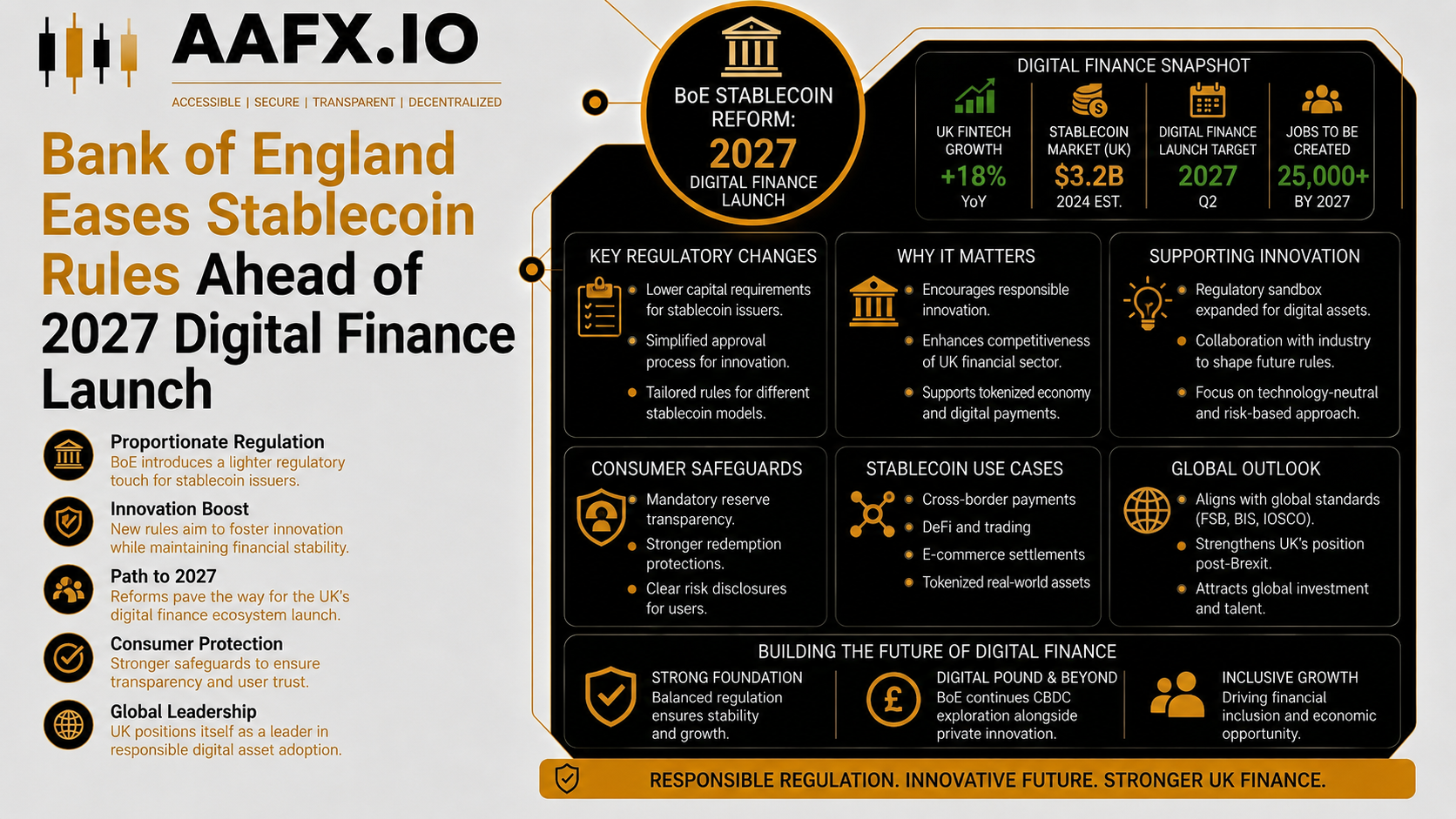
The Bank of England (BoE) has significantly revised its approach to stablecoin regulation, abandoning proposed restrictions on how much digital currency individuals and businesses can hold. Instead, the central bank has introduced a broader market-based framework that aims to balance financial stability with innovation, setting a temporary issuance cap of £40 billion, or roughly $50 billion, for any single systemic stablecoin.
The decision marks one of the most important regulatory shifts for the U.K.’s emerging digital asset sector. Industry participants had argued that the original limits would weaken the competitiveness of the country’s financial technology ecosystem and discourage investment in blockchain-powered payment systems.
By removing those restrictions, policymakers have signaled a more flexible approach as the nation prepares for a regulated stablecoin market expected to launch in 2027.
New Framework Replaces User Caps
Under the previous proposal, individuals would have been limited to holding £20,000 in stablecoins, while corporations faced a ceiling of £10 million. Critics argued these thresholds would make it difficult for stablecoins to function effectively as payment tools or settlement assets.
The revised framework removes those user-level restrictions entirely. Instead, the BoE will monitor overall issuance by imposing a temporary cap on the total supply of any single systemic stablecoin.
Key changes include:
- Elimination of retail stablecoin holding limits.
- Removal of corporate transaction caps.
- Introduction of a £40 billion issuance ceiling per systemic stablecoin.
- Greater flexibility for stablecoin issuers operating in the U.K.
Officials stated that the new structure is designed to encourage innovation while preventing excessive concentration risks within the financial system.
Reserve Rules Become More Flexible
The central bank also adjusted reserve management requirements, offering stablecoin issuers greater opportunities to generate income from their backing assets.
Previously, issuers were expected to maintain a larger share of reserves in non-interest-bearing deposits at the central bank. Under the updated rules, only 30% of reserves must remain in these deposits. The remaining 70% can be invested in short-term U.K. Treasury bills with maturities of less than six months.
This modification improves the economic viability of stablecoin businesses by allowing issuers to earn returns on reserve assets.
The framework permits:
- Investment of up to 70% of reserves in short-term government debt.
- Yield generation at the issuer level.
- Transaction-based customer rewards such as loyalty points and cashback incentives.
However, the BoE continues to prohibit direct interest payments or dividend distributions to users simply for holding stablecoins.
Industry Gains Major Regulatory Win
The policy reversal follows extensive feedback from lawmakers, financial institutions, and digital asset companies. A parliamentary committee recently warned that strict holding limits could undermine the business models of regulated stablecoin providers and reduce the U.K.’s competitiveness in global financial markets.
By adopting a more accommodating framework, the Bank of England has strengthened the prospects for blockchain-based payments, digital settlements, and tokenized financial services. Officials emphasized that the £40 billion issuance guardrail is temporary and could be gradually reduced or removed as the market matures.
With final consultations continuing through September, the updated rules establish a clearer pathway for regulated stablecoins to enter the U.K. financial system in 2027. The move positions Britain as a serious contender in the global race to build compliant digital asset infrastructure while maintaining safeguards for financial stability.
Sources & Methodology
Primary-source standard: Market-moving facts should link to original data releases, regulator notices, company filings or official project announcements whenever available. Secondary reporting is used for additional context, not as a substitute for original evidence.
Page last reviewed: