

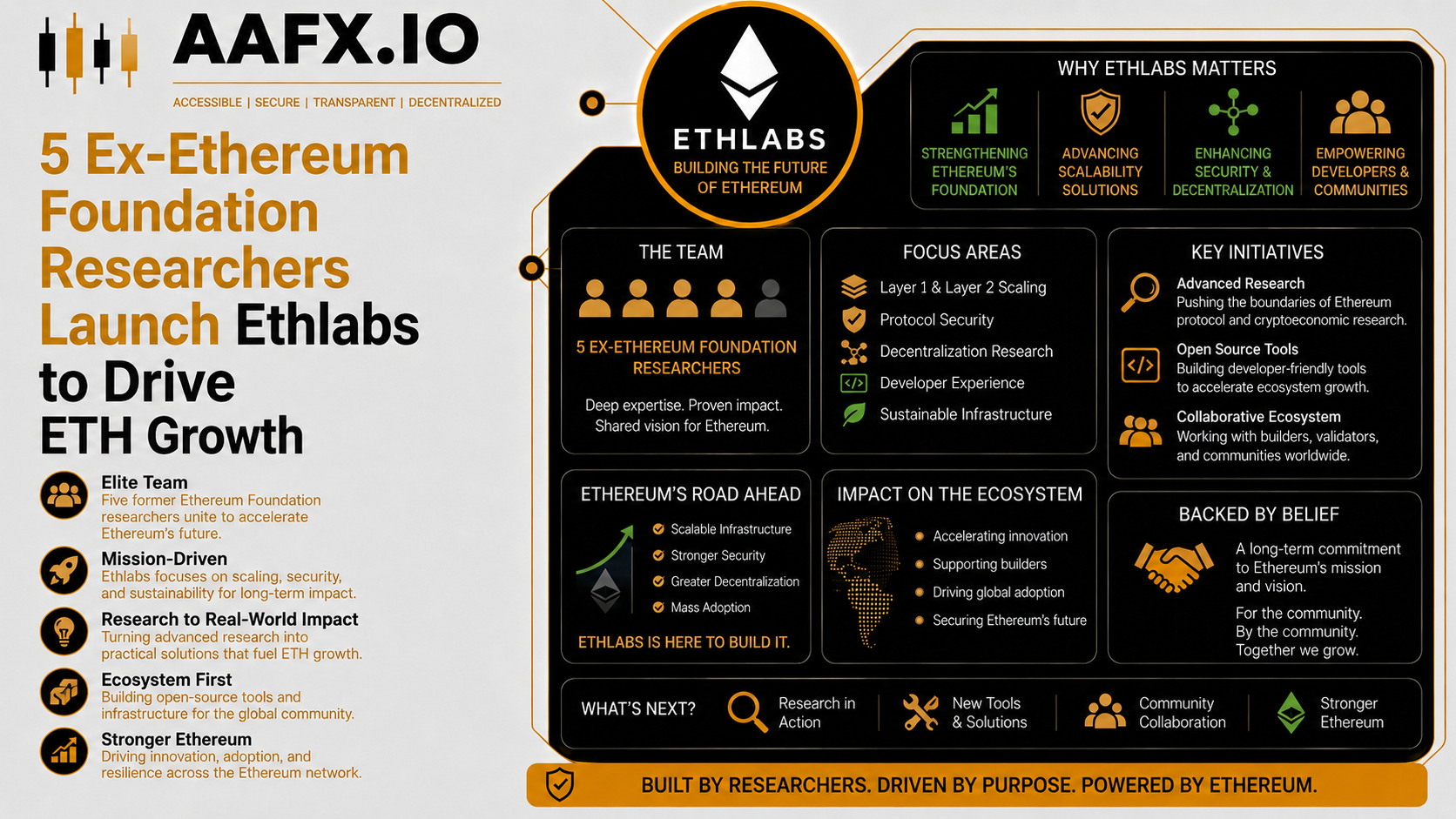
Ethereum’s research ecosystem is entering a significant new phase as five former Ethereum Foundation researchers have launched Ethlabs, an independent nonprofit focused on advancing Ethereum’s core infrastructure.
The initiative is backed by prominent industry players, including Consensys co-founder Joseph Lubin, along with major Ether treasury firms Bitmain Immersion Technologies and SharpLink Gaming.
Announced on June 22, Ethlabs aims to strengthen Ethereum’s readiness for large-scale institutional adoption. The launch reflects a broader trend in which blockchain research is increasingly being funded through independent organizations rather than relying solely on a central foundation.
While the amount raised remains undisclosed, the caliber of supporters highlights growing institutional confidence in Ethereum’s long-term future. More than 50 ecosystem partners have reportedly pledged support, demonstrating widespread industry interest in expanding Ethereum’s technical capabilities.
Independent Research Gains Momentum
Ethlabs was founded by former Ethereum Foundation researchers Ansgar Dietrichs, Barnabé Monnot, Caspar Schwarz-Schilling, Josh Rudolf, and Julian Ma. Collectively, the team has contributed to some of Ethereum’s most critical technical developments.
Their expertise spans several foundational areas:
- Ethereum scaling and throughput improvements
- Transaction finality and network security
- Data availability architecture
- Ethereum Virtual Machine (EVM) development
- Protocol economics and monetary design
These components play a crucial role in determining how Ethereum processes transactions, maintains security, and supports decentralized applications.
According to Executive Director Ansgar Dietrichs, Ethereum is uniquely positioned to serve as the foundational infrastructure layer for the expanding digital economy. Ethlabs was established to help accelerate that vision through focused, independent research and development.

The launch also comes during a period of organizational transition for the Ethereum Foundation. Several leadership changes have occurred over the past year, prompting discussions about how Ethereum’s research efforts should be structured and funded moving forward.
Building Ethereum for Institutions
Ethlabs intends to focus on technical challenges that could hinder large-scale institutional participation in blockchain networks.
Its early research priorities include:
- Faster transaction settlement
- Improved cross-chain interoperability
- Greater Ethereum mainnet capacity
- Native asset issuance frameworks
- Enhanced ETH monetary infrastructure
These objectives align closely with the rapid growth of stablecoins, tokenized real-world assets, decentralized finance applications, and AI-powered blockchain transactions. As institutional participation expands, demand for faster and more scalable infrastructure is expected to increase significantly.
Supporters argue that Ethereum must dramatically expand research investment to meet future demand. Treasury-focused firms such as Bitmine and SharpLink view infrastructure improvements as essential for supporting broader adoption and strengthening Ethereum’s role as a global settlement layer.
A key feature of Ethlabs is its governance model. Funding decisions will be managed through an independent grants administrator, while research priorities will remain under the control of Ethlabs leadership. This separation is designed to protect scientific independence despite substantial financial backing from organizations with significant ETH exposure.
The emergence of Ethlabs signals a broader evolution in Ethereum’s governance landscape. Rather than relying exclusively on a single institution, the network’s future development is increasingly being supported by a diverse collection of independent organizations.
If successful, Ethlabs could establish a new framework for funding open-source blockchain research while preserving transparency, neutrality, and technical integrity.
