Uniswap’s UNI burn proposal gains 74% support as $5M daily fees and Robinhood Chain’s $1B volume raise hopes for stronger token scarcity.
Uniswap Community Backs UNI Burn
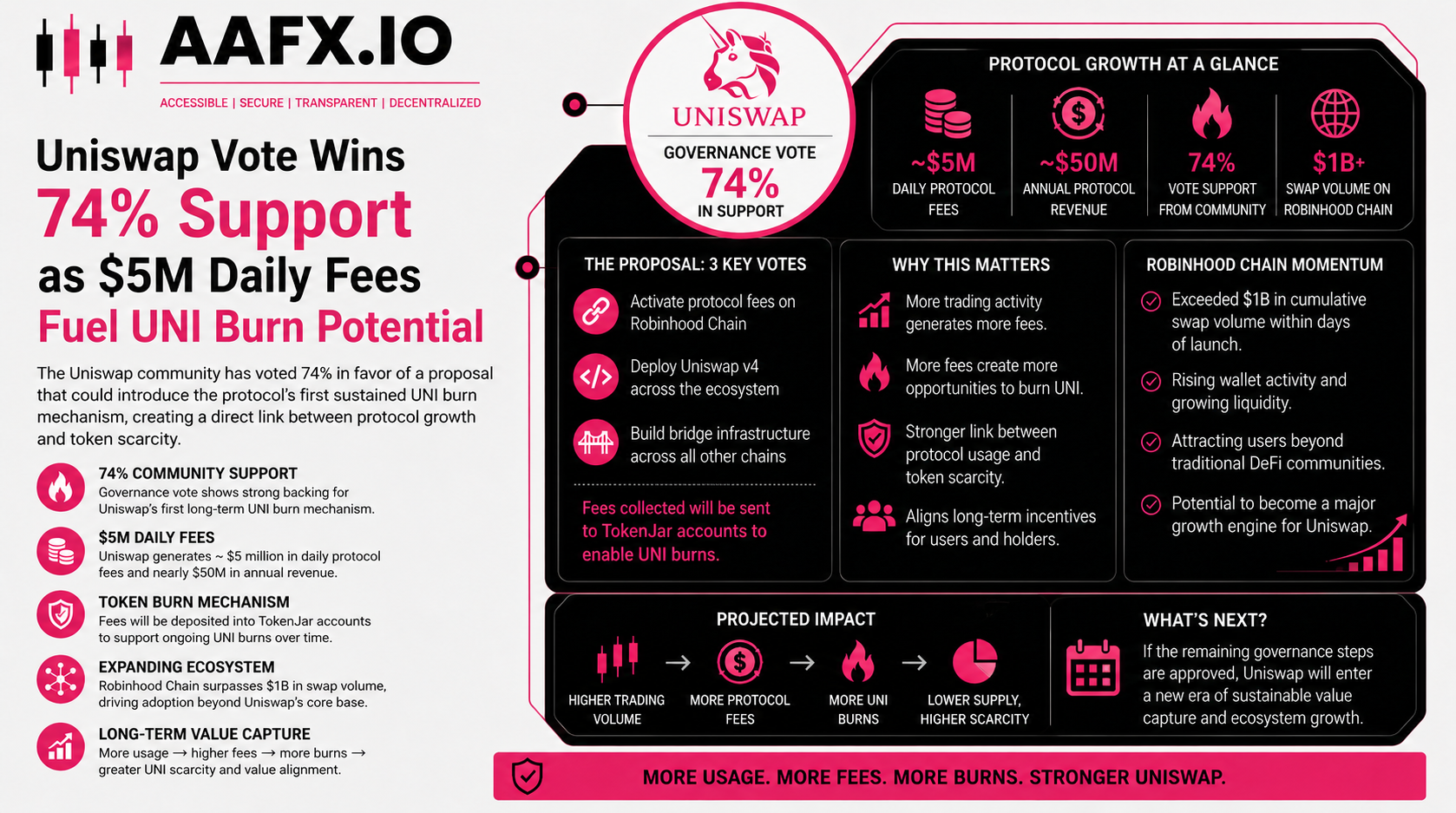
Uniswap is moving closer to introducing a long-discussed token burn mechanism after a community governance proposal secured 74% support during voting. The initiative represents a significant step in the evolution of the decentralized exchange, potentially creating a direct relationship between platform activity and UNI token scarcity.
The proposal consists of three governance measures designed to expand Uniswap’s infrastructure and improve value capture within the ecosystem. These include activating protocol fees on Robinhood Chain, deploying Uniswap v4 technology, and establishing bridge infrastructure across additional blockchain networks.
If approved through the governance process, protocol-generated fees would be directed into TokenJar accounts, creating the foundation for a sustainable UNI burn framework. While token burns are common across the cryptocurrency sector, this would mark Uniswap’s first long-term mechanism tied directly to platform usage and revenue generation.
For investors and community members, the proposal signals a shift toward rewarding participation through increased token scarcity rather than relying solely on market sentiment.
$5M Daily Fees Strengthen Outlook
The timing of the proposal coincides with strong financial performance across the Uniswap ecosystem. According to DeFi analytics data, the protocol currently generates approximately $5 million in daily fees, making it one of the largest revenue-producing decentralized finance platforms.
Annual protocol revenue is estimated at nearly $50 million, highlighting the scale of economic activity flowing through Uniswap’s infrastructure. If the burn mechanism becomes operational, a portion of this value could contribute to reducing UNI’s circulating supply over time.
Key figures supporting the proposal include:
- Approximately $5 million in daily protocol fees
- Nearly $50 million in annual protocol revenue
- 74% community support recorded during voting
- More than $1 billion in swap volume on Robinhood Chain shortly after launch
Despite these impressive numbers, analysts note that the projected burn rate would remain relatively small compared with UNI’s total token supply. Nevertheless, the proposal introduces an important structural change by linking protocol success directly to token economics.
Robinhood Chain Drives Expansion
A major factor influencing the proposal’s long-term impact is user adoption. Governance approval alone will not guarantee meaningful token scarcity. Instead, sustained transaction growth and ecosystem participation will determine whether the burn mechanism creates lasting value.
Robinhood Chain has emerged as an early indicator of that potential. The network recently exceeded $1 billion in cumulative swap volume within days of launch, demonstrating strong initial demand for decentralized trading services.
The rapid growth suggests Uniswap is successfully expanding beyond its traditional user base. Increased wallet activity, growing transaction counts, and rising liquidity levels indicate broader engagement across the ecosystem.
Looking ahead, continued expansion on Robinhood Chain and other supported networks could strengthen fee generation and reinforce the proposed burn model. If adoption remains strong, Uniswap may establish a more sustainable framework where growing protocol usage steadily contributes to UNI scarcity, creating a closer connection between platform performance and token value.
Sources & Methodology
Primary-source standard: Market-moving facts should link to original data releases, regulator notices, company filings or official project announcements whenever available. Secondary reporting is used for additional context, not as a substitute for original evidence.
Page last reviewed: