
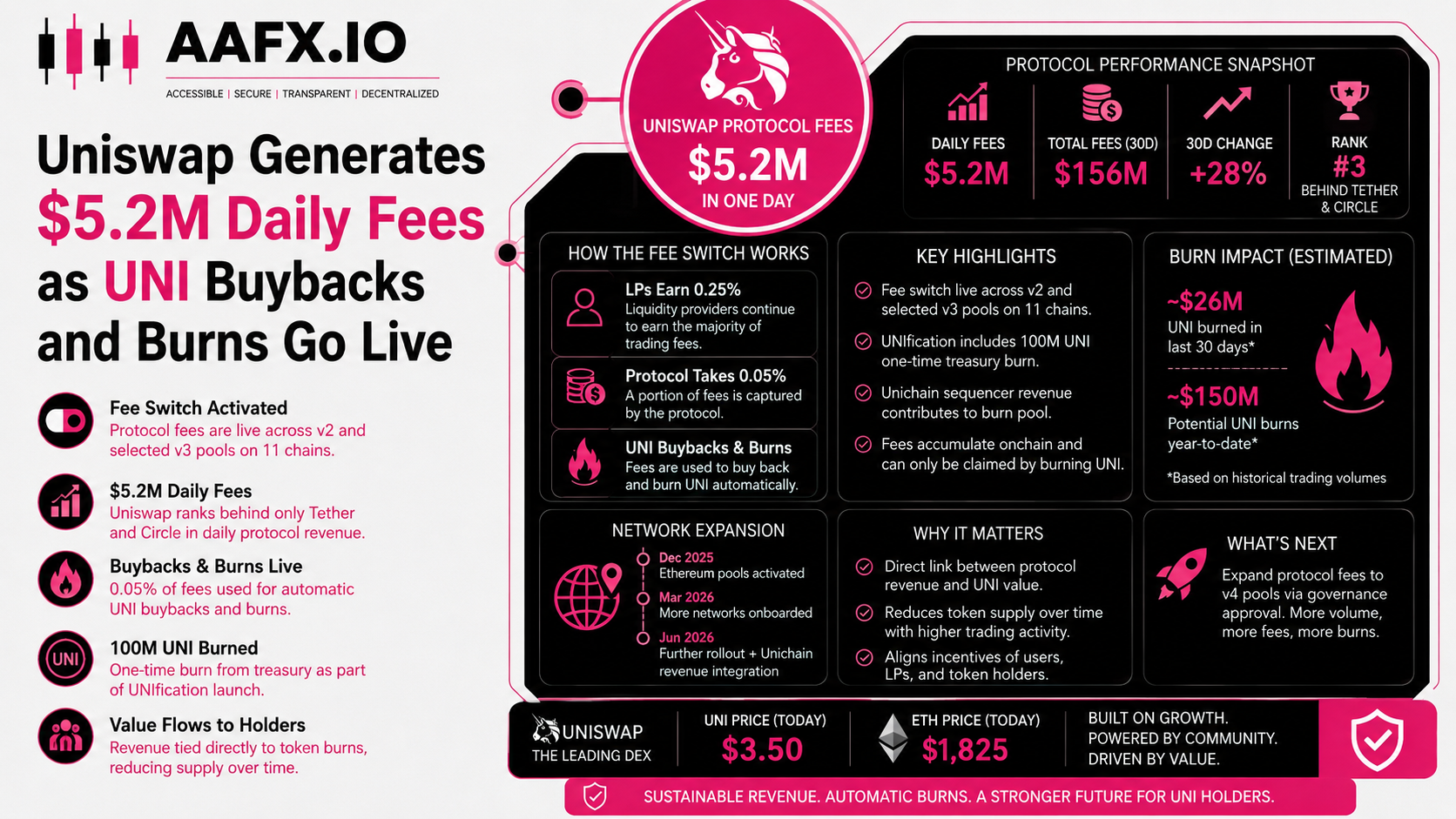
Uniswap activates UNI buybacks and burns as $5.2M daily protocol fees go live, creating a new value model that could reshape UNI token economics.
Uniswap Fee Switch Starts Paying Off
Uniswap has officially activated its long-awaited fee switch, introducing a mechanism that directly links protocol revenue to UNI token buybacks and burns. The development marks one of the most significant changes in the decentralized exchange’s history, transforming how value generated by the protocol is distributed.
According to Uniswap founder Hayden Adams, the platform is currently producing approximately $5.2 million in daily fees. That places Uniswap among the highest revenue-generating crypto protocols, trailing only stablecoin giants Tether and Circle. The milestone reinforces Uniswap’s position as the leading decentralized exchange by fee generation despite increasing competition across decentralized finance (DeFi).
Unlike previous governance discussions that debated how protocol revenue should be used, the new system operates automatically. Fees accumulate on-chain and can only be claimed through UNI token burns. As a result, protocol growth now has a direct impact on token supply reduction, creating a measurable economic link between platform activity and UNI value.
UNI Burns Create New Economics
The fee switch affects both liquidity providers and UNI holders. Across Uniswap v2 and selected v3 pools operating on 11 blockchain networks, liquidity providers continue earning the majority of trading fees while the protocol retains a small percentage dedicated to token buybacks and burns.
Key features of the new framework include:
- Liquidity providers receive 0.25% of trading fees.
- The protocol captures 0.05% for UNI buybacks and burns.
- A one-time burn of 100 million UNI was completed from treasury holdings.
- Revenue from Unichain sequencing activities also contributes to the burn mechanism.
The initiative, known as UNIFication, was implemented gradually. Ethereum-based pools were activated first in late 2025, followed by deployments across additional networks during 2026. This phased rollout allowed the protocol to test and refine the model before wider adoption.
Governance estimates highlight the potential impact. Based on historical trading volumes, approximately $26 million worth of UNI could have been burned during a recent 30-day period. On an annualized basis, burn activity could approach $150 million if trading conditions remain consistent.
Growth Depends on Trading Volume
While the new burn mechanism strengthens UNI’s value proposition, its effectiveness remains tied to transaction activity. Higher trading volumes generate larger protocol fees, accelerating buybacks and reducing token supply. Conversely, weaker market participation would lower fee generation and slow the pace of burns.
The next major objective for the Uniswap community is extending protocol fees to v4 liquidity pools through governance approval. Success would broaden the fee-capture model and potentially increase revenue available for token burns.
The broader significance extends beyond Uniswap itself. Investors increasingly favor blockchain infrastructure projects capable of generating sustainable cash flows rather than relying solely on speculative demand. Uniswap’s new model demonstrates how decentralized protocols can convert platform usage into tangible economic value.
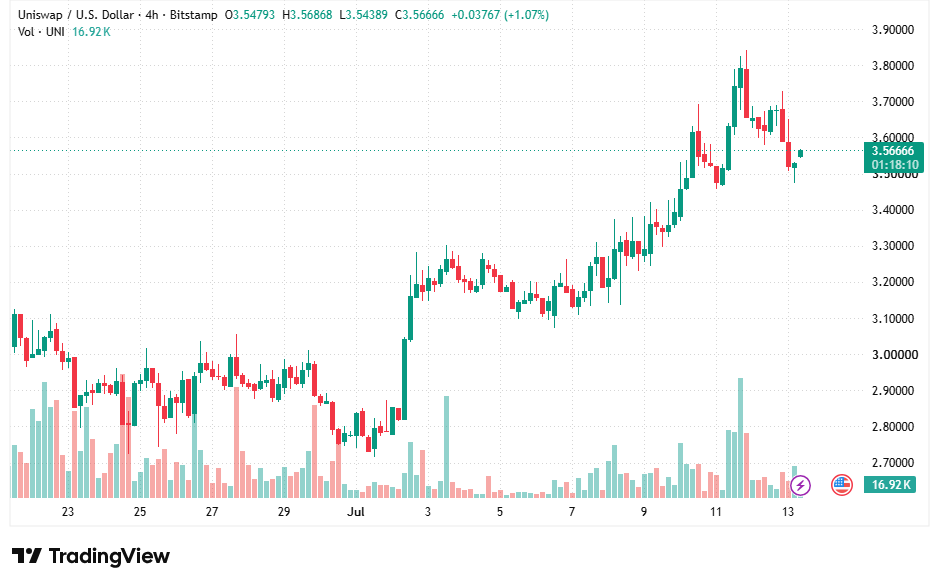
With UNI trading near $3.50 and Ethereum activity continuing to drive a significant share of decentralized exchange volume, market participants now have a concrete metric to monitor. If Uniswap consistently maintains more than $5 million in daily fees, investors may begin reassessing whether current UNI valuations fully reflect the protocol’s growing revenue-generating power.
