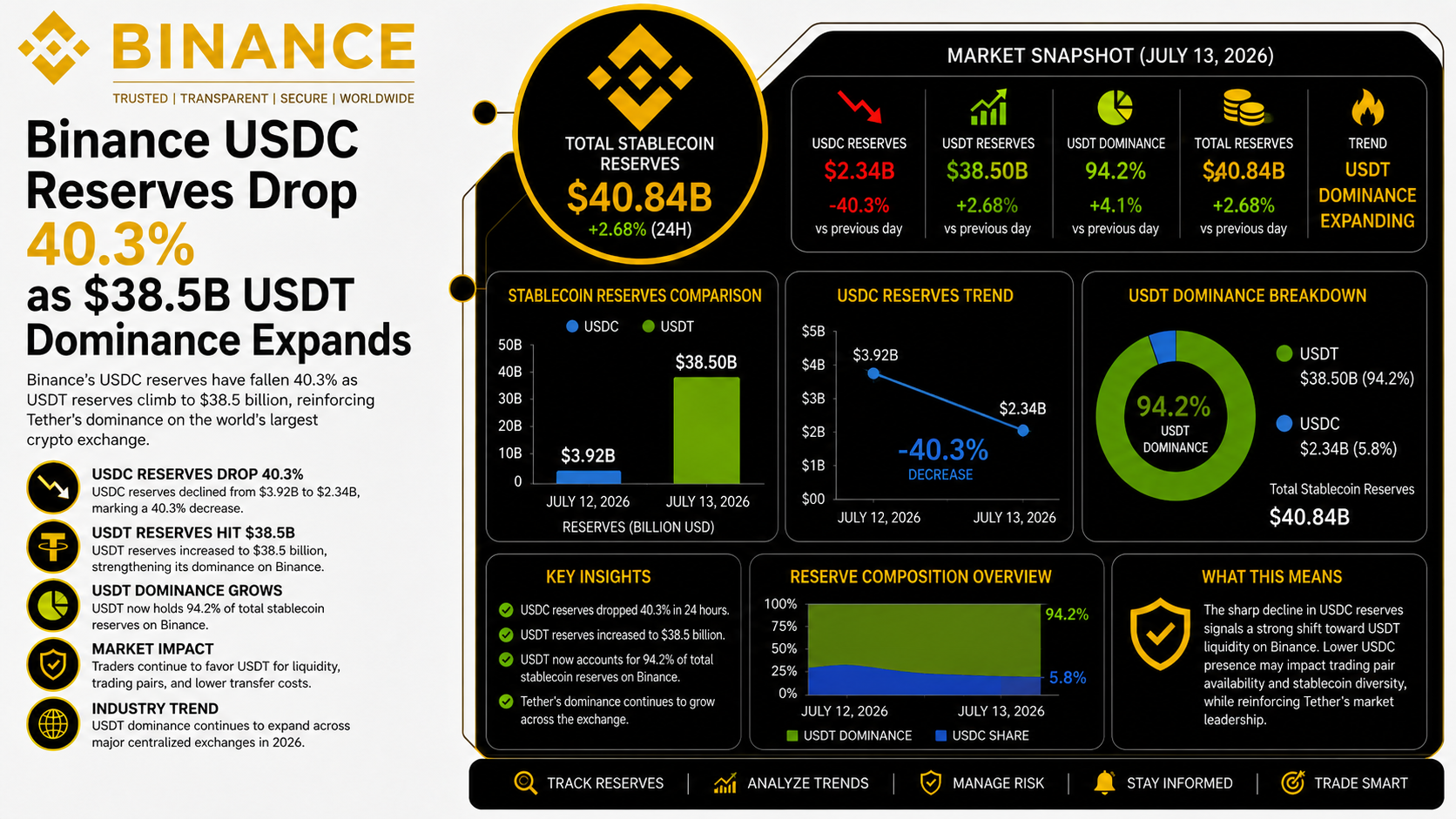
Binance’s USDC reserves fell 40.3% while USDT held at $38.5B. Explore how shifting stablecoin liquidity could influence crypto market growth.
Binance’s Stablecoin Balance Shifts
Binance remains the largest hub for stablecoin liquidity in the cryptocurrency market, but recent reserve data highlights a notable change in how users are allocating capital. USD Coin (USDC) reserves on the exchange have fallen sharply, declining 40.3% from approximately $7.7 billion to $4.6 billion. The drop effectively erased much of the growth recorded during the first months of 2026.
At the same time, Tether’s USDT reserves have remained remarkably stable at around $38.5 billion. This has widened the reserve gap between the two leading stablecoins to nearly $33.9 billion, reinforcing USDT’s position as the dominant asset used for trading and settlement activity on Binance.
The divergence does not necessarily point to weakening liquidity conditions. Instead, it suggests a growing user preference for holding USDT on exchanges. Binance continues to maintain one of the deepest liquidity pools in the digital asset sector, providing traders and institutions with substantial capital availability.
Several key figures illustrate Binance’s continued market strength:
- Binance controls roughly $53 billion in stablecoin reserves.
- The exchange accounts for approximately 57% of the $93 billion held across major exchange stablecoin reserves.
- Since early 2025, exchange stablecoin reserves have increased by 61%, adding nearly $35 billion in value.
If current trends continue, USDT could further strengthen its role as Binance’s primary trading currency, while USDC may face increasing challenges in maintaining its relative influence within exchange ecosystems.
Stablecoin Ownership Is Broadening
Beyond exchange reserves, a separate trend is emerging across the broader stablecoin market. Ownership of both USDT and USDC is becoming more distributed rather than concentrated among a small group of large holders.
During the last three months, the top 100 USDT wallets reduced their share of total supply by 0.6%. The shift was even more pronounced for USDC, where the largest wallets reduced their share by 4.7%.
This redistribution suggests that stablecoin liquidity is increasingly flowing into a wider network of participants, including:
- Institutional investors
- Crypto exchanges
- Decentralized finance protocols
- Retail market participants
A broader ownership structure can strengthen market stability because liquidity becomes less dependent on the decisions of a handful of large investors. As institutional adoption expands globally, diversified capital distribution may improve the resilience of digital asset markets during periods of volatility.
What This Means for the Next Crypto Rally
The crypto market now faces a critical question: can abundant stablecoin liquidity translate into stronger asset demand?
Total stablecoin supply remains near $312 billion, providing a substantial pool of capital that could enter risk assets. However, market participation metrics indicate that much of this liquidity remains inactive. Exchange balances, ETF flows, and broader risk-on activity continue to send mixed signals.
For a sustained market advance to develop, liquidity alone is not enough. Growth in active wallet addresses, new user adoption, transaction volume, and trading activity must accompany the available capital.
The current environment reflects a market with significant financial resources waiting on the sidelines. While the foundation for future expansion appears strong, the next major rally will likely depend less on the amount of stablecoin liquidity available and more on investors’ willingness to deploy it. Until participation accelerates, billions of dollars in stablecoin reserves may remain positioned as potential fuel rather than active market momentum.
Sources & Methodology
Primary-source standard: Market-moving facts should link to original data releases, regulator notices, company filings or official project announcements whenever available. Secondary reporting is used for additional context, not as a substitute for original evidence.
Page last reviewed: