

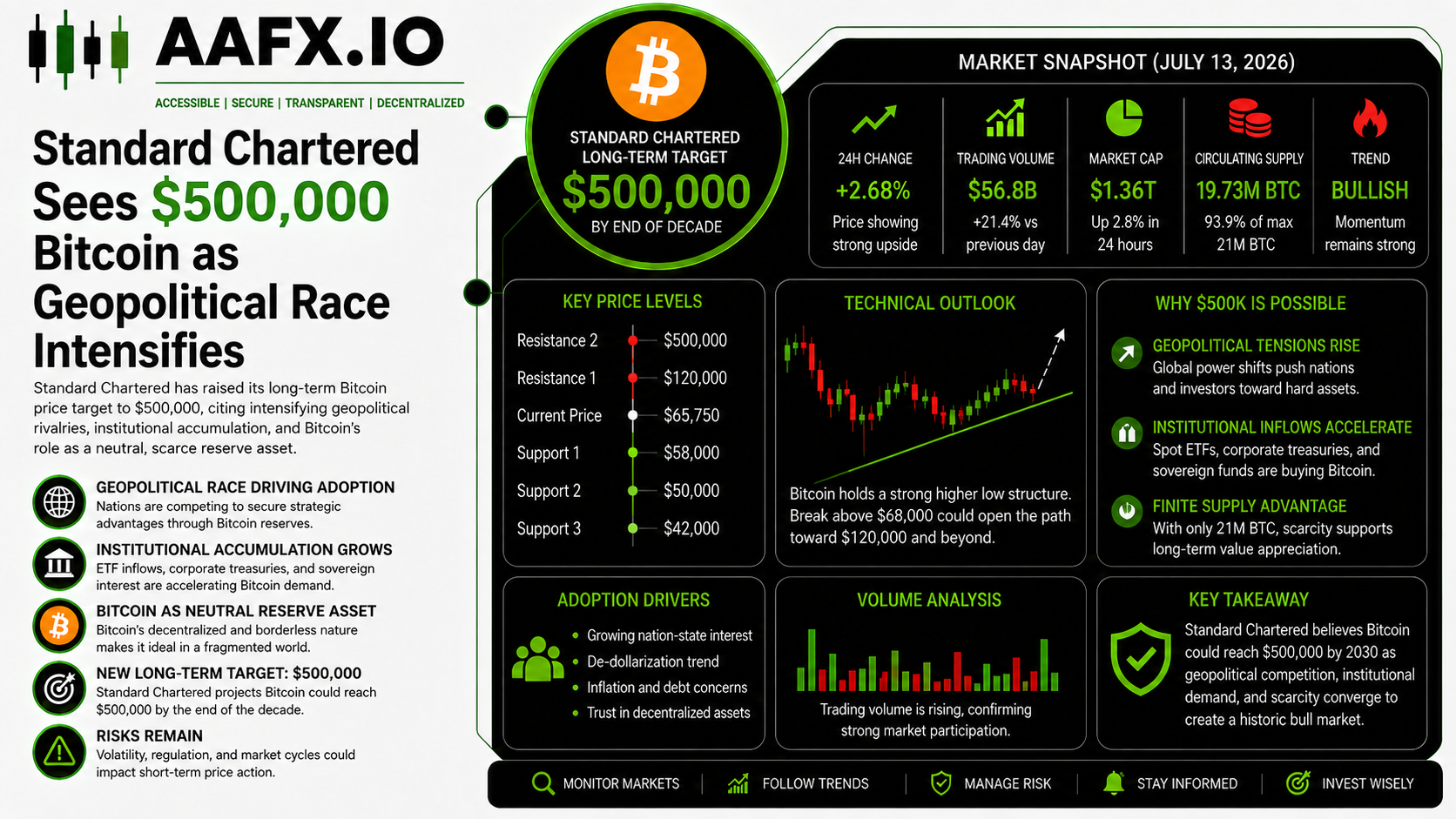
Standard Chartered maintains its $500,000 Bitcoin forecast, citing geopolitics, institutional adoption, ETFs, and sovereign interest as key drivers.
Bitcoin’s New Strategic Narrative
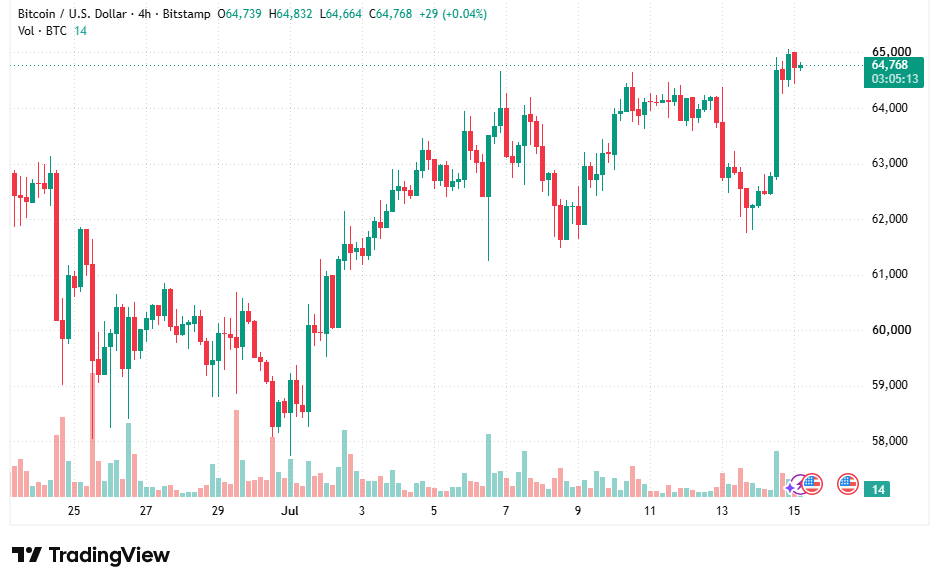
Standard Chartered is reaffirming one of the most ambitious forecasts in the digital asset market, maintaining its projection that Bitcoin could reach $500,000 before President Donald Trump leaves office. While Bitcoin currently trades near $64,000, significantly below its record high of $126,198 reached in October 2025, the bank believes the long-term investment case remains firmly intact.
What has changed is not the target itself, but the reasoning behind it. Earlier Bitcoin forecasts were largely tied to traditional market factors such as supply cycles, investor sentiment, and macroeconomic conditions. Today, Standard Chartered argues that Bitcoin’s future is increasingly linked to geopolitics, national economic strategy, and global competition for financial influence.
This shift reflects a broader transformation occurring across the digital asset industry. Bitcoin is no longer viewed solely as a speculative investment. Instead, major financial institutions and policymakers are beginning to assess it as a strategic asset with potential implications for national competitiveness and financial infrastructure.
Geopolitics Reshapes Bitcoin Demand
A key component of Standard Chartered’s updated thesis centers on the growing intersection between cryptocurrency and government policy. The bank believes that political decisions, regulatory frameworks, and sovereign participation will play a greater role in determining Bitcoin’s long-term value than short-term market cycles.
The debate gained momentum after President Trump emphasized the importance of maintaining U.S. leadership in Bitcoin and digital assets. By framing cryptocurrency as a strategic issue rather than a niche financial technology, policymakers have expanded the discussion beyond investment markets.
Several developments continue supporting this view:
- Growth of spot Bitcoin exchange-traded funds (ETFs)
- Increased institutional participation in digital assets
- Expanding regulatory clarity in major economies
- Rising government engagement with blockchain technologies
- Limited Bitcoin supply capped at 21 million coins
At the same time, China continues to restrict cryptocurrency trading and mining activities while advancing its central bank digital currency initiatives. This contrast has fueled arguments that decentralized digital assets could become part of a broader competition over future financial systems.
Why the $500K Forecast Remains
Despite missing its previous target of $200,000 by the end of 2025, Standard Chartered has not abandoned its long-term outlook. Instead, the bank argues that the structural foundations supporting Bitcoin have strengthened over time.
According to the bank, sustained institutional capital inflows, increasing sovereign interest, and clearer regulatory frameworks continue to create conditions for substantial long-term growth. These factors are viewed as more durable than the speculative trading activity that dominated earlier cryptocurrency cycles.
Analysts remain divided on whether Bitcoin can ultimately reach $500,000. However, the discussion increasingly extends beyond price charts and market sentiment. Investors are now evaluating Bitcoin through a framework traditionally reserved for reserve assets, strategic commodities, and critical financial infrastructure.
As governments establish rules governing stablecoins, digital asset markets, and blockchain innovation, Bitcoin’s valuation is becoming more closely tied to public policy decisions. Standard Chartered’s forecast reflects this evolution, suggesting that the cryptocurrency’s future may depend as much on geopolitical strategy as on market dynamics.
