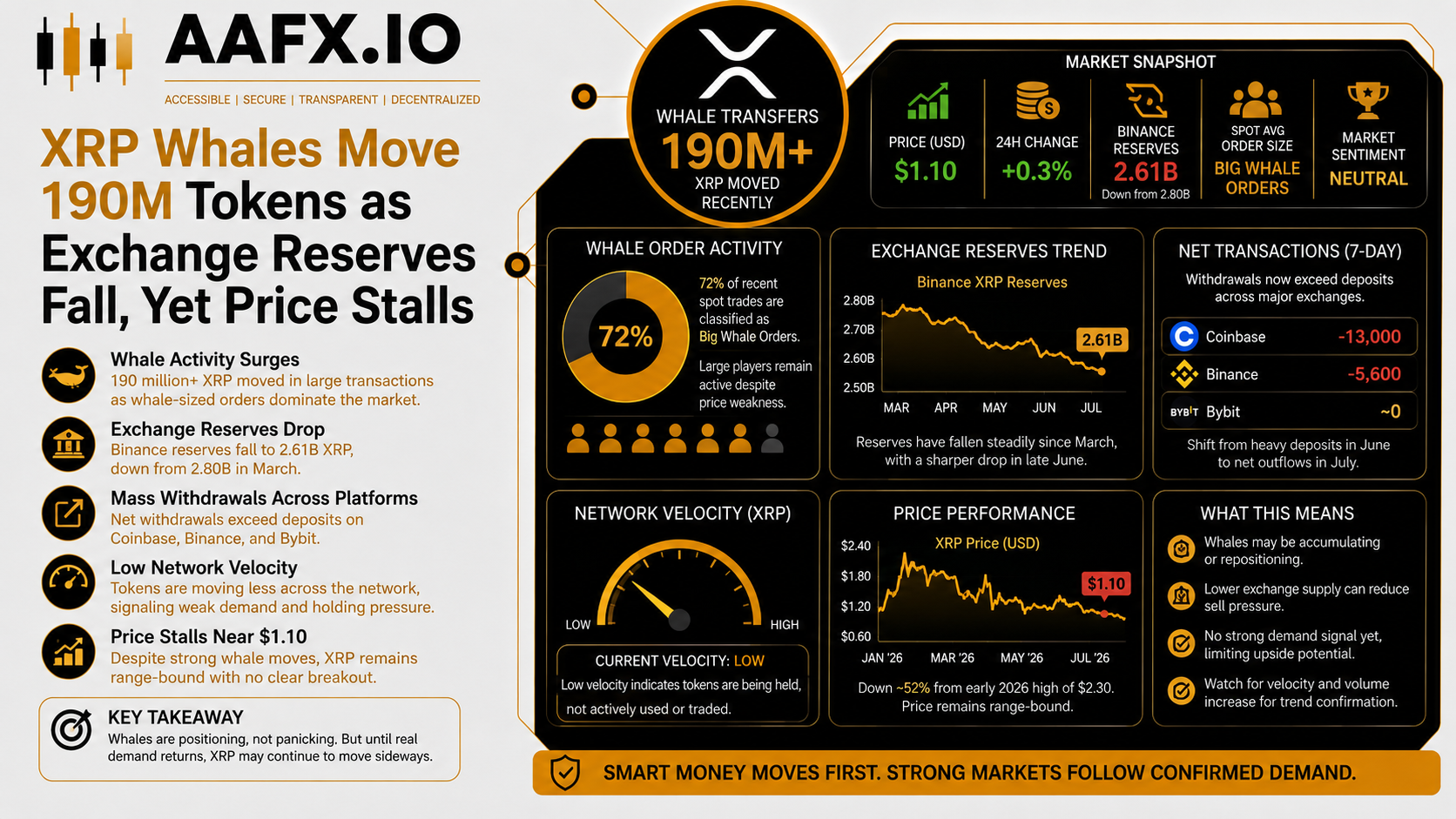
XRP whale activity surges as exchange reserves drop to 2.61 billion tokens, but weak network velocity and limited demand keep prices near $1.10.
Whale Activity Signals Interest
XRP is witnessing a notable rise in large-scale investor activity, yet the cryptocurrency’s market performance remains surprisingly subdued. While whale-sized transactions have increased and exchange reserves continue to decline, the token has struggled to generate meaningful upward momentum.
Recent trading data shows that a significant share of XRP transactions falls into the category of “Big Whale Orders,” indicating that institutional investors and large holders remain actively involved in the market. Such activity often attracts attention because whales can influence liquidity, market sentiment, and future price trends.
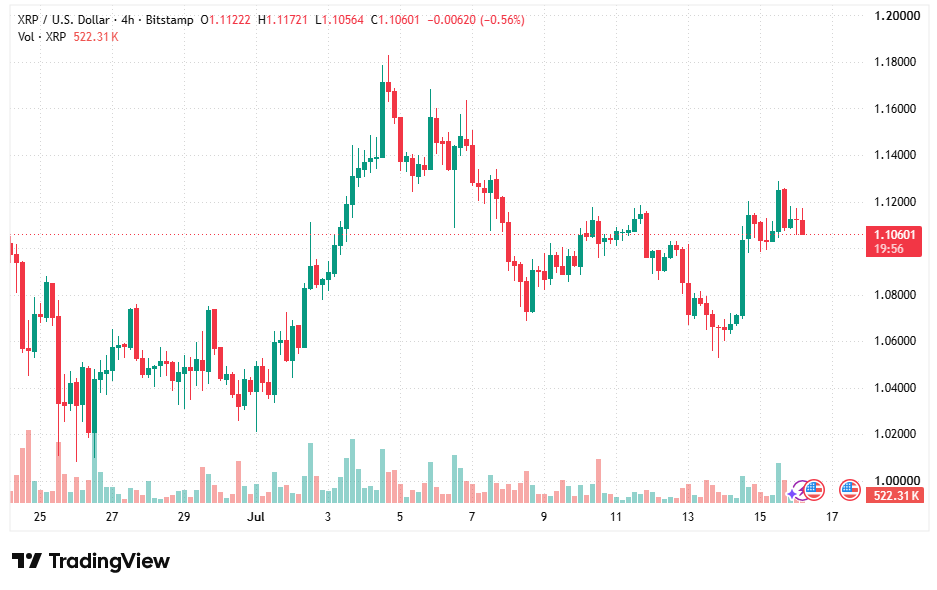
Despite this heightened participation, XRP was trading near $1.10, far below its early 2026 peak of approximately $2.30. The gap highlights a key market puzzle: large investors appear active, but their actions have not yet translated into a stronger price recovery.
Importantly, whale transaction data reveals participation levels rather than investor intent. Large trades alone cannot determine whether whales are accumulating XRP for the long term or reducing exposure through strategic selling.
Exchange Reserves Keep Falling
One of the most significant developments is the continued decline in XRP balances held on major cryptocurrency exchanges. Binance, the world’s largest crypto exchange by trading volume, saw its XRP reserves fall to approximately 2.61 billion tokens, down from nearly 2.80 billion XRP recorded in March.
This trend is often interpreted as a bullish signal because fewer tokens on exchanges can reduce immediate selling pressure. When investors transfer assets into private wallets, they are generally less accessible for quick liquidation.
Key developments include:
- Binance XRP reserves declined from 2.80 billion to 2.61 billion tokens.
- Withdrawal activity accelerated during late June and early July.
- Large holders appear to be responsible for a substantial portion of the transfers.
- Reduced exchange supply may limit near-term selling pressure.
The timing of these reserve reductions aligns closely with the increase in whale-sized transactions, suggesting that major investors may be repositioning assets away from trading platforms.
Weak Demand Holds XRP Back
While exchange outflows have intensified, broader network activity paints a more cautious picture. Market analyst Amr Taha reported that Coinbase’s seven-day net transaction count fell to approximately -13,000, marking its most withdrawal-heavy period in nearly five months.
Binance recorded roughly -5,600 net transactions, while Bybit shifted from around +27,000 transactions in early June to nearly neutral levels by mid-July. Collectively, the data indicates that withdrawals now exceed deposits across several major exchanges.
However, another metric tells a different story: network velocity remains low. Velocity measures how frequently tokens move across the blockchain. Despite substantial whale activity and declining exchange balances, XRP is not circulating at a pace typically associated with strong market demand.
This suggests that investors may be moving XRP into storage rather than actively trading or deploying it. While lower exchange balances can support future price gains, sustainable rallies generally require fresh buying interest and increased network usage.
For now, XRP’s largest holders appear to be positioning themselves for potential future developments. Yet until stronger demand emerges and network activity accelerates, the market may continue to wait for a decisive catalyst that turns whale activity into meaningful price movement.
Sources & Methodology
Primary-source standard: Market-moving facts should link to original data releases, regulator notices, company filings or official project announcements whenever available. Secondary reporting is used for additional context, not as a substitute for original evidence.
Page last reviewed: