
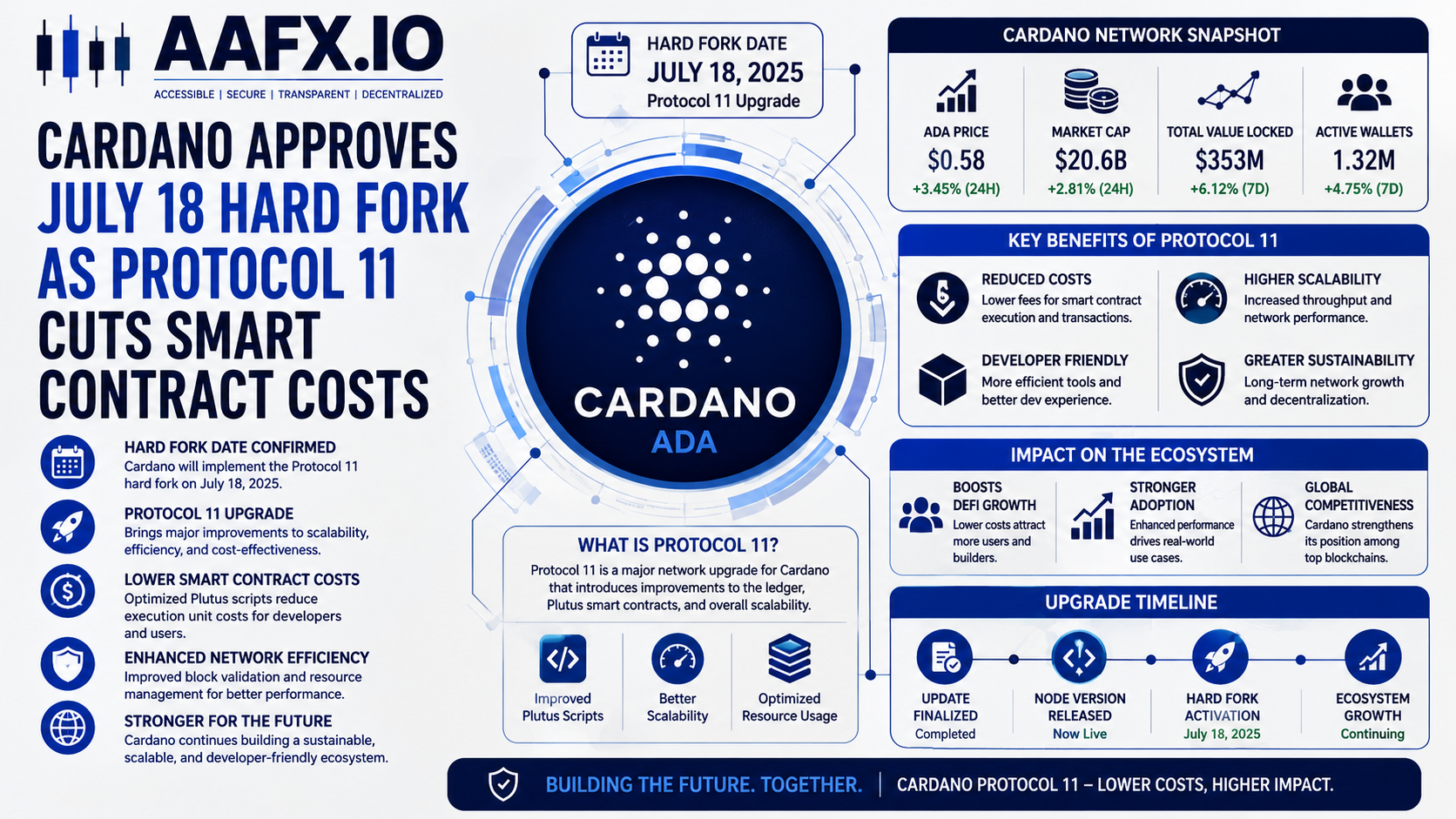
Cardano approves its first community-led hard fork on July 18. Protocol 11 lowers smart contract costs while Hydra and x402 boost ADA adoption prospects.
First Community-Led Hard Fork
Cardano has entered a new chapter in its development after the network approved the van Rossem hard fork through its Voltaire governance framework. Scheduled for July 18, the upgrade introduces Protocol Version 11 and represents the first major network hard fork approved entirely by Cardano’s decentralized community governance system.
The decision is significant because previous upgrades involved input from Cardano’s founding organizations. Under the Voltaire governance model, however, stakeholders now have direct authority over critical protocol changes. The approval demonstrates how Cardano’s governance system has evolved from a guided framework into a fully community-driven decision-making process.
Protocol Version 11 brings several technical enhancements aimed at improving network efficiency. According to Input Output Global (IOG), the upgrade introduces new Plutus primitives and expanded scripting capabilities. These additions are designed to reduce smart contract execution costs while giving developers greater flexibility when building decentralized applications.
For developers and businesses, lower execution costs can improve the economics of deploying blockchain-based services. Reduced computational overhead may also help attract additional projects to the Cardano ecosystem, strengthening network activity over time.
Hydra Sparks Institutional Debate
Beyond the upcoming hard fork, Cardano is gaining attention for its potential role in institutional blockchain infrastructure. Recent discussions within the community have focused on Hydra, Cardano’s scaling solution, and whether it could support large-scale settlement systems.
Cardano contributor Dori highlighted that institutional users often prioritize:
- Settlement speed and efficiency
- Network security and reliability
- Controlled participation and governance
- Regulatory compliance capabilities
The discussion referenced developments in South Korea, where financial institutions are actively exploring tokenized securities platforms. Many organizations currently favor solutions such as private blockchain networks because they provide stronger control mechanisms and governance structures.
Supporters argue that Cardano could serve as a secure settlement layer while compliance features are implemented through smart contracts and supporting software. However, experts acknowledge that Hydra alone does not provide every institutional requirement. Features such as identity verification, selective disclosure, access management, and asset recovery would still need additional infrastructure.
As institutional blockchain adoption continues to grow, these conversations are keeping ADA firmly on investors’ radar.
x402 Membership Expands Reach
Another development drawing attention is Cardano’s participation in the newly launched x402 Foundation. According to the Linux Foundation, Cardano joins a roster of prominent founding members that includes Amazon Web Services, Google Cloud, Visa, Mastercard, Stripe, Coinbase, Ripple, and Circle.
The foundation will oversee development of the open x402 payment standard, a framework designed to support internet-native transactions and machine-to-machine payments. As automation expands across digital services, standardized payment infrastructure is expected to become increasingly important.
Cardano’s involvement places the network alongside major technology and financial companies working to define future payment systems. The combination of governance progress, technical upgrades, institutional discussions, and industry collaboration has created strong momentum around the ecosystem.
With the July 18 hard fork approaching, market participants will be closely watching whether these developments translate into greater network adoption and renewed interest in ADA. While price performance remains uncertain, Cardano’s latest initiatives demonstrate a clear focus on scalability, governance, and real-world utility.
