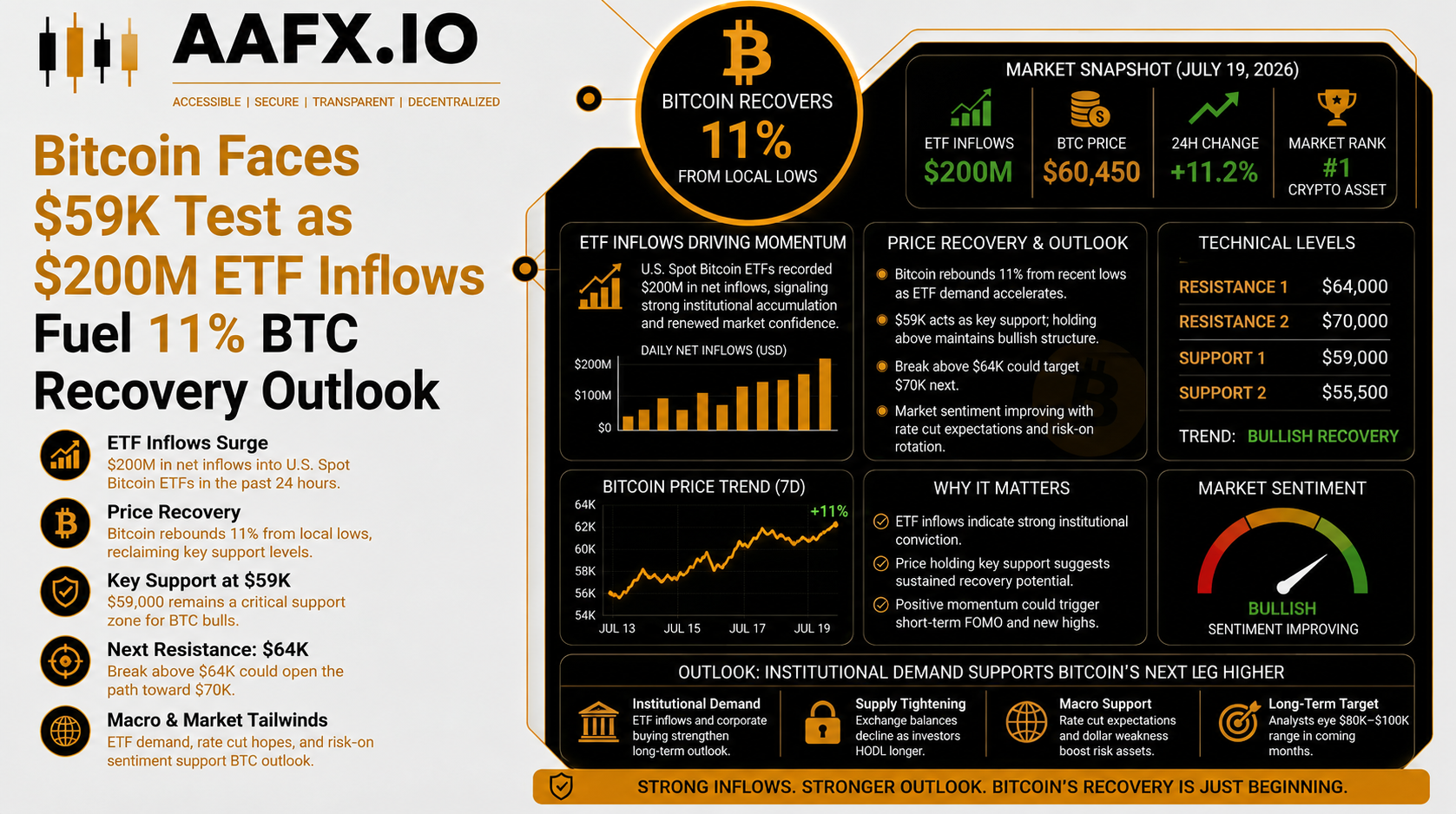
Bitcoin defends the crucial $59K support as $200M ETF inflows, long-term holders, and on-chain data shape BTC’s next major breakout potential.
$59K Emerges as Key BTC Support
Bitcoin has regained momentum after enduring several months of selling pressure, with the world’s largest cryptocurrency trading near $64,000 following a strong rebound from its July 1 low of $57,800. While the recovery has improved market sentiment, analysts argue that Bitcoin’s most important challenge is no longer reaching higher prices—it’s successfully defending the $59,000 support zone.
On-chain data from Checkonchain shows that slightly more than 50% of Bitcoin investors hold an average cost basis near $59,000, making this one of the market’s most influential price levels. A broader view of supply distribution reveals that the majority of Bitcoin holders accumulated their positions between $59,000 and $70,000, creating a dense area of investor activity.
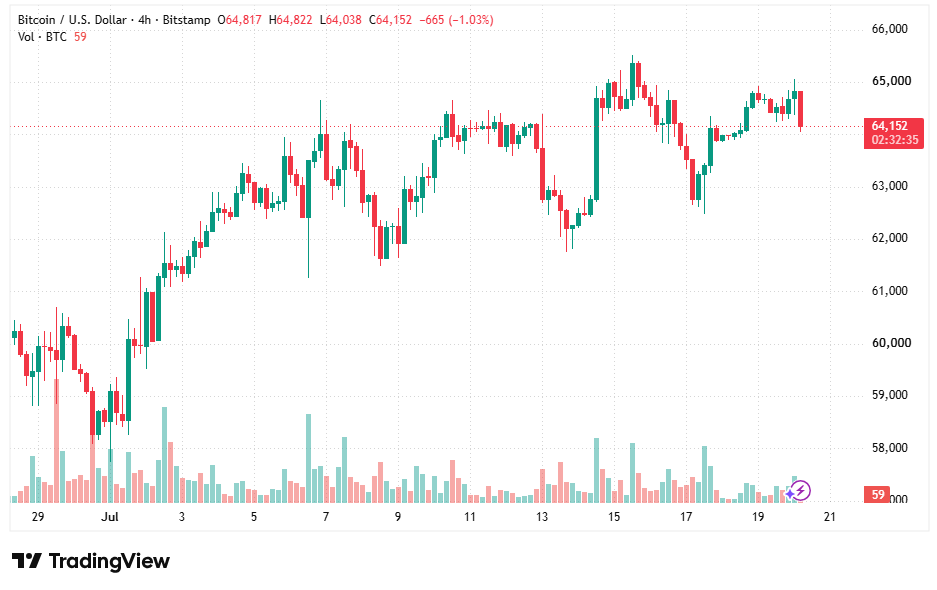
When Bitcoin briefly slipped below $59,000 earlier this month, buyers quickly stepped in to absorb selling pressure. That response highlights strong conviction among existing holders who are unwilling to exit at a loss. However, analysts caution that defending support alone does not automatically establish a lasting market bottom.
A senior market strategist notes that short-term holders (STHs) continue to display mixed behavior, with some investors capitulating while others aggressively accumulate. Such conflicting activity often appears during the early stages of market stabilization rather than at the conclusion of a correction.
Long-Term Holders Stay Confident
While short-term traders influence daily price swings, long-term holders (LTHs) continue to provide the foundation for Bitcoin’s broader trend. Investors who have held their BTC for more than 155 days remain remarkably inactive, signaling confidence despite recent volatility.
Bitcoin’s Binary Coin Days Destroyed (Binary CDD) indicator has dropped to 0, indicating that long-term holders are largely refusing to sell their coins. Historically, periods of low spending from experienced investors have often preceded stronger market recoveries.
Another closely watched metric, the Spent Output Profit Ratio (SOPR), currently stands at 0.89 and is gradually improving. Previous instances where SOPR reached similar levels—in April 2020 and September 2023—were followed by meaningful Bitcoin rallies.
Key on-chain observations include:
- Bitcoin has advanced 11% since its July 1 low.
- Binary CDD at 0 reflects minimal long-term selling pressure.
- SOPR remains below 1, suggesting the market has not fully shifted into profit-taking.
- A move above 1.0 would indicate stronger bullish momentum returning.
ETF Demand Could Drive Next Breakout
Institutional participation remains one of Bitcoin’s strongest bullish catalysts. Throughout February to April 2026, consistent inflows into U.S. spot Bitcoin ETFs helped lift BTC from approximately $65,594 to $76,412, demonstrating the growing influence of regulated investment products.
The trend has remained encouraging this month. According to SosoValue, U.S. spot Bitcoin ETFs recorded net inflows of roughly $200.17 million during July, reflecting continued investor confidence despite broader market uncertainty.
For Bitcoin to decisively overcome the nearby $64,336 resistance, multiple factors must align. Strong ETF demand, resilient long-term holders, and improving profitability metrics would together strengthen the case for a sustained advance. Conversely, a failure to maintain support around $59,000 could weaken sentiment and invite renewed selling pressure.
Although Bitcoin’s recovery has gained traction, the coming weeks are likely to determine whether this rebound evolves into a new bullish phase or remains another temporary recovery within a broader consolidation. As institutional capital and on-chain fundamentals continue to improve, the battle around $59,000 may ultimately shape Bitcoin’s next major market cycle.
Sources & Methodology
Primary-source standard: Market-moving facts should link to original data releases, regulator notices, company filings or official project announcements whenever available. Secondary reporting is used for additional context, not as a substitute for original evidence.
Page last reviewed: