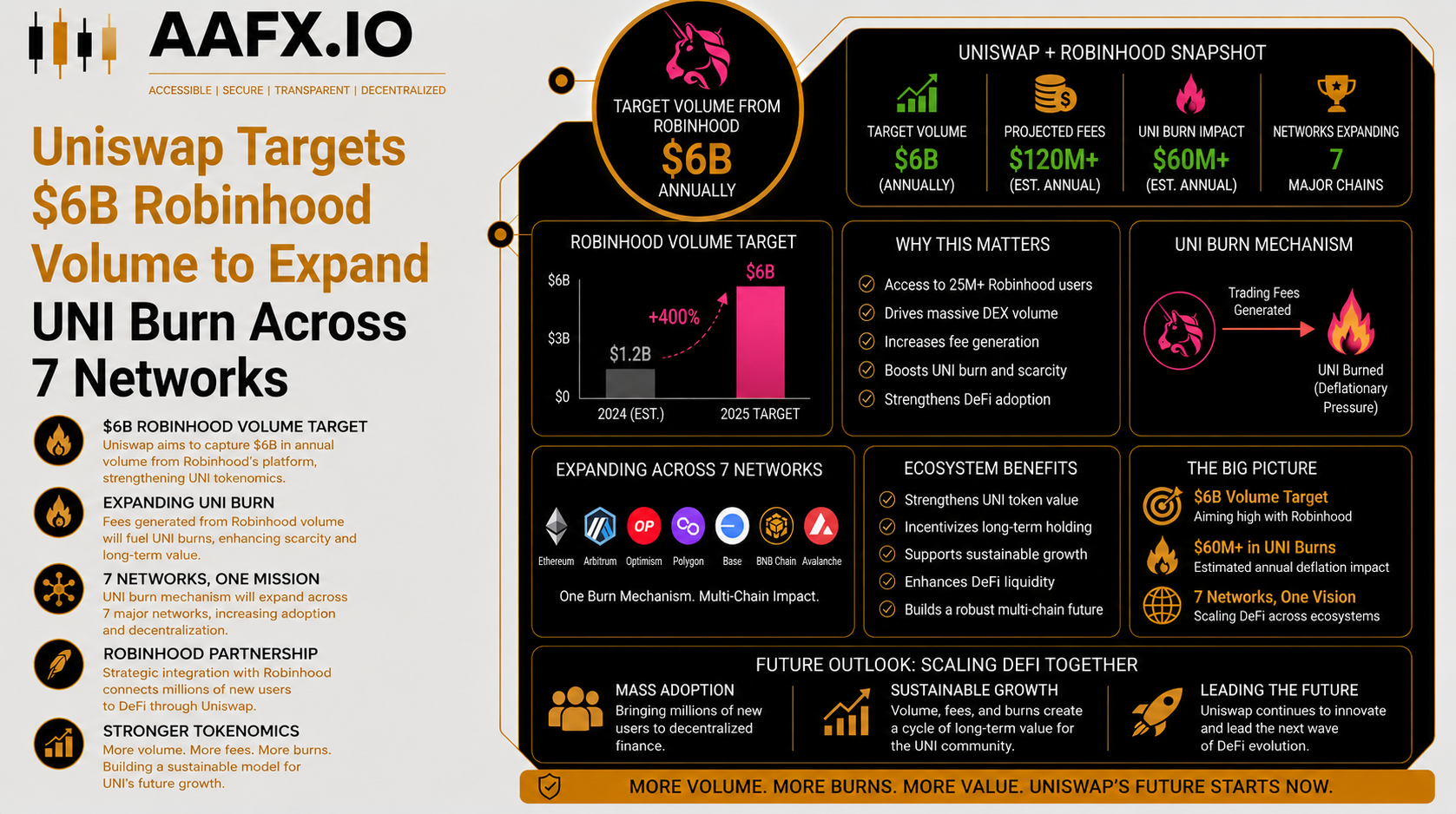
Uniswap governance votes could expand the UNI burn across seven networks as Robinhood Chain surpasses $6B in trading volume, boosting price outlook.
Uniswap Expands UNI Burn Strategy
Uniswap is preparing for a pivotal governance decision that could significantly expand the scope of its UNI token burn mechanism. Two governance proposals, open for voting from July 19 to July 26, aim to introduce protocol fee collection across additional liquidity pools and integrate Robinhood Chain into the existing burn framework.
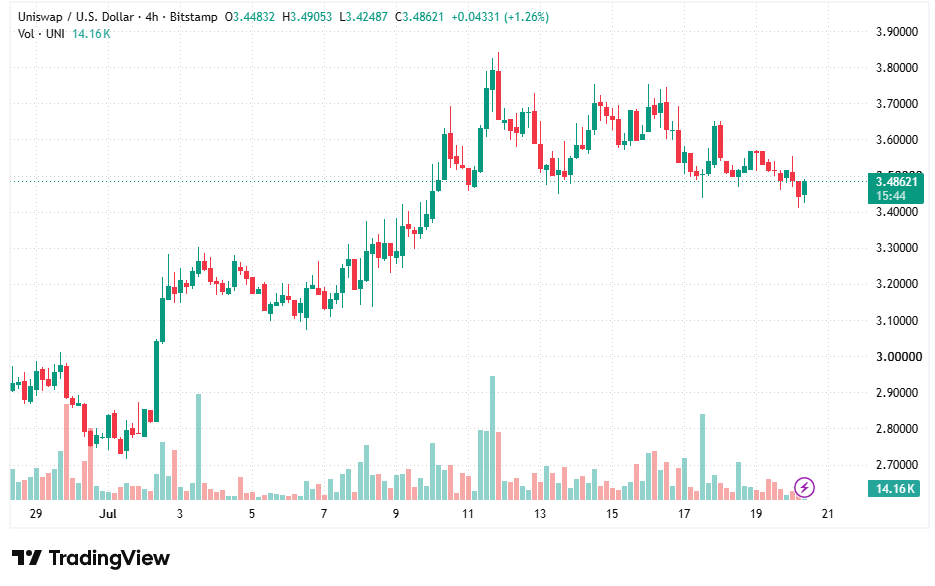
The proposals arrive as UNI trades between $3.52 and $3.53, posting a modest 1% daily gain while maintaining support above the $3.41 Fibonacci retracement level. Meanwhile, Robinhood Chain has emerged as an important contributor after processing more than $6 billion in cumulative Uniswap swap volume within just 10 days of launch.
If approved, the governance measures would channel more protocol fees into UNI token burns, strengthening the protocol’s value capture model. The combination of growing network activity and a broader fee structure could improve long-term token economics, although market participants continue watching whether trading activity remains sustainable beyond the initial launch excitement.
Fee Model Covers Seven Networks
The first proposal focuses on enabling protocol fees for selected Uniswap v4 pools across seven blockchain networks:
- Ethereum
- Arbitrum
- Base
- BNB Chain
- Polygon
- Optimism
- Robinhood Chain
Unlike previous versions, Uniswap v4 introduces customizable “hooks” that allow developers to modify pool behavior and dynamically adjust trading fees. Because of this flexibility, governance cannot simply apply one universal fee across every pool.
Instead, the proposal introduces a V4FeePolicy contract capable of calculating fees individually, while a V4FeeAdapter would automatically route collected assets into TokenJar, the protocol’s fee collection system.
Initially, the rollout targets:
- Static-fee pools
- Continuous clearing auction pools
- Aggregator-hook pools
The framework creates a single governance structure capable of managing multiple pool types without requiring separate votes for every deployment. More importantly, approval would allow Uniswap v4 trading activity to contribute to UNI burns for the first time.
Protocol fees are already active across Uniswap v2 and v3 on 11 blockchain networks. According to Uniswap Labs, approximately 186,000 UNI were burned in a single day last month, highlighting how additional trading volume could accelerate future token reductions.
Price Outlook Hinges on Vote
The second proposal specifically targets Uniswap v2 and v3 deployments on Robinhood Chain, where trading activity has exceeded expectations since the July 1 launch.
Under the proposal, collected fees would accumulate inside a TokenJar contract. Network participants would exchange assets for UNI tokens, which would then be bridged to Ethereum before being permanently removed from circulation through the burn address. Robinhood Chain’s Arbitrum Orbit architecture already supports this cross-chain governance process.
From a technical perspective, UNI continues showing constructive signals despite slowing momentum. The token recently rebounded from June lows near $2.36 before reaching $3.59 on July 19. Although buying pressure has cooled after touching the $3.70 region earlier this month, the broader trend remains intact.
Momentum indicators also remain favorable. The Relative Strength Index (RSI) stands at 59.55, comfortably above neutral territory without entering overbought conditions. Meanwhile, the MACD remains positive, although the narrowing histogram suggests bullish momentum is gradually weakening.
A sustained close above $3.57 could reopen the path toward the recent $3.83 swing high. Conversely, losing the $3.41 support level may expose downside risk toward $3.28. Ultimately, the outcome of the governance votes and continued trading activity on Robinhood Chain are likely to determine UNI’s next major move.
Sources & Methodology
Primary-source standard: Market-moving facts should link to original data releases, regulator notices, company filings or official project announcements whenever available. Secondary reporting is used for additional context, not as a substitute for original evidence.
Page last reviewed: