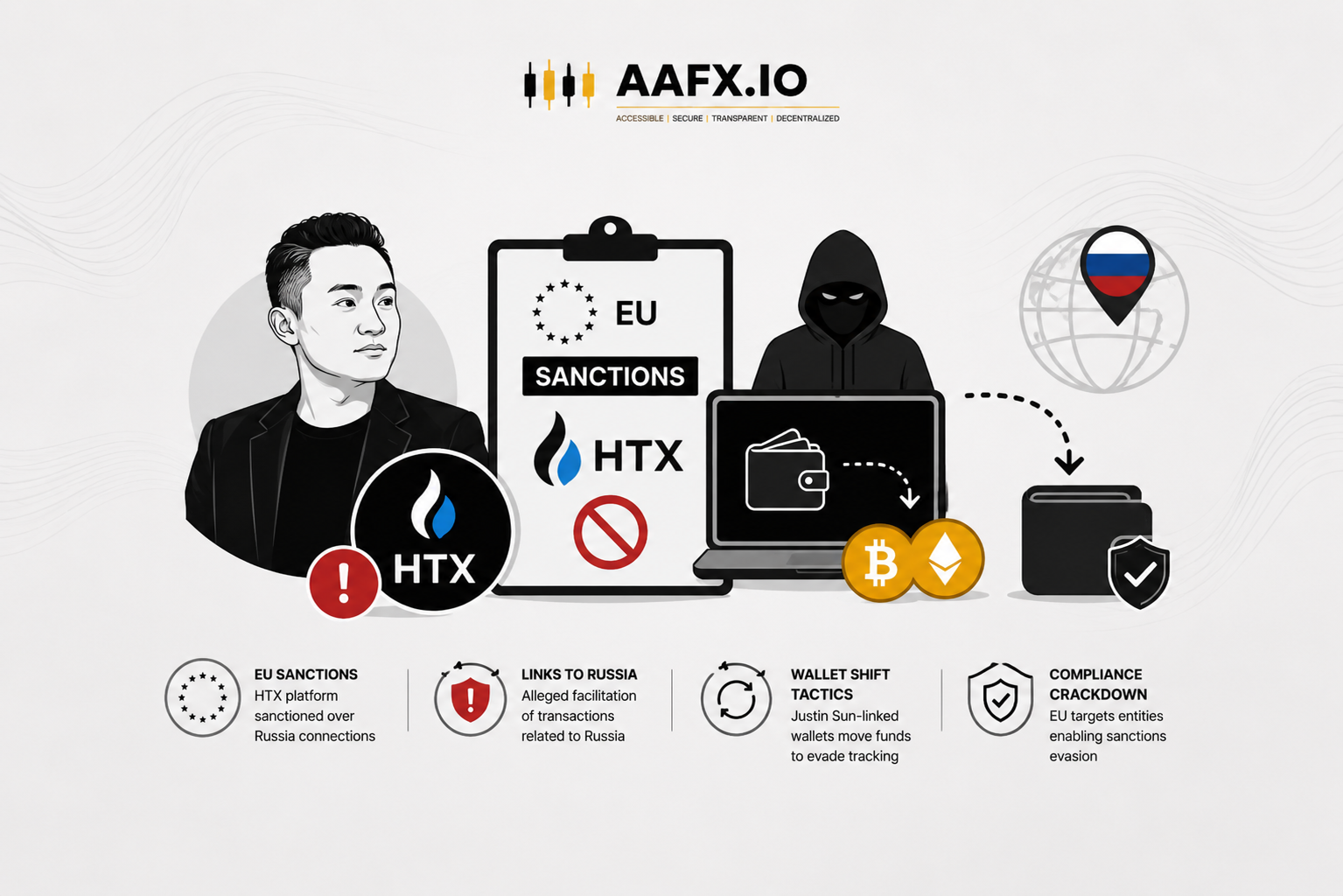
The EU sanctions Justin Sun’s HTX and Huobi Global S.A. over alleged Russia-linked financial services, raising scrutiny of crypto compliance and wallet activity.
EU Tightens Crypto Sanctions
The European Union has expanded its sanctions against cryptocurrency businesses by targeting Justin Sun-owned HTX and Huobi Global S.A., marking another step in its effort to restrict financial channels that could support Russia’s economy. The decision, announced by the Council of the European Union, is intended to increase pressure on entities believed to have facilitated financial activity connected to Russia following its invasion of Ukraine.
The move follows similar action by the United Kingdom’s Foreign, Commonwealth and Development Office, which previously sanctioned Huobi Global S.A. over allegations that it provided financial services connected to Russia, including interactions with the A7 Network. European policymakers argue that limiting access to digital asset infrastructure is becoming an increasingly important part of enforcing international sanctions.
While HTX has emerged as one of the world’s largest cryptocurrency exchanges by trading activity, the latest measures place renewed focus on the compliance responsibilities of global digital asset platforms operating across multiple jurisdictions.
Ownership Claims Under Scrutiny
Following the UK sanctions, HTX stated that Huobi Global S.A. and the online HTX exchange were separate legal entities. However, public records reviewed by Protos painted a different picture.
According to court filings cited in the investigation, Huobi Global S.A. identified itself as the company that “owns and operates HTX.” The review also found that the company held the HTX trademark in the United States, contradicting claims that the sanctioned entity was unrelated to the exchange.
These findings have complicated compliance efforts for exchanges, custodians, and blockchain monitoring firms attempting to identify sanctioned entities accurately. Ownership structures within the cryptocurrency industry often span multiple jurisdictions, making regulatory enforcement significantly more challenging.
Key developments include:
- The European Union formally sanctioned HTX and Huobi Global S.A.
- The United Kingdom previously imposed similar restrictions.
- Court filings reportedly identified Huobi Global S.A. as the operator of HTX.
- The company also reportedly owns the HTX trademark in the United States.
Wallet Changes Challenge Compliance
Sanctions enforcement extends beyond corporate ownership to blockchain activity. Compliance firms rely heavily on identifying cryptocurrency wallet addresses associated with sanctioned organizations, but HTX’s operational practices have reportedly complicated that process.
Ari Redbord, Global Head of Policy at TRM Labs, said the exchange frequently rotates its wallet addresses, making static screening lists quickly outdated. He described the activity as HTX “changing its wallets every few hours to stay a step ahead of screening built on static lists.”
Such rapid wallet rotation creates additional challenges for exchanges, financial institutions, and blockchain analytics providers that must continuously update monitoring systems to comply with international sanctions requirements.
HTX rejected any suggestion that the practice was designed to avoid regulatory oversight. In comments provided to The Block, the company said the wallet updates represent routine security-driven platform operations that are common across the cryptocurrency industry. HTX also stated that it “categorically rejects” any implication that the behavior is intended to circumvent sanctions.
The sanctions highlight a broader shift in global crypto regulation, where authorities are increasingly targeting not only individuals but also digital asset infrastructure, exchange operators, and blockchain networks. As regulators strengthen enforcement mechanisms, cryptocurrency platforms are expected to face growing pressure to improve transparency, maintain accurate ownership disclosures, and enhance compliance systems capable of keeping pace with rapidly changing blockchain activity.
Sources & Methodology
Primary-source standard: Market-moving facts should link to original data releases, regulator notices, company filings or official project announcements whenever available. Secondary reporting is used for additional context, not as a substitute for original evidence.
Page last reviewed: