
The U.S. dollar remained near a one-month high on Tuesday as investors positioned for this week’s Federal Reserve policy decision. Expectations that U.S. interest rates will stay higher for longer continued to support the greenback, offsetting the recent decline in crude oil prices following renewed optimism over possible diplomatic progress between the United States and Iran.
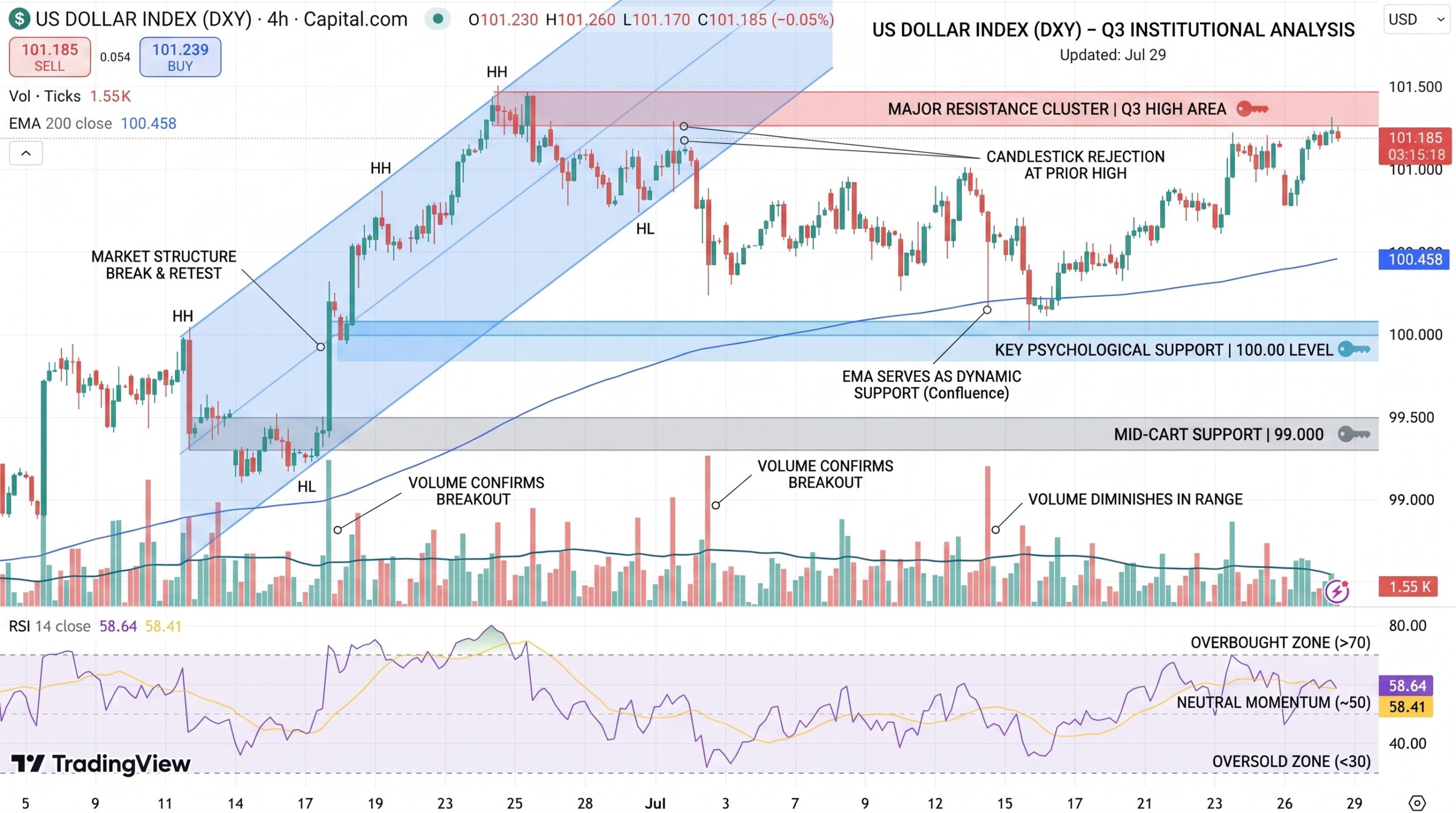
Dollar Index Holds Near 101.50 as Markets Price 38% Chance of Fed Hike
The U.S. Dollar Index (DXY) hovered around 101.50, holding close to its strongest level in four weeks, while the euro, British pound, Japanese yen and Swiss franc traded largely unchanged.
The dollar continued to find support from elevated U.S. Treasury yields and persistent inflation expectations, with markets increasingly believing the Federal Reserve could maintain a restrictive monetary policy even if it leaves interest rates unchanged this week.
According to the CME FedWatch Tool, markets were pricing in roughly a 38% probability of a 25-basis-point interest rate increase at Wednesday’s Federal Reserve meeting, although the base-case expectation remained that policymakers would keep rates unchanged.
ING Global Head of Markets Chris Turner said the foreign exchange market is taking the possibility of a Fed rate hike more seriously than before, adding that the central bank’s limited communication has created room for increased speculation over its next policy move.
Meanwhile, President Donald Trump said the United States was holding “good talks” with Iran in an effort to ease regional tensions. The prospect of de-escalation weighed on oil prices, reducing concerns that higher energy costs could fuel another wave of inflation.
However, Trump also warned that U.S. military strikes could resume if negotiations fail. Security incidents reported in Saudi Arabia, Jordan and Iraq, along with continued disruptions to shipping through the Strait of Hormuz, highlighted that geopolitical risks remain elevated despite ongoing diplomatic efforts.
Market reaction: Dollar gains on interest rate expectations
Investors continued buying the U.S. dollar because expectations of higher-for-longer U.S. interest rates outweighed the negative impact of falling oil prices.
Lower crude prices typically reduce inflationary pressures, making future rate hikes less likely. However, traders remain focused on persistent underlying inflation, resilient U.S. economic data and elevated Treasury yields, all of which continue to support the dollar.
According to the CME FedWatch Tool, traders currently see a 62% probability that the Federal Reserve will leave interest rates unchanged within the 3.50%-3.75% range this week. Market participants are now looking beyond the policy decision itself and focusing on the Fed’s forward guidance for clues about whether another rate increase could come later this year.
On Monday, President Trump also urged Federal Reserve Chairman Kevin Warsh to lower interest rates, arguing that inflation has eased and prices could fall further if the Gulf conflict comes to an end.
Background and context
Attention is also turning to other major central banks.
The euro traded near $1.1370 after European Central Bank Governing Council member Peter Kazimir indicated that another ECB rate increase in September could still be appropriate even if economic growth strengthens.
Sterling remained near $1.3280 ahead of this week’s Bank of England policy decision, while the Japanese yen hovered near multi-decade lows around 163.8 per dollar as investors awaited Friday’s Bank of Japan meeting for signs of faster policy normalization.
In emerging markets, Indonesia’s rupiah stayed under pressure following the unexpected resignation of Bank Indonesia Governor Perry Warjiyo earlier this week.
What’s next
Investors are now awaiting Wednesday’s Federal Reserve interest rate decision, which is expected to be the week’s biggest market-moving event.
Beyond the Fed announcement, markets will closely watch Chair Kevin Warsh’s comments for signals on the future path of U.S. monetary policy. Upcoming U.S. economic releases, including second-quarter GDP data and the Core Personal Consumption Expenditures (Core PCE) Price Index, will also play an important role in shaping expectations for interest rates through the remainder of 2026
Sources & Methodology
Primary-source standard: Market-moving facts should link to original data releases, regulator notices, company filings or official project announcements whenever available. Secondary reporting is used for additional context, not as a substitute for original evidence.
Page last reviewed: