
European equities edged higher to start the week, drawing support from falling sovereign bond yields and a softer U.S. dollar as global trading desks increasingly price in a Federal Reserve rate hold next month. The pan-European STOXX Europe 600 Index advanced 0.2%, reclaiming ground after snapping a four-week winning streak last Friday. Germany’s DAX rose 0.2% and France’s CAC 40 traded flat, while London’s FTSE 100 outperformed with a 0.4% gain.
Falling Yields Ease Pressure on Growth Stocks
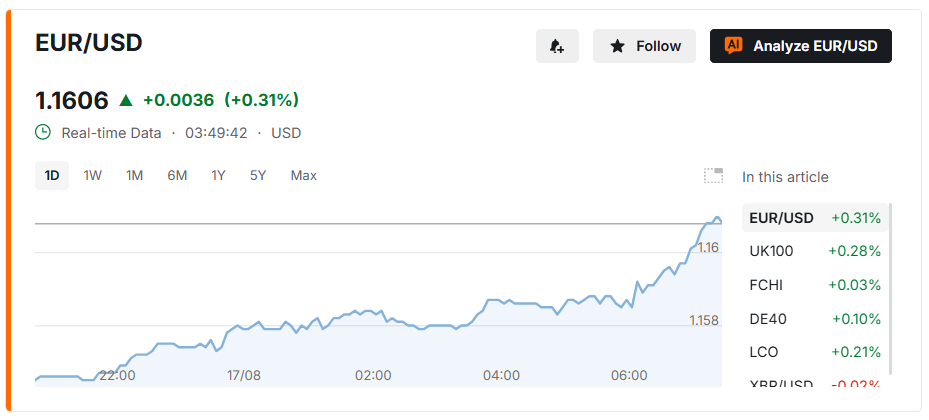
Risk sentiment drew steady support from sovereign debt markets, where European government bond yields pulled back from the multi-week highs reached earlier in August, when a resurgence in hawkish Fed rhetoric had pushed long-end yields sharply higher and pressured growth-oriented sectors. That yield pullback gave equities immediate breathing room, while the dollar eased against major peers as interest-rate expectations recalibrated lower across both sides of the Atlantic.
Soft U.S. Data Push Fed Pause Odds to 70%
Money markets now price in roughly a 70% probability that the Federal Reserve will leave its benchmark rate unchanged at the September policy meeting, a decisive shift from the elevated rate-hike bets that had briefly resurfaced in mid-August. That unwinding followed a dovish trio of economic releases global trading desks absorbed over recent sessions: a softer-than-expected July jobs report showing an outright payroll contraction, an on-target Consumer Price Index reading alongside a flat Producer Price Index, and an unexpected 0.6% decline in July retail sales. Together, the sequence eased concern over cost-push inflation and reassured equity investors that policymakers can sustain a prolonged pause without reigniting price pressures.
Overhangs Persist Despite the Improved Tone
With the European economic calendar unusually light this week, continental benchmarks are taking their direction from global macro trends and cross-asset dynamics rather than domestic data. Broader gains remain capped by several overhangs that have shaped trading throughout August. Diplomatic gridlock between Washington and Tehran over commercial transit through the Strait of Hormuz has kept crude oil prices elevated, sustaining a raw-material cost burden for Europe’s energy-intensive industrial sector even as broader sentiment improves. Following a strong summer advance that pushed European benchmarks near record levels, strategist desks remain divided over whether equity risk premia have compressed too far relative to still-elevated real borrowing costs. With the second-quarter corporate reporting season largely concluded, the steady stream of earnings beats that anchored European shares through late July has dried up, leaving markets more dependent on macroeconomic data for near-term direction.
- Strait of Hormuz disruption: ongoing U.S.-Iran diplomatic stalemate keeps oil prices elevated, pressuring European industrial input costs
- Risk-premium debate: strategists remain split on whether valuations have run ahead of high real borrowing costs following the summer rally
Conclusion
Global equity desks are now turning their focus to late-week catalysts for the next directional push. August S&P Global flash Purchasing Managers’ Index figures for the U.S. are due later this week, followed by the Federal Reserve’s annual Jackson Hole Symposium the following week. Traders will scrutinize both events to confirm whether manufacturing and services activity are cooling gradually enough to validate a soft-landing scenario without reigniting the inflation risks that briefly rattled markets earlier this month. Until then, European stocks are likely to stay range-bound near recent highs, buoyed by falling yields but restrained by unresolved geopolitical and valuation questions that a light data calendar can’t yet resolve.
Sources & Methodology
Primary-source standard: Market-moving facts should link to original data releases, regulator notices, company filings or official project announcements whenever available. Secondary reporting is used for additional context, not as a substitute for original evidence.
Page last reviewed: