
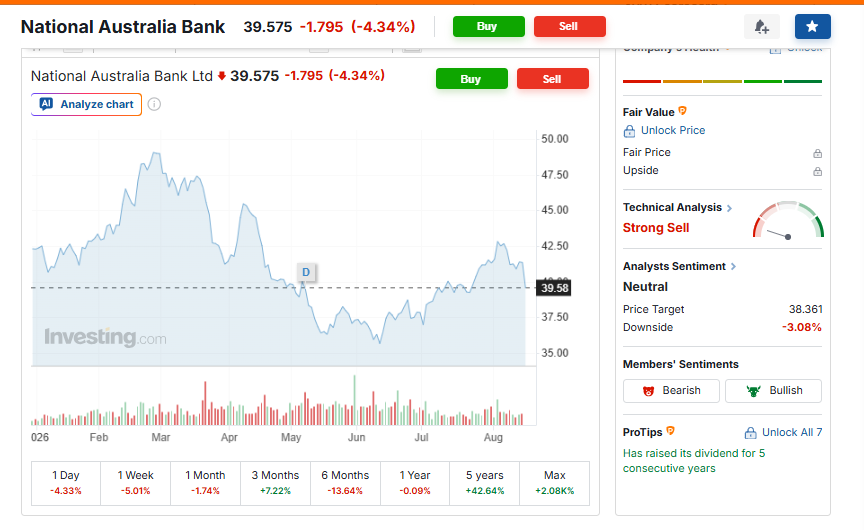
NAB stock slid 4.1% to A$39.67 after Q3 update showed home loan applications down 15% QoQ, overshadowing a 2% rise in cash earnings to A$1.83 billion and stronger CET1 ratio of 11.93%.
National Australia Bank shares dropped 4.1% to A$39.67 on Monday, August 17, 2026, after the lender’s third-quarter trading update revealed a 15% quarter-on-quarter plunge in home loan applications. The sharp slowdown in mortgage demand overshadowed a modest rise in cash earnings and sent the stock lower, weighing on the broader ASX 200, which closed down about 0.3–0.5%.
NAB Q3: Cash Earnings A$1.83bn (+2%), Home Loan Applications –15%, CET1 11.93%
For the three months ended June 30, 2026, NAB reported unaudited cash earnings of A$1.83 billion, up 2% compared with the first-half 2026 quarterly average (excluding a large notable item related to software capitalisation in the prior half). Statutory net profit rose 32% to A$1.81 billion versus the same first-half quarterly average.
Net operating income increased 2% to approximately A$5.5 billion. Net interest margin narrowed 2 basis points to 1.79%. Credit impairment charges fell 15% to A$299 million, helping support the earnings lift, although collective provision charges rose to A$119 million.
Australian business lending grew 2%, with the Business & Private Banking division up 4%. Total customer deposits also rose 2%. Australian home lending volumes grew in line with system (excluding Advantedge run-off), and proprietary market share improved from 47.7% to 50.9%. However, home loan applications fell 15% versus the second quarter, with owner-occupier applications down 14% and investor applications down 17%.
The Group CET1 capital ratio strengthened to 11.93% (from 11.65% at March 2026), remaining above NAB’s operating target of greater than 11.25%.
NAB Shares Fall 4.1% to A$39.67 as 15% Drop in Mortgage Applications Overshadows Earnings
Investors focused on the abrupt slowdown in mortgage applications rather than the modest profit improvement. Cash earnings came in below consensus estimates, and the 15% drop in applications — driven by higher domestic interest rates, Federal Budget tax changes aimed at housing affordability, and uncertainty linked to the Middle East conflict — raised concerns about future housing credit growth.
NAB’s own economists project system housing credit growth will slow to 2.5% in FY27 from 6.7% in the current year. Early signs of stress also appeared, with higher “watch loans” and a rise in non-performing mortgages. These factors outweighed positives such as business lending growth and the stronger capital ratio, triggering the sell-off. NAB shares fell as much as 4.8% intraday before closing around A$39.67.
6. Background and context
NAB is Australia’s largest business bank and one of the “Big Four” lenders. The third-quarter update continues a trend seen across major banks, all of which have reported double-digit declines in home loan applications in recent months (Westpac –20%, Commonwealth Bank around –15%, ANZ –12%).
CEO Andrew Irvine noted that the combination of geopolitical tensions, elevated interest rates and recent tax changes is creating “challenges and uncertainties for our customers.” While non-performing loan ratios improved slightly, watch loans increased, reflecting potential stress among currently performing borrowers. The bank continues to target more than A$450 million in productivity savings for FY26 and expects operating expense growth to remain below the 4.6% recorded in FY25.
7. What’s next
Attention now turns to the full-year results and whether the mortgage slowdown deepens. Investors will monitor housing credit growth guidance, further asset-quality trends (especially watch loans and collective provisions), and the bank’s ability to sustain business-lending momentum. NAB remains well capitalised and has reiterated its cost and productivity targets. The next major update will be the full-year results later in 2026.
Sources & Methodology
Primary-source standard: Market-moving facts should link to original data releases, regulator notices, company filings or official project announcements whenever available. Secondary reporting is used for additional context, not as a substitute for original evidence.
Page last reviewed: