BNB Chain now leads major networks by the number of addresses that hold tokenized real-world assets. RWA.xyz listed 854,889 RWA holders on Aug. 21, up 415% from 30 days earlier. On Aug. 19 the same dashboard showed 776,428 holders, up 369%. Official network posts counted 524,752 on Aug. 17 after a 124,000 rise in 72 hours. Thirty-day transfer volume was $26.45 billion. Changpeng Zhao, Binance’s founder, wrote on Aug. 21, “Let’s tokenize everything,” and framed issuance as a way for countries to attract foreign capital. He also said fragmented liquidity across issuers can be reduced if tokens are interchangeable. Tokenized stocks remain securities. They still have to follow issuance and trading law.
Holders Rise Faster Than Value
Holder counts and asset value are different series. RWA.xyz showed 1,284 assets on BNB Chain. Distributed value on the network has been cited near $5.8 billion, with a large share in cash-like products, gold and equity wrappers from bStocks, Ondo, Circle and Franklin Templeton. Binance Research said tokenized equities on BNB Chain grew from $34 million at the start of 2026 to $652 million by July, and that the chain took about 83% of on-chain tokenized-stock volume that month.
The source article put tokenized stocks at $884 million on BNB Chain versus $683 million on Ethereum. Those figures move with the dashboard and the definition of “stock.” What is stable is the direction: BNB Chain has taken share in equity wrappers through exchange distribution, including bStocks. A new wallet that receives a promotional token is still a holder. It is not proof of lasting demand or of foreign direct investment.
Stocks Lead, Canton Still Larger
Zhao backed tokenization on every chain, not only BNB Chain. That is consistent with the fragmentation he named: the same economic exposure listed on several venues splits order books unless issuers make units fungible.
Across the wider RWA market, value and fee share are not the same as holder rank. One compilation used in coverage put Canton first by tokenized-asset market share, at 79%, with about $11 million of revenue in seven days, and BNB Chain fifth, with $4.5 million and 12% of that revenue sample. Those revenue prints describe protocol take, not the BNB token. BNB Chain can lead in addresses and still trail in value locked if another network hosts larger credit or institutional books.
BNB Price Still Follows Bitcoin
BNB traded in the mid-$650s to high $670s on Friday, up about 10% on the week from the mid-$610s. Bitcoin had extended through $73,000 toward the high $70,000s after the Treasury buyback and short squeeze.
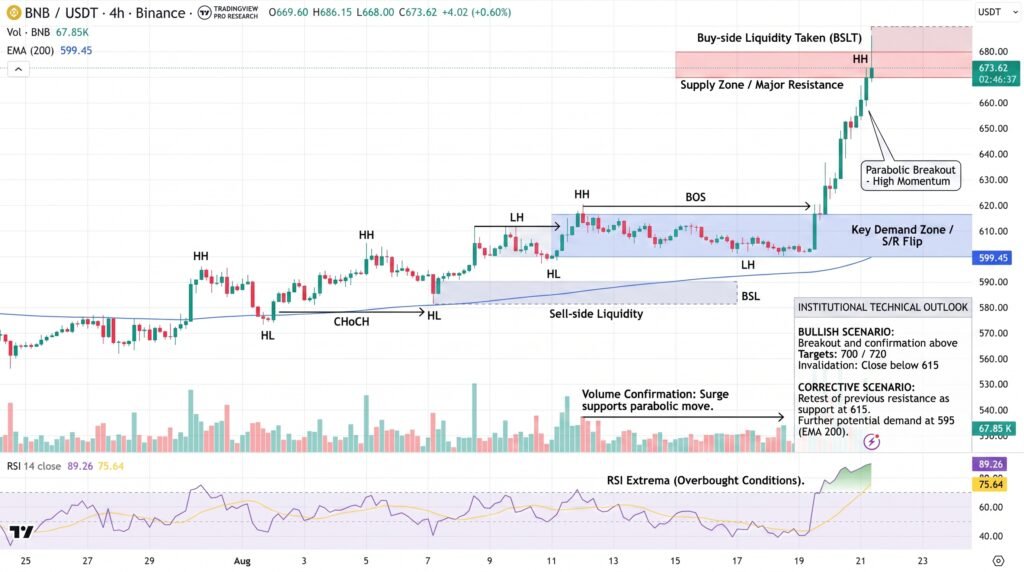
One four-hour reading put BNB’s RSI near 87. The 2026 range high cited in the source tape is $686. A tag of that level would add a few more percentage points. A move to $730 would require bitcoin to keep running and this token to break the year’s range. Mixed positioning—larger wallets adding, some “smart money” reducing—does not settle that question.
Zhao’s post does not reprice BNB by itself. The token’s cash flows still depend on Binance-ecosystem activity. Tokenized-stock volume can raise chain fees without a one-for-one lift in the coin.
Conclusion
BNB Chain’s RWA holder count is the fact that changed this month: from about 400,000 in mid-August to 855,000 on RWA.xyz. CZ’s “tokenize everything” line is a policy pitch, not a balance-sheet event. Watch whether those new addresses keep transferring, whether equity wrappers stay near the $650 million–$900 million band, and whether BNB can hold a close above $686 if bitcoin stalls. Holder growth, fee share and the token price are three series. Only the first is clearly in the lead.
Sources & Methodology
Primary-source standard: Market-moving facts should link to original data releases, regulator notices, company filings or official project announcements whenever available. Secondary reporting is used for additional context, not as a substitute for original evidence.
Page last reviewed: