Cardano is moving its post-quantum security work from long-term research toward formal technical proposals. Two proposals—CIP-0197, covering post-quantum protections for hierarchical deterministic wallets, and CPS-0034, focused on stronger Plutus Core conformance testing—have reached confirmed-candidate status in Cardano’s public standards process. The developments complement Cardano Vision 2026, a research program spanning 15 initiatives with post-quantum security among its central priorities. Neither proposal has been deployed to Cardano mainnet, making this an infrastructure-development story rather than an immediate ADA catalyst.
CIP-0197 Targets Quantum Wallet Risk
The most significant proposal for ADA holders is CIP-0197, formally titled “Post-Quantum ZK Signatures for HD Wallets.” The proposal was opened on August 11, 2026 and is categorized under wallets. Cardano’s official CIP repository currently marks it as a confirmed candidate under review.
Its objective is to address a genuine long-term cryptographic problem. Cardano wallets rely on public-key cryptography, while sufficiently capable fault-tolerant quantum computers could theoretically use Shor’s algorithm against widely used public-key systems. The concern becomes particularly relevant when a public key is exposed during transaction authorization.
CIP-0197 explores using zero-knowledge proofs tied to hierarchical deterministic wallet secrets as an additional authorization mechanism. The important design goal is preserving compatibility with existing wallets rather than immediately requiring every ADA holder to migrate to an entirely new address system.
That distinction matters. This is an attempt to develop an intermediate protection mechanism, not evidence that Cardano has already become quantum-proof.
The urgency should also be presented carefully. There is no confirmed date for a cryptographically relevant quantum computer. NIST says such machines do not currently threaten deployed cryptography and warns that migration itself can take many years. That is why standards bodies and blockchain developers are beginning preparation before the threat becomes practical.
Cardano Vision 2026 Expands Research
CIP-0197 fits into the broader Cardano Vision 2026 research roadmap. The program contains 15 research initiatives across six technical pillars, covering scalability, zero-knowledge technology, decentralized identity, governance and post-quantum cryptography. Cardano describes post-quantum security as a framework for evaluating and eventually replacing cryptographic primitives that could become vulnerable to quantum attacks.
Another proposal now under review is CPS-0034, “Extending Plutus Core conformance testing.” It was opened on August 18 and is also listed as a confirmed candidate.
Plutus Core is the scripting language embedded in Cardano’s ledger and is used when nodes validate smart-contract transactions. More comprehensive conformance testing can help ensure that different implementations interpret and execute Plutus Core consistently.
For developers, that work is important because implementation differences can create reliability and compatibility problems even when the underlying protocol specification is correct.
Cardano Vision 2026 goes considerably further. Its published roadmap calls for evaluation and migration planning around quantum-resistant cryptographic primitives, alongside work on Leios, Peras, ZK-enabled scaling and other network technologies.
What It Means for ADA Investors
The developments do not constitute a Cardano hard fork or completed security upgrade. CIP-0197 remains in the proposal-review process, meaning its technical design can still change before adoption. Implementation would require additional engineering, testing and coordination.
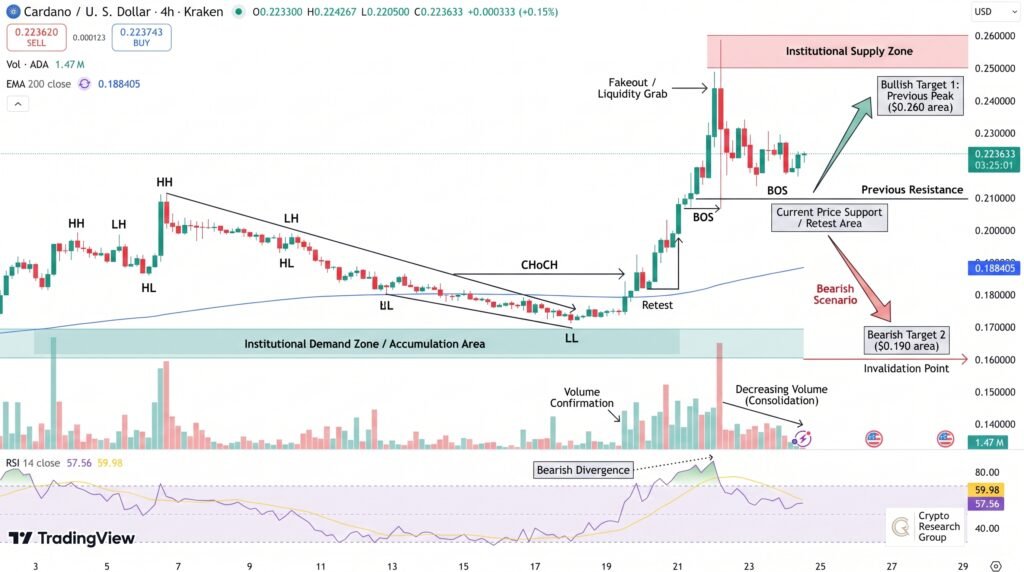
There is nevertheless evidence that traditional investment firms are expanding the universe of crypto assets they are prepared to consider.
T. Rowe Price’s Active Crypto ETF, for example, identified ADA as an eligible crypto asset in a July regulatory filing alongside Bitcoin, Ether, Solana, XRP, Avalanche and several other tokens. The filing establishes ADA’s eligibility for the fund; it should not by itself be interpreted as proof of a particular current ADA allocation.
For ADA investors, the more important near-term developments are therefore:
- Whether CIP-0197 progresses beyond community review toward implementation.
- Whether Cardano converts its broader post-quantum research into production-ready cryptography.
- How those changes are ultimately incorporated without disrupting existing wallets and applications.
Conclusion
Cardano’s quantum-security work is becoming more concrete, but it remains at an early stage. CIP-0197 is now a confirmed candidate under review, while Cardano Vision 2026 provides a wider research framework covering 15 initiatives and a planned transition toward quantum-resistant cryptography. The strategy is significant because cryptographic migrations can require years of research, standardization and deployment. For ADA holders, however, there is no immediate wallet migration or mainnet change to make. The next meaningful milestone will be whether CIP-0197 survives technical review and moves from proposal to an implementable Cardano standard.
Sources & Methodology
Primary-source standard: Market-moving facts should link to original data releases, regulator notices, company filings or official project announcements whenever available. Secondary reporting is used for additional context, not as a substitute for original evidence.
Page last reviewed: