The Japanese yen weakened against the U.S. dollar on Friday despite stronger underlying inflation and improving labor-market data from Japan, as traders shifted their attention toward Federal Reserve Chair Kevin Warsh’s highly anticipated Jackson Hole speech. USD/JPY rose about 0.14% to trade near 159.60, extending its advance for a fifth consecutive session and bringing the psychologically important 160.00 level back into focus. The yen’s inability to benefit from supportive domestic data suggests that expectations surrounding U.S. interest rates remain the stronger driver of the currency pair in the near term.
Tokyo Inflation Strengthens BOJ Case
Japan’s latest inflation report strengthened the argument for additional monetary tightening from the Bank of Japan. Tokyo’s headline Consumer Price Index eased slightly to 1.9% year over year in August from 2.0% in July, but underlying inflation moved in the opposite direction. Core CPI, which excludes fresh food, accelerated to 1.8% from 1.7%, beating expectations for an unchanged reading. The measure excluding both fresh food and energy also strengthened to around 2%, suggesting underlying price pressures remain relatively firm even as government electricity and gas subsidies temporarily suppress headline inflation.
The labor market provided another supportive signal. Japan’s unemployment rate unexpectedly declined to 2.4% in July from 2.5%, reaching its lowest level in roughly a year. A tight labor market is important for the BOJ because stronger employment conditions can support wage growth, consumer spending and ultimately more sustainable inflation. Together, the inflation and employment figures reinforce expectations that policymakers could continue gradually raising interest rates if economic conditions remain supportive.
Recent comments from BOJ Deputy Governor Ryozo Himino have strengthened that argument. Himino has warned that underlying inflationary pressures remain important and suggested policymakers should respond in a timely manner rather than risk having to tighten more aggressively later. Economists at Societe Generale have similarly argued that energy subsidies are temporarily masking some underlying price pressure, while another round of corporate price revisions could emerge toward the end of the year. With the BOJ’s next policy meeting scheduled for September 17-18, expectations surrounding another rate increase are likely to remain an important source of potential support for the yen.
Warsh Keeps Dollar in Control
Despite those supportive Japanese developments, the yen remains under pressure because traders are increasingly focused on the U.S. side of the USD/JPY equation. The dollar has strengthened ahead of Kevin Warsh’s Jackson Hole address, where investors will be looking for guidance on how the Federal Reserve intends to respond to inflation that remains above its 2% target. Recent U.S. inflation readings have kept the possibility of additional monetary tightening alive, making Warsh’s assessment of inflation and interest rates particularly important for Treasury yields and the dollar.
Other Federal Reserve officials have also maintained a cautious stance toward inflation. Kansas City Fed President Jeffrey Schmid has warned that price pressures remain sticky and that policymakers need to continue working to bring inflation down, while Cleveland Fed President Beth Hammack has emphasized the risks associated with inflation remaining above target for an extended period. Those comments have made investors reluctant to aggressively price lower U.S. interest rates before hearing directly from the Fed chair.
This interest-rate differential remains central to the yen’s weakness. The BOJ may be moving gradually toward tighter policy, but Japanese rates remain substantially below U.S. rates. As long as U.S. yields stay elevated, investors have an incentive to maintain exposure to dollar-denominated assets, limiting the benefit the yen receives from stronger Japanese economic data. A hawkish message from Warsh could reinforce that dynamic, while a softer-than-expected speech could trigger a pullback in U.S. yields and provide the yen with some relief.
USD/JPY Tests the 160.00 Area
The technical structure also remains constructive for USD/JPY. At around 159.60, the pair continues to trade above its rising 100-period and 200-period simple moving averages on the one-hour chart, currently located near 159.29 and 159.13. Price is also holding above an ascending trend line, while the Relative Strength Index near 59 indicates positive momentum without showing severe overbought conditions.
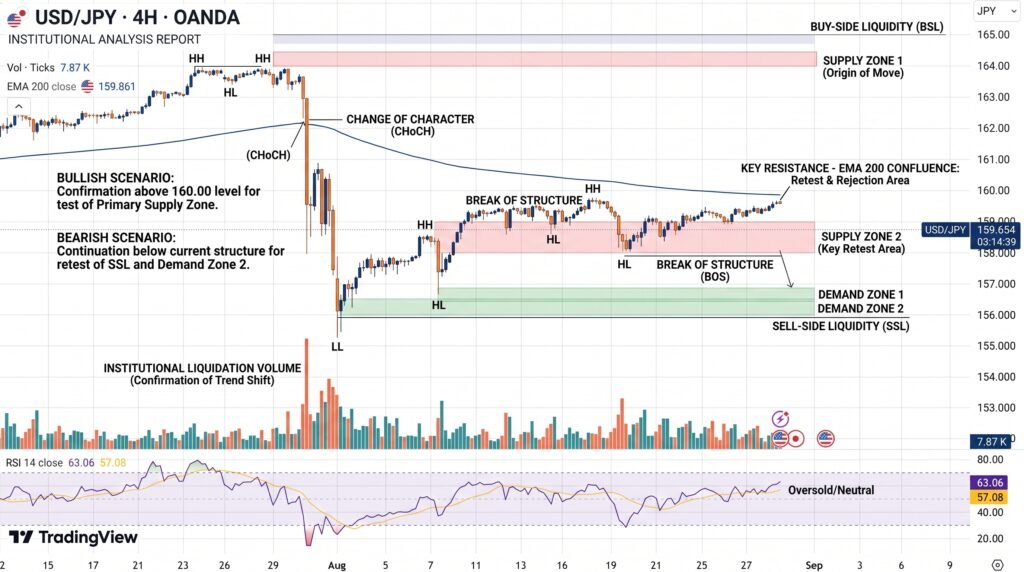
The immediate technical battle is concentrated between 159.50 and 160.00. Holding above 159.50 keeps buyers in control of the short-term structure, while the 159.34 trend-line area and the moving-average cluster between 159.13 and 159.29 provide stronger support underneath. On the upside, resistance around 159.78 stands immediately ahead of the psychological 160.00 barrier. A sustained move through that region would reinforce the existing bullish structure, although the reaction to Warsh’s speech could produce considerable volatility in either direction.
The broader picture therefore remains a contest between increasingly supportive Japanese fundamentals and a still-firm U.S. dollar. Tokyo inflation and employment data strengthen the case for another BOJ rate increase, but they have not yet been powerful enough to overcome elevated U.S. yields and expectations surrounding Federal Reserve policy. With USD/JPY approaching 160.00, Warsh’s Jackson Hole message is likely to determine whether the dollar extends its five-day advance or gives the yen an opportunity to recover.
Sources & Methodology
Primary-source standard: Market-moving facts should link to original data releases, regulator notices, company filings or official project announcements whenever available. Secondary reporting is used for additional context, not as a substitute for original evidence.
Page last reviewed: