
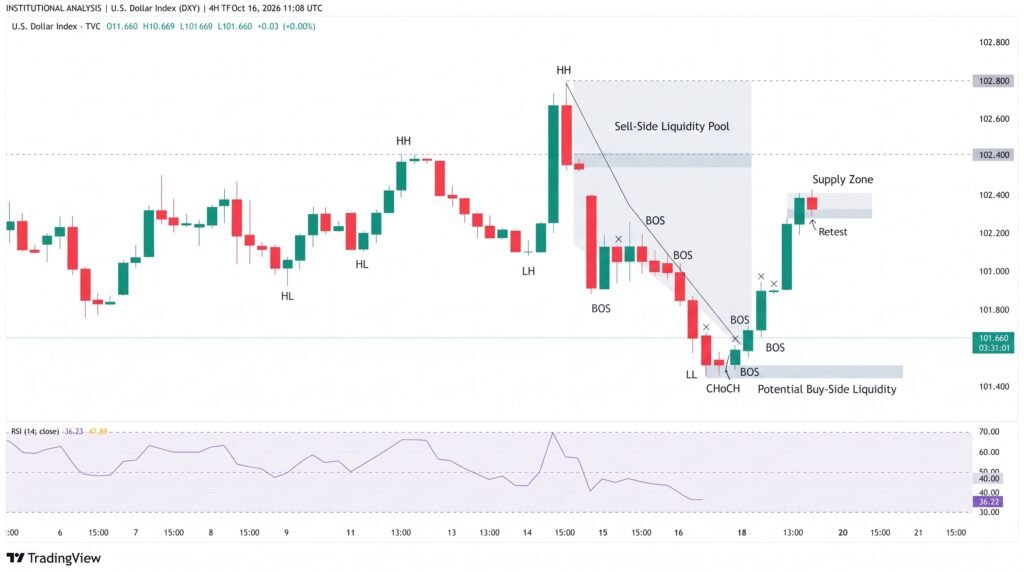
The US Dollar Index (DXY) traded near 101.90 on Friday, extending losses for a second consecutive session as investors reassessed the outlook for Federal Reserve policy. Although stronger-than-expected US inflation and economic activity initially supported the dollar, cautious Fed commentary and falling Treasury yields have limited its advance. Technically, the index is testing key resistance near 102.07 after slipping below the lower boundary of an ascending channel, leaving traders watching whether the move signals a temporary pullback or a deeper correction.
DXY Tests Key Technical Support
The dollar’s near-term outlook remains mixed. The index is holding above its 50-day Exponential Moving Average (EMA) at 100.87, preserving part of its broader bullish structure. However, trading below the nine-day EMA at 102.07 suggests that short-term buying momentum has weakened.
The 14-day Relative Strength Index (RSI) stands at 57.40, above the neutral 50 threshold but below overbought territory. This indicates that underlying momentum remains positive, although buyers have yet to regain control.
A sustained recovery above 102.07 could bring the recent 18-month high of 102.94 back into focus. A stronger advance could then expose the ascending wedge’s upper boundary near 103.70.
On the downside, the main technical levels are:
- 102.07: Immediate resistance at the nine-day EMA.
- 102.94: Recent high and potential upside target.
- 100.87: Support at the 50-day EMA.
- 98.56: August 20 low and a deeper downside reference.
A sustained move back inside the ascending channel would strengthen the bullish case. Continued weakness below its lower boundary, however, would increase the risk of a broader reversal.
Hot US Data Fails to Lift Dollar
Recent economic releases have complicated the outlook for the greenback. September consumer price inflation rose 3.7% year over year, while the core measure increased 2.6%. The monthly headline index climbed 0.6%, partly reflecting a sharp rise in gasoline prices. Producer prices subsequently increased 1.3% in September, their largest monthly gain since March 2022. Meanwhile, retail sales advanced 0.8%, exceeding economists’ expectations.
Despite these figures, the dollar struggled to maintain its gains. Commerzbank analyst Thu Lan Nguyen noted that stronger inflation, retail sales and producer prices point to increasingly broad price pressures, yet have not generated a sustained currency rally.
Markets are also weighing whether the Federal Reserve will raise rates again or maintain its current stance. Higher interest rates can support the dollar by making US assets more attractive, but expectations can change quickly when policymakers signal caution.
Fed Signals Keep Traders Cautious
Fed Chair Kevin Warsh has highlighted financial-stability risks while also pointing to structural growth and investment linked to artificial intelligence. His remarks reflect a cautious approach to policy, with future decisions dependent on incoming inflation, employment and economic-growth data.
The FXS Fed Sentiment Index remained elevated at 127.51, suggesting that the broader policy tone still leans hawkish. Nevertheless, a firm inflation backdrop alone may not be enough to sustain dollar gains if investors expect policymakers to remain patient.
Conclusion
The US Dollar Index remains vulnerable near 101.90 after slipping below its ascending channel, despite persistent inflation pressures. A move above 102.07 could reopen the path toward 102.94, while a decline toward 100.87 would weaken the near-term bullish structure. Traders will continue monitoring Fed communications, Treasury yields and incoming US data for confirmation of the next directional move.
Sources & Methodology
Primary-source standard: Market-moving facts should link to original data releases, regulator notices, company filings or official project announcements whenever available. Secondary reporting is used for additional context, not as a substitute for original evidence.
Page last reviewed: