The USD/JPY pair retreated from the 158.15–158.20 area on Friday, slipping below 158.00 after Federal Reserve Chair Kevin Warsh avoided signaling the central bank’s next policy move. His comments at the International Monetary Fund (IMF) meetings in Bangkok, combined with falling US Treasury yields, put pressure on the US dollar. However, the Japanese yen also faces competing forces, including the risk of renewed intervention by Japanese authorities and uncertainty over future US interest rates. Technically, 157.50 remains the key support level, while repeated failures near 159.00 continue to limit bullish momentum.
Warsh’s Remarks Pressure the US Dollar
During a discussion with IMF Managing Director Kristalina Georgieva, Warsh said developments since the September Federal Open Market Committee (FOMC) meeting had broadly matched expectations. He reiterated the Federal Reserve’s commitment to price stability but stressed that he would not prejudge upcoming policy decisions.
The comments provided little fresh guidance on whether policymakers will raise rates again. The Fed increased its policy rate in September, bringing the target range to 3.75%–4.00%. Its next meeting is scheduled for October 27–28, with the December decision also dependent on incoming economic data.
Falling US Treasury yields added to the dollar’s pressure. Lower yields can reduce the appeal of dollar-denominated assets relative to currencies offering more attractive returns.
Still, downside risks for USD/JPY may be limited if inflation remains persistent and markets anticipate further US monetary tightening. Geopolitical tensions in the Middle East could also support demand for the dollar as a perceived safe-haven currency.
Yen Intervention Risk Caps USD/JPY
The Japanese yen has drawn support from concerns that officials could intervene to slow excessive depreciation. Authorities in Japan have previously used currency-market operations to counter sharp yen declines, keeping traders cautious when USD/JPY approaches psychologically important levels.
The Bank of Japan and Japanese finance officials remain important to the outlook, although intervention is not guaranteed at any particular exchange rate. The prospect of action can itself discourage traders from extending bullish positions near recent highs.
Key levels traders are watching include:
- 158.00: Near-term threshold the pair has slipped below.
- 157.50: Horizontal support that has repeatedly attracted buyers.
- 157.00: Psychological level to watch if support breaks.
- 156.50–156.45: Potential next support zone under renewed selling.
- 159.00: Resistance area where previous advances have stalled.
Technical Signals Favor Caution
Momentum indicators point to a neutral-to-bearish near-term bias. The 14-period Relative Strength Index (RSI) stands at 45.03, below the neutral 50 threshold, while the Moving Average Convergence Divergence (MACD) remains slightly negative. Neither indicator confirms a decisive trend, but both suggest that buyers have yet to regain control.
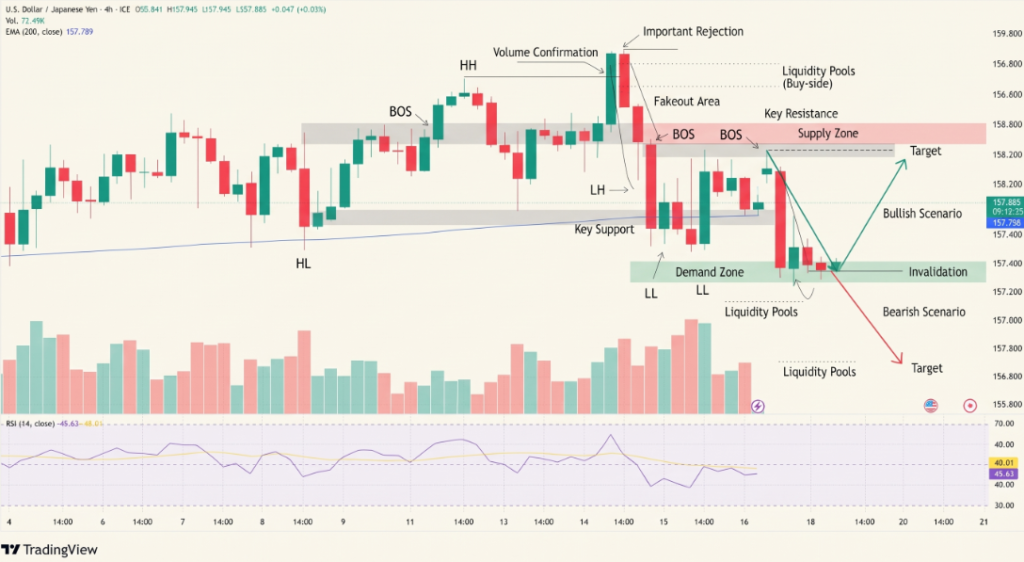
Repeated rejection near 159.00 also weakens the immediate bullish case. A sustained move above that level would improve the outlook, while a confirmed break below 157.50 could expose 157.00 and then the 156.50–156.45 support zone.
Conclusion
USD/JPY remains caught between softer US yields and the possibility of renewed Federal Reserve tightening, while Japanese intervention concerns may restrain further gains. A sustained break below 157.50 would strengthen the bearish outlook, whereas a recovery above 158.00 could stabilize the pair. Traders may seek confirmation from price action and upcoming policy signals before committing to a stronger directional view.
Sources & Methodology
Primary-source standard: Market-moving facts should link to original data releases, regulator notices, company filings or official project announcements whenever available. Secondary reporting is used for additional context, not as a substitute for original evidence.
Page last reviewed: