
XRP traded near $1.39 Monday after a sharp dip from $1.60, settling into a $1.35-to-$1.45 range, as on-chain data and technical analysis from popular analysts pointed to a potential breakout. CryptoQuant Whale Flow data showed XRP whale accumulation rebounding sharply in September after fading in late August, when the metric flipped to an average daily outflow of 3 million XRP. Daily XRP Ledger transactions have stayed above 2 million through early September, with active accounts and payments also holding elevated.
Whale Accumulation Rebounds in September
Positive whale flows dominated from early to mid-August, coinciding with XRP’s breakout above $1.20 and later $1.40. Inflows faded starting around Aug. 26, when the metric turned largely negative and exchange inflows accelerated, a pattern that preceded the price pullback from its $1.66-to-$1.70 August peak. The latest rebound is consistent with earlier XRP whale accumulation cycles, when Whale Flow 30DMA data hit a 10-month high. Daily XRP Ledger activity has stayed resilient throughout the swing, with more than 2 million daily transactions recorded through early September alongside elevated active accounts and payment volume.
ETF Inflows Hit $1.68 Billion
U.S. spot XRP ETFs are drawing steady institutional demand even as the token struggles to hold above $1.40. Cumulative net inflows have reached roughly $1.68 billion, according to SoSoValue data, with total assets under management exceeding $1.48 billion amid the recent rebound in whale accumulation. Institutional filings have separately put Goldman Sachs at roughly $87.4 million of reported XRP ETF exposure, alongside positions from Jane Street and Millennium Management, underscoring how the fund flows and whale behavior now move somewhat independently of each other:
- Cumulative U.S. spot XRP ETF inflows have reached approximately $1.68 billion, per SoSoValue
- Total XRP ETF assets under management have climbed past $1.48 billion despite price volatility
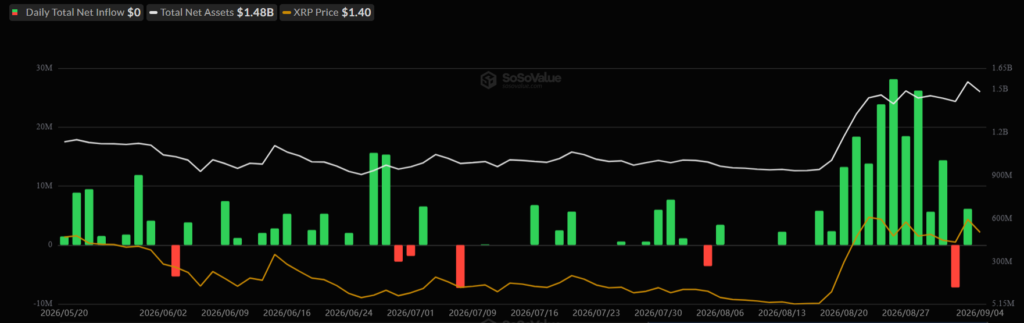
Source: sosovalue.com
Martinez Eyes $1.46, Then $60
Crypto analyst Ali Martinez shared an hourly XRP chart showing a descending triangle formation, predicting a rally toward $1.46 following a confirmed breakout above $1.40, and recommending traders wait for an hourly close above that level before entering. For a longer-term outlook, Martinez has pointed to $3.66 as the key resistance level; a monthly close above it would confirm what he describes as a nearly decade-long ascending triangle and activate a technical target near $60, a move that would require XRP to gain roughly 158% just to reach the breakout threshold from current levels. XRP traded at $1.40 Monday, up more than 1% over 24 hours, with the day’s range between $1.38 and $1.41. Derivatives markets showed similar buying interest, with futures volume surging to a six-month high and total XRP futures open interest climbing 0.81% to $3.13 billion, led by gains of nearly 1% on CME, 0.80% on Binance, and 1.15% on Hyperliquid.
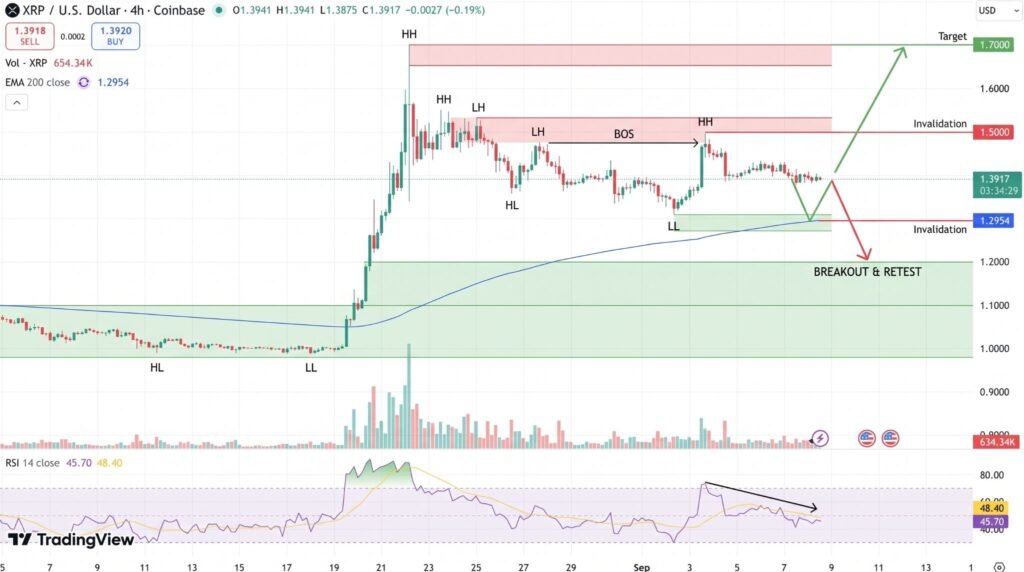
XRP Price Chart – Source: Tradingview
Conclusion
XRP’s setup now rests on two indicators moving in the same direction after weeks of divergence: whale wallets that spent late August selling are accumulating again, and institutional ETF demand has kept climbing toward $1.68 billion regardless of the token’s short-term price swings. The near-term case is straightforward — an hourly close above $1.40 that Martinez says opens a path to $1.46 — while the far larger $60 target depends on a monthly close above $3.66 that remains 158% away from current prices. Both outcomes depend on the same underlying signal traders are now watching most closely: whether whale accumulation and ETF inflows can stay aligned long enough to translate into sustained price momentum rather than another false start. This article is for informational purposes only and does not constitute financial advice; cryptocurrency markets can experience sharp price movements.
Sources & Methodology
Primary-source standard: Market-moving facts should link to original data releases, regulator notices, company filings or official project announcements whenever available. Secondary reporting is used for additional context, not as a substitute for original evidence.
Page last reviewed: