Key Points
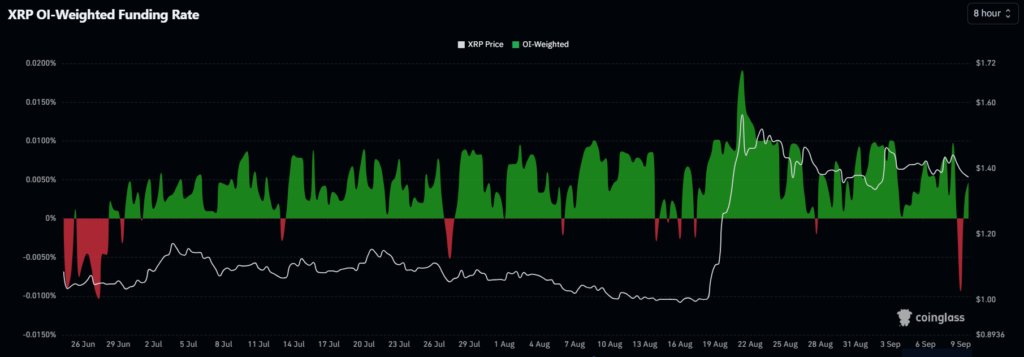
- XRP trades near $1.39 on September 10 as negative funding rates show increased short positioning on major derivatives exchanges.
- U.S. August CPI is due September 11 at 8:30 a.m. ET, making inflation the next major macro catalyst for XRP and the broader crypto market.
- U.S.-listed XRP ETFs recorded $12.29 million in net inflows on September 9 despite weakness in XRP’s spot price.
XRP fell toward $1.38–$1.39 on September 10 as crypto traders reduced risk before the release of U.S. inflation data. Derivatives markets have become increasingly defensive, with funding rates turning negative on major exchanges including Binance and Bybit. The decline contrasts with continued demand for U.S.-listed XRP ETFs, which recorded fresh inflows on Wednesday. Traders are now watching whether Friday’s Consumer Price Index changes expectations for the Federal Reserve meeting scheduled for September 15–16.
XRP Shorts Increase Before CPI
XRP was trading around $1.39 on Thursday, extending its retreat from levels above $1.45 earlier in September. Derivatives positioning indicates that some traders expect further downside. XRP perpetual-futures funding rates have turned negative on several major venues. Negative funding occurs when short-position holders pay traders holding longs, generally indicating greater demand for bearish leveraged positions.
The exact rate differs by exchange, making it misleading to use one funding figure for the entire XRP market. Available September 10 readings showed negative funding on both Binance and Bybit, while some other venues remained positive.
Attention is now centered on the U.S. Consumer Price Index, scheduled for September 11 at 8:30 a.m. ET. The previous CPI report showed headline inflation rising 0.1% month over month and 3.4% year over year in July. Core CPI, which excludes food and energy, increased 0.2% monthly and 2.5% annually.
August inflation is particularly important because higher energy prices have increased concerns about renewed price pressures. A stronger-than-expected CPI could reinforce expectations that the Fed will maintain tighter monetary policy or raise rates, potentially pressuring cryptocurrencies and other risk-sensitive assets.
XRP ETFs Continue Attracting Capital
While futures traders have become more defensive, XRP investment products continue to attract money. According to SoSoValue, U.S.-listed XRP ETFs recorded approximately $12.29 million in net inflows on September 9, the strongest daily result since September 1.
Ethereum ETFs attracted about $34.75 million, while Bitcoin funds recorded approximately $120.24 million in net outflows. The divergence is notable. Negative futures funding reflects short-term positioning among leveraged traders, while ETF flows measure net capital entering regulated investment products. The two indicators therefore represent different parts of the market and can move in opposite directions.
$1.38 Becomes Critical Support
Technically, $1.38 is the immediate XRP support level. The token has repeatedly traded around this area during its September pullback.
A sustained break below $1.38 would shift attention toward the $1.31–$1.35 region, which contains XRP’s September 2 low. On the upside, XRP would need to recover above $1.40 before challenging the stronger $1.45–$1.48 resistance zone.
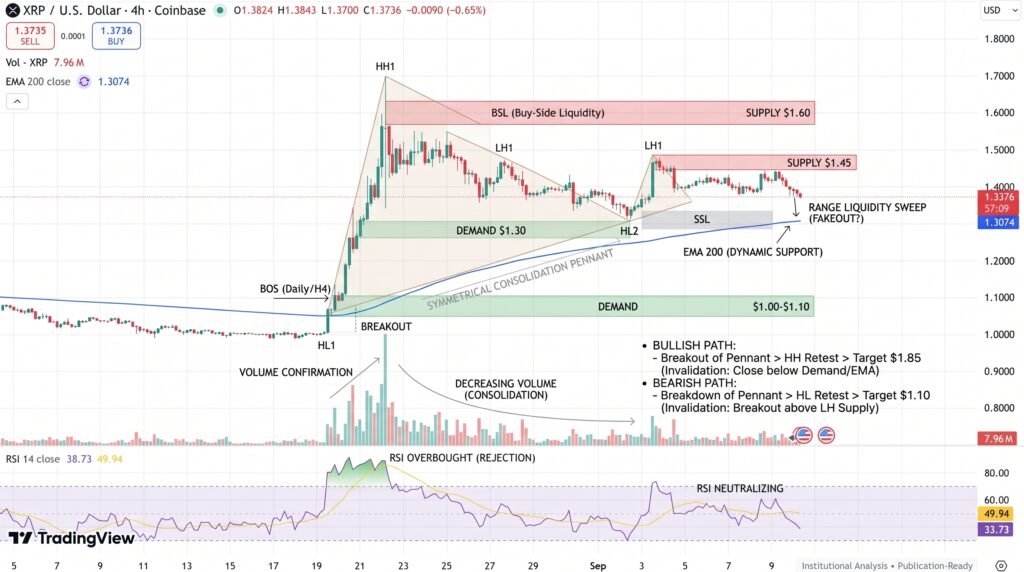
Momentum indicators also remain soft. A four-hour RSI around 40 suggests sellers currently have the advantage without XRP being deeply oversold.
Conclusion
XRP enters Friday’s inflation report with conflicting market signals. Negative funding rates point to increased short positioning, while continued XRP ETF inflows indicate demand remains present among investment-product buyers.
The immediate technical battle centers on $1.38 support and $1.45 resistance. However, the larger catalyst is the September 11 CPI report. A hotter inflation reading could increase expectations for tighter Fed policy and pressure XRP, while softer inflation could reduce macroeconomic pressure and give buyers an opportunity to regain control above $1.40.
Sources & Methodology
Primary-source standard: Market-moving facts should link to original data releases, regulator notices, company filings or official project announcements whenever available. Secondary reporting is used for additional context, not as a substitute for original evidence.
Page last reviewed: