Gold prices came under renewed pressure as stronger U.S. inflation data increased expectations that the Federal Reserve will raise interest rates this week. Rising oil prices added another inflationary threat, potentially keeping monetary policy tighter for longer and reducing the appeal of the non-yielding metal.
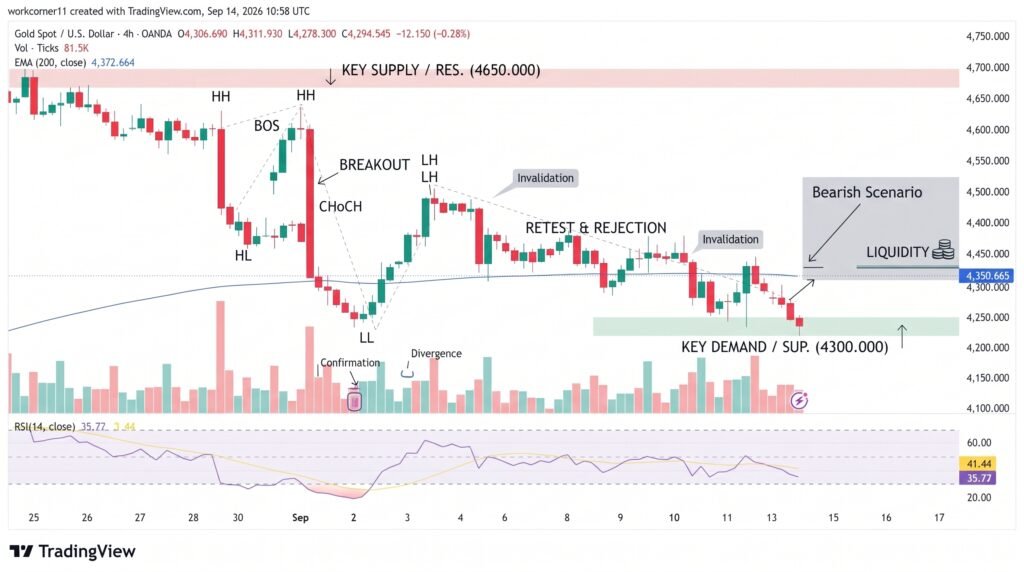
Spot Gold was trading near $4,340 an ounce after declining for a third consecutive week. Bullion lost 1.8% last week despite finishing Friday higher.
At 21:29 ET, XAU/USD was down 0.3% at $4,335.98, while Gold Futures fell 0.7% to $4,376.92. Silver and platinum also weakened, while the US Dollar Index gained 0.1% to 99.19.
- XAG/USD: $64.09, down 0.7%
- XPT/USD: $1,792.63, down 0.3%
- Gold Futures: $4,376.92, down 0.7%
Inflation Raises Fed Rate Bets
The August core Consumer Price Index rose 0.3% month over month, excluding food and energy, reinforcing concerns that inflation remains sticky. Markets subsequently lifted the probability of a September Fed rate increase to roughly 88%.
Higher interest rates generally pressure gold because the metal does not pay interest or dividends. When Treasury yields rise, investors have a stronger incentive to hold yield-producing assets, increasing the opportunity cost of owning bullion.
The policy outlook is also politically sensitive. President Donald Trump has continued calling for lower interest rates, putting additional attention on the Federal Reserve as policymakers balance inflation risks against economic growth.
Oil is complicating that decision. Brent crude moved toward $107 a barrel after gaining almost 9% last week as Middle East supply disruptions intensified.
ANZ Keeps $5,400 Gold Target
Despite the near-term pressure, ANZ remains constructive on gold. The bank expects continued Middle East tensions and elevated energy prices to keep inflation risks high and forecasts three 25-basis-point Fed rate increases by March 2027.
ANZ argues that inflation caused by geopolitical disruption could simultaneously strengthen gold’s safe-haven appeal. It therefore maintained its 12-month gold target at $5,400 an ounce.
Investment demand provides another layer of support. Gold ETF holdings and speculative positioning have recovered, while institutional demand in China and rising investor participation in India are helping offset pressure from higher U.S. rates.
Gold’s near-term direction will therefore depend on whether higher yields and a stronger dollar outweigh geopolitical demand. Recent market action suggests rates remain the dominant short-term headwind, but persistent energy and geopolitical risks could keep the longer-term bullish case intact.
Conclusion
Gold faces a difficult short-term setup as stronger inflation and rising oil prices reinforce expectations for tighter Federal Reserve policy. With markets pricing an elevated probability of a rate hike, XAU/USD may remain vulnerable to higher yields and a firm dollar. However, geopolitical risks, ETF demand and strong Asian investment could limit deeper declines. ANZ’s $5,400 target highlights why the longer-term outlook remains constructive despite near-term monetary-policy pressure.
Sources & Methodology
Primary-source standard: Market-moving facts should link to original data releases, regulator notices, company filings or official project announcements whenever available. Secondary reporting is used for additional context, not as a substitute for original evidence.
Page last reviewed: