
NZD/USD remains under pressure near 0.5770 as a stronger U.S. dollar keeps the New Zealand dollar close to a key technical floor. The pair recovered part of its early decline Tuesday but was still down about 0.17%, with buyers defending the 61.8% Fibonacci retracement near 0.5765. The level is becoming the central test for whether the recent selloff can stabilize or extend toward deeper support.
The pressure on the Kiwi comes as markets increasingly expect the Federal Reserve to raise interest rates this week. The US Dollar Index (DXY) was around 99.62 in the supplied market snapshot, keeping the dollar near recent highs as U.S. yields and inflation expectations rise. Reuters reported Tuesday that markets were pricing a 94% probability of a Fed hike on September 16.
Fed Bets Keep Dollar Firm
The U.S. monetary-policy outlook remains the main fundamental driver for NZD/USD. August U.S. CPI increased 0.4% month over month and 3.4% year over year, while core CPI rose 0.3% in August. The stronger inflation reading has reinforced expectations for tighter policy, particularly as oil prices remain elevated.
The rise in energy prices is adding another layer to the Fed debate. Brent crude has climbed above $107 a barrel, while Treasury yields have moved sharply higher. The U.S. 10-year Treasury yield reached roughly 5.03%, its highest level since 2007, according to Reuters.
Higher U.S. yields typically support the dollar because they improve the return available from dollar-denominated assets. That dynamic can weigh on NZD/USD, particularly while the pair’s own domestic rate outlook provides less support.
ING economists have also shifted toward a September Fed hike after recent U.S. data, although the firm argues the increase could prove to be a one-off rather than the start of a prolonged tightening cycle.
RBNZ Support Has Its Limits
The Reserve Bank of New Zealand has already raised its Official Cash Rate by 25 basis points to 2.75%. The central bank said inflation rose to 4.1% in the June quarter, driven in part by higher fuel costs linked to the Middle East conflict. It expects inflation to remain above 3% through the remainder of 2026 before moving back toward its target range next year.
The RBNZ’s latest decision therefore offers some support to the Kiwi, but markets are focused more heavily on the widening U.S. yield advantage. A hawkish Fed combined with elevated oil prices could keep the dollar favored in the near term.
The technical levels are now clearly defined:
- Immediate support: 0.5765–0.5769
- Next support: 0.5705
- Major downside level: 0.5628
- First resistance: 0.5808
- Major resistance: 0.5850–0.5854
Bears Target 0.5705 Below Fib
On the daily chart, NZD/USD remains below the 20-day Exponential Moving Average (EMA) near 0.5854, while the 50% Fibonacci retracement sits around 0.5808. The 14-day Relative Strength Index (RSI) is near 33, showing that downside momentum is strong but approaching oversold territory.
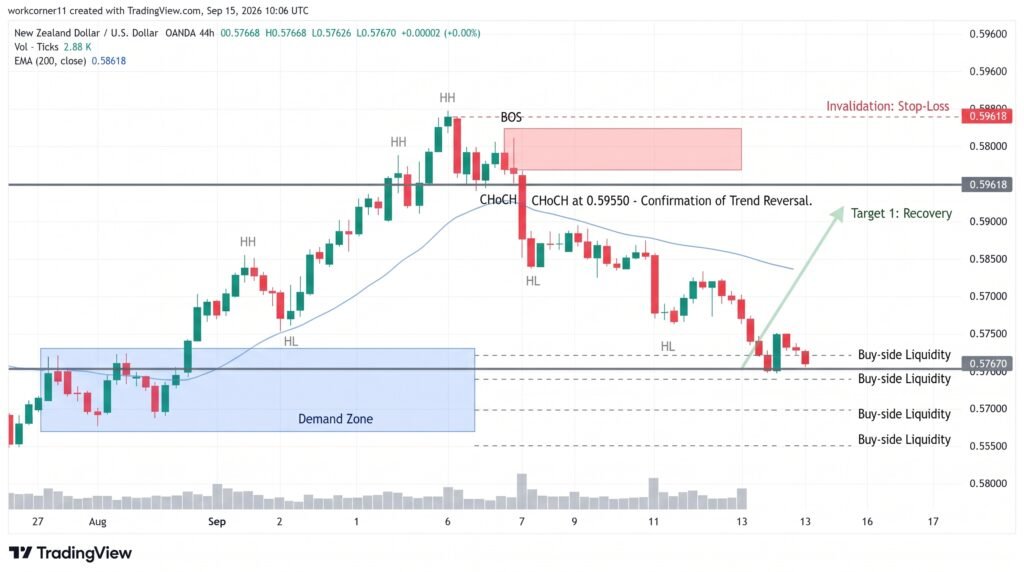
The 61.8% Fibonacci retracement at 0.5765 is therefore the immediate line to watch. A sustained daily break beneath this level would strengthen the bearish structure and expose 0.5705, corresponding to the 78.6% retracement.
Below that, the 0.5628 area marks the 100% retracement and prior swing base. Such a move would indicate that the entire June-August advance had been retraced.
For bulls, the first improvement would come from a recovery above 0.5808. A stronger move through 0.5850–0.5854, where the 38.2% Fibonacci level and 20-day EMA converge, would provide a more convincing signal that the decline is losing control.
Conclusion
NZD/USD is sitting at a critical 0.5765–0.5769 support zone as strong U.S. rate expectations keep pressure on the Kiwi. The pair remains below its 20-day EMA, while RSI near 33 shows sellers still control the short-term trend. A decisive break below the 61.8% Fibonacci retracement would expose 0.5705 and potentially 0.5628. Conversely, reclaiming 0.5808 would provide initial relief, with 0.5850–0.5854 the key resistance zone that bulls must overcome to challenge the bearish structure.
Sources & Methodology
Primary-source standard: Market-moving facts should link to original data releases, regulator notices, company filings or official project announcements whenever available. Secondary reporting is used for additional context, not as a substitute for original evidence.
Page last reviewed: