
Key Points
- Spot gold recovered above $4,300 after recent selling pushed futures to a six-week low.
- Markets price roughly a 92% probability of at least a 25-basis-point Federal Reserve rate increase.
- The 10-year Treasury yield has crossed 5%, while elevated oil prices continue to complicate the inflation outlook.
Gold is holding above $4,300 an ounce as investors prepare for the Federal Reserve policy decision. The metal has retreated sharply from its late-August highs as elevated oil prices, a firmer U.S. Dollar and Treasury yields above 5% increase the opportunity cost of holding non-yielding bullion. Markets overwhelmingly expect the Fed to raise interest rates, making Chair Kevin Warsh’s guidance on future tightening potentially more important than the rate decision itself.
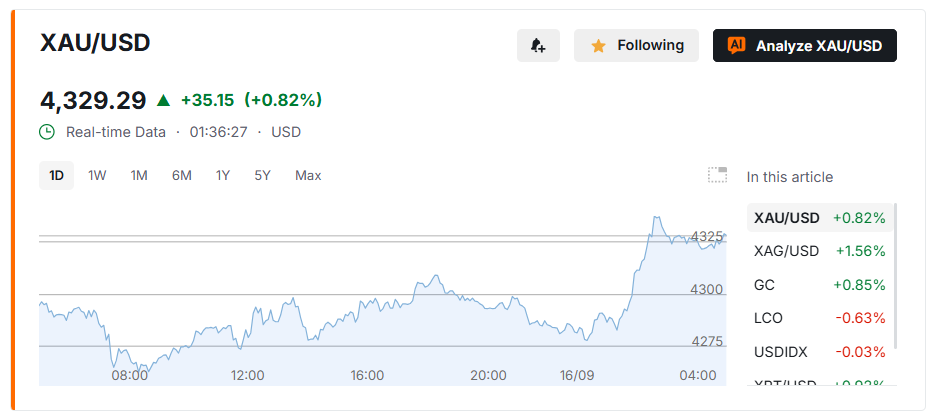
Gold Recovers After Six-Week Low
Spot gold recovered to around $4,328 an ounce in Wednesday trading after significant selling pressure during the previous sessions. Front-month gold futures had fallen toward $4,292, leaving bullion substantially below the near-$4,700 levels reached in late August as investors rapidly repriced expectations for U.S. monetary policy. Silver and platinum have also experienced considerable volatility as rising yields affect the broader precious-metals complex.
The immediate pressure on gold is coming from the combination of higher interest-rate expectations, elevated bond yields and dollar strength. Because bullion does not generate interest, higher yields increase the relative attraction of Treasury securities and other income-producing assets.
Treasury Yield Above 5% Changes the Setup
The bond market has become one of the most important drivers for gold. The benchmark 10-year U.S. Treasury yield has moved above 5%, reaching levels not seen in years as investors respond to persistent inflation concerns, government borrowing requirements and changing expectations for Federal Reserve policy.
The yield subsequently touched approximately 5.04%, creating a difficult environment for bullion. A Treasury yield around 5% gives investors a relatively high return from government debt. That creates direct competition for gold, which provides no coupon or regular interest payment.
Higher yields can also support the U.S. Dollar Index. Because gold is priced primarily in dollars, a stronger U.S. currency can make bullion more expensive for buyers using other currencies.
Oil Keeps Inflation Risk Elevated
Energy prices are another major part of the Fed equation. Brent crude remains elevated following disruptions to Middle Eastern energy infrastructure and shipping routes.
Saudi Arabia’s strategically important East-West Pipeline has faced disruption following attacks, increasing uncertainty around regional crude flows while traffic through the Strait of Hormuz remains a major focus for energy markets.
The pipeline provides Saudi Arabia with an alternative route for moving crude toward the Red Sea without relying entirely on Hormuz.
Persistently expensive oil can feed into transportation, manufacturing and consumer prices. That matters directly for the Federal Reserve because renewed inflation pressure could require policymakers to keep monetary conditions restrictive for longer.
Fed Decision Becomes Gold’s Main Test
Markets see an interest-rate increase as the dominant scenario. The CME FedWatch Tool has indicated that traders assign roughly a 92% probability to at least a 25-basis-point increase.
A quarter-point move would represent the Fed’s first rate increase since 2023. However, the headline decision will only be part of the story. Investors will closely examine the Fed’s updated economic projections, inflation outlook and expected path for interest rates. Chair Kevin Warsh’s press conference could therefore generate a larger market reaction than the rate increase itself.
A hawkish message suggesting additional tightening could keep Treasury yields and the dollar elevated, increasing pressure on gold. A less aggressive outlook could push yields lower and provide bullion with room to recover.
$4,200 Support Comes Into Focus
Gold’s technical structure has weakened following its retreat from approximately $4,697. The first important downside area sits around $4,280. A sustained break below that region would shift attention toward $4,200, which represents an important psychological and technical support area. On the upside, reclaiming $4,400 would improve the short-term structure.
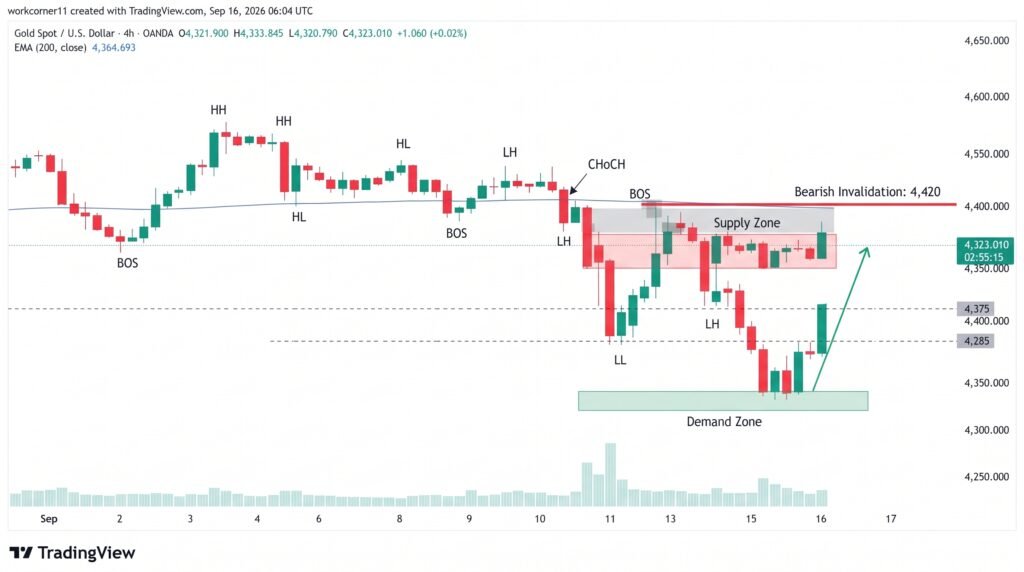
A more significant technical hurdle sits around the 200-day moving average near $4,539. Recovering above that region would provide stronger evidence that the correction from the August peak is losing momentum.
Key Gold Levels
- Immediate support: $4,280
- Major support: $4,200
- Initial resistance: $4,400
- Major resistance: $4,539
- Recent major high: approximately $4,697
Conclusion
Gold enters the Federal Reserve decision caught between inflation-related support and increasingly restrictive financial conditions. Geopolitical uncertainty, high energy prices and concerns about purchasing power continue to support gold’s longer-term portfolio role. At the same time, Treasury yields around 5%, a stronger dollar and expectations for tighter Federal Reserve policy have substantially increased pressure on bullion. With a 25-basis-point hike already heavily priced into markets, gold’s next significant move may depend more on what the Fed signals about future interest rates than on Wednesday’s decision itself.
For now, $4,280 and $4,200 are the main downside levels, while a recovery above $4,400 would improve the short-term picture. A sustained move toward and above the 200-day average near $4,539 would provide stronger technical evidence that the correction from August’s highs is ending.
Sources & Methodology
Primary-source standard: Market-moving facts should link to original data releases, regulator notices, company filings or official project announcements whenever available. Secondary reporting is used for additional context, not as a substitute for original evidence.
Page last reviewed: