Natural gas is trading around $2.907 on the 5-hour chart, remaining locked inside a narrow $2.880-$2.950 consolidation range. The market lacks a clear short-term trend, with the Average Directional Index (ADX) at 15.86 signaling weak directional momentum. Price is also showing mixed signals across moving averages and momentum indicators. With natural gas positioned near the center of the range, traders are watching for a sustained break above $2.950 or below $2.880 to establish the next directional move.
Natural Gas Remains in Tight Range
The current setup is a classic rectangle consolidation, where price repeatedly moves between defined support and resistance without establishing a lasting trend. At $2.907, natural gas is almost exactly in the middle of the current range, leaving neither buyers nor sellers with a decisive advantage.
The ADX reading of 15.86 reinforces the lack of trend strength. Generally, lower ADX readings indicate that directional momentum is limited, although the indicator does not predict whether the eventual breakout will be higher or lower.
The latest price action also reflects indecision. A Doji candle around $2.904 indicates that buyers and sellers ended the period with relatively little separation between opening and closing prices.
The broader structure remains mixed. Natural gas is trading above its 200-period simple moving average near $2.817, while the SuperTrend indicator provides support around $2.824.
- Current price: $2.907
- Range support: $2.880
- Range resistance: $2.950
- 200-period SMA: $2.817
- ADX: 15.86
Bulls and Bears Watch Key Levels
The bullish case depends on natural gas maintaining its position above the long-term 200-period SMA. The MACD has also turned positive, with the indicator around 0.0105 versus a signal line near 0.0024. However, the relatively small separation indicates that bullish momentum has not yet produced a decisive trend.
The bearish structure is visible in the sequence of lower highs. The recent peak near $3.026 remains below the June high around $3.377, showing that the market has yet to recover the earlier peak.
The Ichimoku Cloud also places price close to support near $2.889. A sustained move below this area could pull natural gas deeper into the cloud and weaken the short-term structure.
For the current setup, $2.950 is the first important upside trigger, while $2.880 is the key downside boundary. A break outside those levels would provide more information than price movements inside the range.
Breakout Confirmation Is Critical
A sustained close above $2.950 would signal that buyers have moved beyond the immediate consolidation ceiling. The next reference would be the $3.026 swing high, while a move beyond that level would challenge the broader sequence of lower highs.
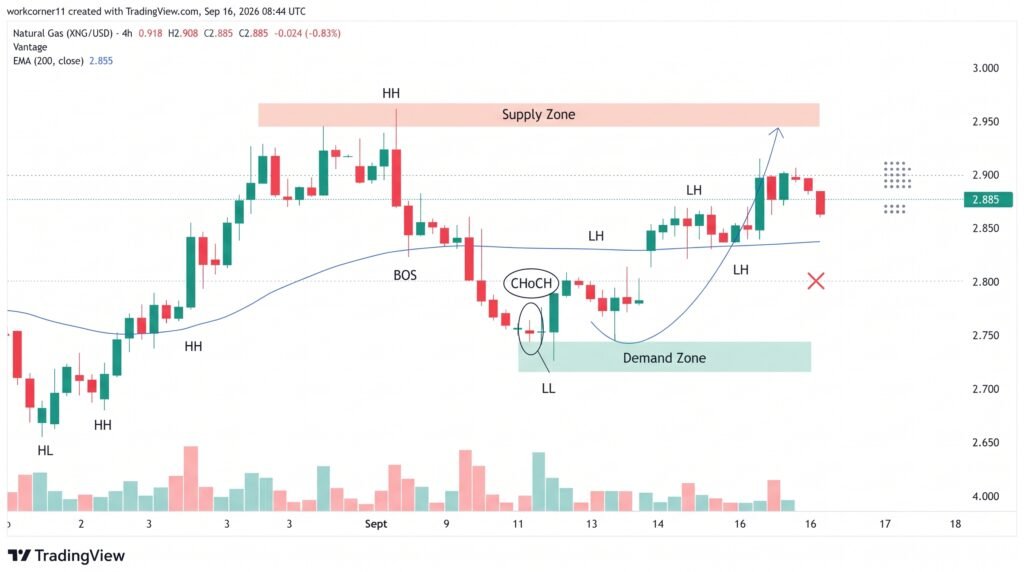
On the downside, a decisive break below $2.880 would expose the lower portion of the current structure. The $2.817 200-period SMA becomes particularly important because losing that longer-term average would materially weaken the technical setup.
Volume and ADX will be important confirmation tools. An expansion in trading activity combined with an ADX move above 20 would provide stronger evidence that a genuine directional trend is developing.
Natural gas markets can also react quickly to fundamental changes, particularly shifts in weather forecasts, storage data, production and demand. The U.S. Energy Information Administration’s weekly natural gas storage reports remain an important source for monitoring changes in U.S. inventories.
Conclusion:
Natural gas remains trapped between $2.880 and $2.950, with weak ADX and mixed momentum keeping the near-term structure neutral. The 200-period SMA at $2.817 provides an important longer-term reference, while $3.026 marks the next major resistance after a confirmed upside break. Until price closes decisively outside the current range, movements between $2.880 and $2.950 remain vulnerable to false breaks and short-lived swings.
Sources & Methodology
Primary-source standard: Market-moving facts should link to original data releases, regulator notices, company filings or official project announcements whenever available. Secondary reporting is used for additional context, not as a substitute for original evidence.
Page last reviewed: